




No. What died is the SEO most law firms bought: a twenty-page site, a monthly "what is negligence" blog post, and a rank report nobody read. Google answers those questions itself now, and the clicks that used to come from them are gone. In the same six months that happened, a Melbourne litigation firm we work with went from 785 organic clicks a month to 5,217, and its enquiries from search went from about seven a week to more than forty. The difference is what was published, who put their name to it, and how much of it there was.
This piece answers the question properly: which searches lost their clicks, which kept them, where AI assistants send law firm traffic, and what to stop doing. It also deals with the fact that we argued the other side of this in February 2025. Half of that piece held up and half did not, and a firm deciding where to put its budget deserves to know which half. The companion article on getting a law firm cited in ChatGPT, Gemini and AI Overviews covers the how; this one covers whether it is worth doing at all.
Key Takeaways
- The clicks that disappeared were the informational ones. Ahrefs measured a 58% drop in click-through for the number one result when an AI Overview appears, and Seer Interactive found those queries were already low-click before AI arrived. A firm whose organic traffic was mostly "what is" and "how long does" blog posts has lost most of it and will not get it back.
- Hire-intent and local searches still send clicks, and still send clients. "Compensation lawyers Brisbane", "family lawyer near me" and a lawyer's name rarely trigger an AI Overview, and the map pack and organic results underneath are intact. That is where the signed matters always came from.
- Rankings held while clicks fell is a visibility problem, not a death notice. When long-tail impressions vanish, average position improves and clicks drop at the same time. Compare impressions year on year before concluding anything.
- SEO done at volume, with named lawyers and one question per page, grew through the change. The litigation firm's clicks rose every month from April to August 2026 while the industry studies reported declines. It published two to four lawyer-reviewed articles a week and treated the AI Overview as a place to be cited rather than an enemy.
- Some firms should not do SEO at all right now. Firms that need cases next month, firms whose lawyers will not put their names on pages, and firms that will not fund volume should run Google Ads or Meta first and come back to this later.
What the data actually says about AI Overviews and clicks
Three studies change the argument. The rest are variations on the same finding, so we have left them out.
| Study | What was measured | Headline finding | What it means for a law firm |
|---|---|---|---|
| Ahrefs, 300,000 keywords with Search Console data, published February 2026 | Click-through by position with and without an AI Overview | Position one loses 58% of its clicks when an Overview appears (it was 34.5% in April 2025). Position two loses 51%, position five 33%, position ten 19%. Position one CTR on Overview keywords fell from 7.3% to 1.6% | A page-one ranking for a question Google now answers itself is worth a fifth of what it was two years ago |
| Seer Interactive, 3,119 informational queries, 25 million impressions, November 2025 | Organic and paid CTR before and after Overviews | Organic CTR on Overview queries fell from 1.76% to 0.61%. Brands cited inside the Overview saw organic CTR 35% higher and paid CTR 91% higher than those not cited | The queries that lost clicks were already low-click. Being the cited source is now the prize on those queries, and it lifts the ads too |
| Pew Research Center, July 2025 | What people do on a results page with an AI summary | Users clicked a result on 8% of visits with a summary versus 15% without. 1% clicked a link inside the summary | Half the clicks on a summarised query are gone, and the links inside the summary are read rather than clicked |
Clicks lost when an AI Overview appears, by organic position (Ahrefs, 300,000 keywords, 2026)
The page that ranks first for a question Google now answers itself keeps 42% of the clicks it had. The page ranking tenth keeps 81% of a much smaller number.
How often does the Overview appear on legal searches? The two most-cited figures disagree by a wide margin and both are right. Ahrefs, across 146 million results pages, found Overviews on 23.6% of legal queries and 57.9% of question-style queries. SE Ranking's YMYL study found them on 77.7% of its legal keyword set. The difference is the keyword set: a list weighted to questions gets the high number, a list weighted to hire-intent terms gets the low one. For a law firm, that gap is the whole answer. Your question content is heavily affected. Your money pages mostly are not.
We checked this against live Australian results in the first week of October 2026. Every "is SEO dead" variant triggered an Overview. "Does SEO still work for lawyers" triggered one. "No win no fee lawyers Brisbane", a hire-intent query, also triggered one, listing firms with a map, which is newer behaviour and worth watching. "Personal injury lawyer Brisbane" did not; it returned the map pack and organic results as it always has.
Which searches lost their clicks and which kept them
The useful way to think about this is by what the searcher is trying to do, because that predicts whether Google answers in the page or sends them on.
| Query type | Australian example | AI Overview present | Click risk | What to do with it |
|---|---|---|---|---|
| Definitional | "what is a TPD claim" | Usually; 58% of question-style queries | High, 50 to 60% of clicks gone | Publish only to be the cited source. Answer in the first 60 words and cite the Act or the scheme |
| Situational "can I" or "do I" | "can I claim if the accident was partly my fault in Queensland" | Often | High on clicks, high value as a citation | The core content type. One question per page, named lawyer, the state in the title |
| Process and timeline | "how long does a will contest take in Victoria" | Often | Medium; Overviews cite three to eight sources and specifics win | Tables, numbered steps, dated |
| Cost | "how much does a family lawyer cost in Melbourne" | Sometimes | Medium | Give ranges. Overviews quote the pages that have figures |
| Hire-intent plus location | "compensation lawyers Brisbane" | Rarely, though "no win no fee" variants now can | Low; map pack and organic intact | Service pages, location pages, Google Business Profile, reviews |
| Near me and urgent | "family lawyer near me", "criminal lawyer open now" | Rarely | Low | Business Profile, hours, call tracking |
| Brand and lawyer name | "[lawyer name] reviews" | No | None | Bio pages, Person schema, directory listings |
The lower three rows are where the clients were before AI and still are. If a personal injury, family, criminal or commercial firm's organic enquiries have fallen, the first check is whether the drop is in the top four rows (expected, and recoverable as citations) or the bottom three (a real ranking problem, usually a Business Profile or a service page issue).
The firm that grew 6x while the studies reported declines
A Melbourne litigation firm we work with started a content system in March 2026. Partners review every article within days, each article answers one question a client actually asked, the responsible lawyer's name and bio are on the page, and the firm publishes two to four a week. We described the method in how SEO works for law firms and the timing in how long SEO takes, so this section is only the numbers, from the firm's Search Console.
Organic clicks per month, Melbourne litigation firm, 2026
Source: Google Search Console. Impressions over the same months: 47,000 to 374,000. Average position improved from 10.3 to 8.4. Early September ran at about 1,500 clicks a week.
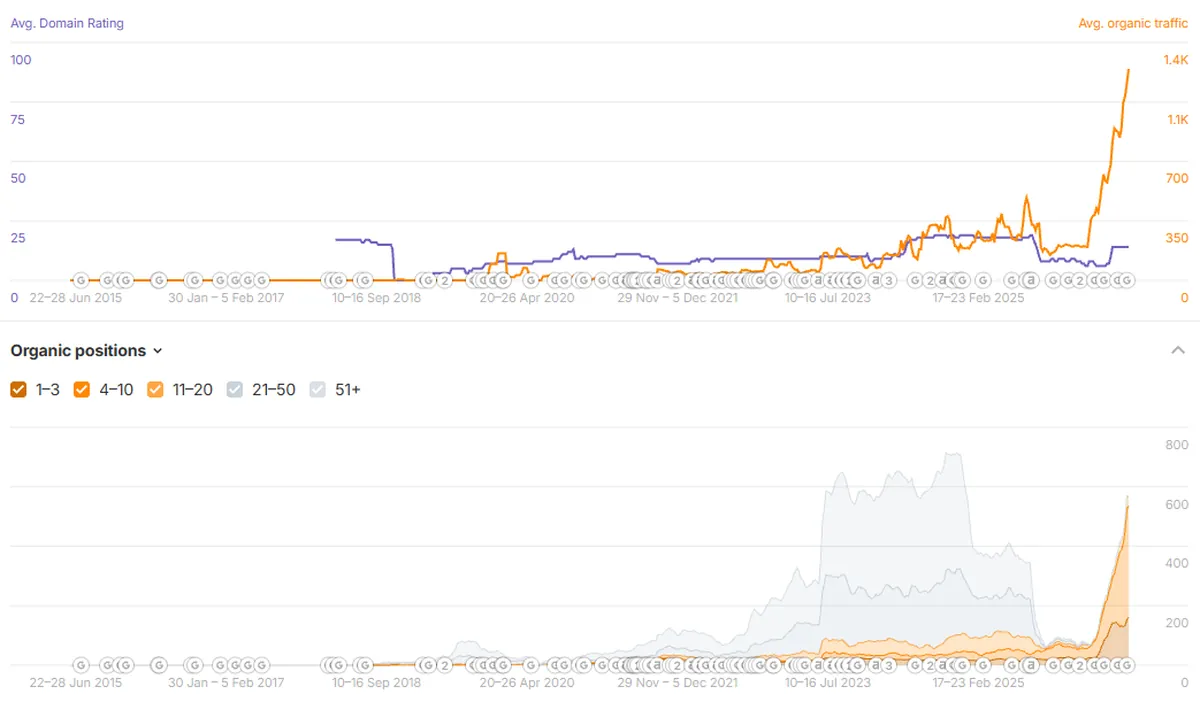
The longer view, from Ahrefs, is the part that answers the question. The firm's domain had a flat line for a decade: the same site, the same lawyers, the same reputation, and no organic growth from 2015 to early 2026. The vertical rise starts in the month the publishing system started, in the same quarter the industry reported that AI Overviews were taking the clicks. Nothing else changed.
Three things in that series matter for the "is it dead" question.
Impressions grew eight-fold, from 47,000 to 374,000. The firm is now being shown for hundreds of questions it was never shown for, and a large share of those impressions are inside AI Overviews, where the firm is a cited source. Search Console counts an Overview citation as an impression and, when the link is used, a click. The firm's citations are visible under the AI features filter.
Click-through rate stayed between 1.2% and 1.65% the whole way. That is low by the standards of 2022 and normal for 2026. The firm did not get its clicks from a high CTR on a few terms; it got them from being present on an enormous number of questions, at a low rate each. Volume is the mechanism.
Enquiries rose with clicks, from about seven a week to more than forty. Some of those enquirers read the firm's name in an Overview and typed it into the search bar or called directly, and those arrive as brand searches and direct visits rather than as clicks on the article, which is one more reason the click count understates what the content is doing.
Compare that with the industry data from the same weeks. Webris published a study of eight US personal injury firms through the September 2026 spam update: positions improved at all eight, clicks fell 16%, and first-time organic callers fell a third. Those firms were doing the SEO of 2022, with templated city pages and a modest publishing rate, and the clicks they lost were the informational ones. The litigation firm was doing something different, and the difference showed up in the one number that matters.
Why "rankings held, clicks fell" is not what it looks like
The most common report from a law firm in 2026 is that the rank tracker looks fine and the phone has gone quiet. Three mechanisms produce that, and none of them is SEO dying.
Average position is an average of the queries you were shown for. When the long tail of informational impressions disappears into an Overview that no longer shows your page, the queries that remain are the ones you rank best for, so the average improves while the total shrinks. A firm that went from position 9 to position 7 while impressions halved has lost ground, not gained it.
Clicks have decoupled from positions on question queries. You can hold position one and receive a fifth of the clicks you did, because the answer is above you. The page still has value as a citation and as a trust signal when the searcher does click, but the click count is no longer the measure.
Fewer searches reach the results page at all. Google reported stable traffic to the web; the independent measurements (SparkToro and Similarweb put zero-click searches at 68% in 2026, up from 60% in 2024) say otherwise, and Pew's panel data agrees. Some of the people who would have searched "how is child support calculated" are asking ChatGPT instead and never see Google.
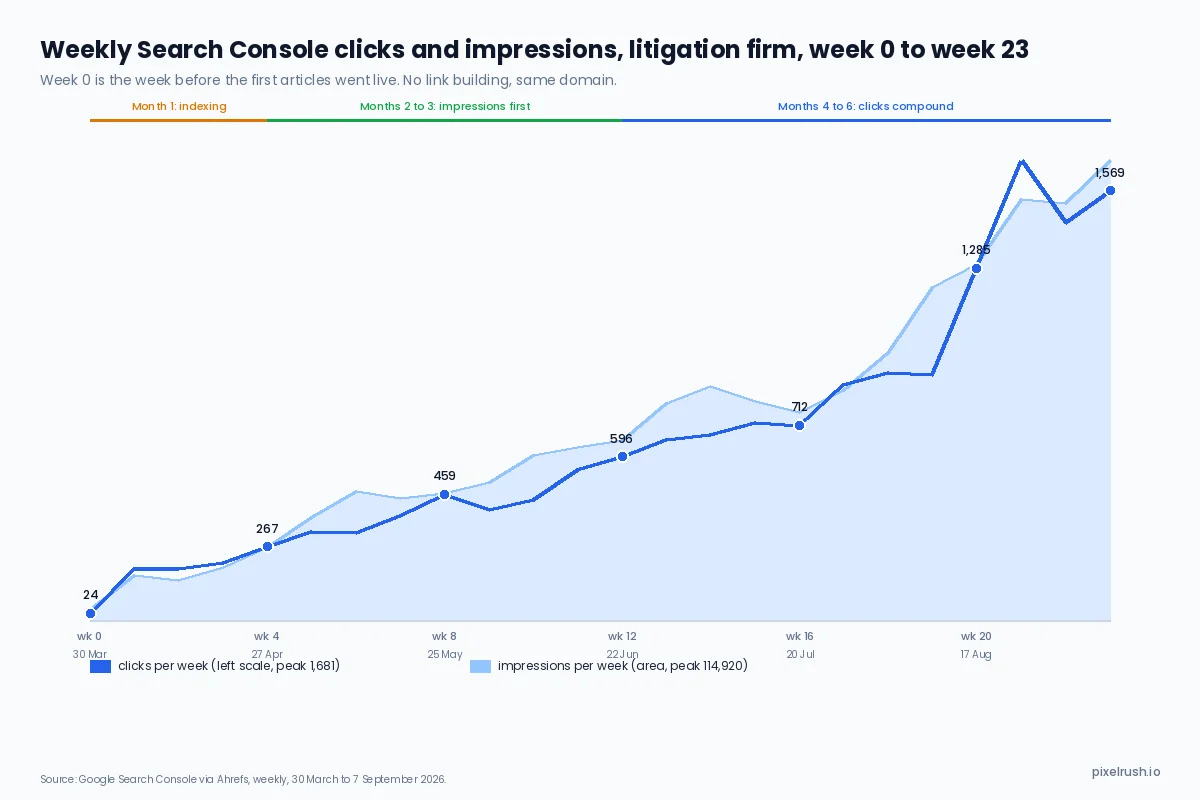
The same firm, week by week, shows what the healthy version of "impressions before clicks" looks like. Impressions moved first, within weeks, as the pages were indexed and shown inside Overviews and on page two. Clicks followed with a lag of a month or more and then compounded. A firm reading only the click line in the first eight weeks would have concluded the content was not working. The impressions line said it was, and said so early.
The diagnostic is simple. Open Search Console, set the comparison to the same months last year, and look at impressions and clicks by query group rather than at average position. Then switch the search appearance filter to AI features and look at what you are being cited for. If impressions on your service and location pages are flat or up and the drop is all in question content, you have a citation opportunity and not a ranking problem. We walk through this in why your law firm is not ranking.
The ten-minute version, for a partner who wants to know before the next agency meeting:
Where AI assistants send law firm traffic
The assistants are a separate question from AI Overviews, and the data is thinner. What we can report from the accounts we see:
| Observation | What the data shows | Source |
|---|---|---|
| Volume | AI assistants are a small fraction of visits to the law firm sites we track, well under 1% where the referrer survives, against organic search as the largest single source | Our client analytics; consistent with SE Ranking's 0.32% industry figure. ChatGPT and Gemini often strip the referrer, so this undercounts |
| Conversion | Where we can attribute an AI-referred visitor, they enquire at a higher rate than an organic visitor. They arrive having read a summary that named the firm | Litigation firm, 2026 |
| Lag | AI citations follow organic rankings by weeks to months. A page that ranks on Google for a question tends to be cited for it in ChatGPT a month or two later, because the assistants search Google and Bing to answer | Litigation firm citation tracking |
| Prerequisite | A firm with no organic presence has no AI presence. We have not seen a single counter-example | All accounts |
| Australian adoption | Roy Morgan puts Australians using AI tools at 13.6 million, and BrightLocal found 45% of consumers used AI for a local recommendation in 2026, up from 6% a year earlier, with 97% then checking reviews | Roy Morgan 2026; BrightLocal Local Consumer Review Survey 2026 |
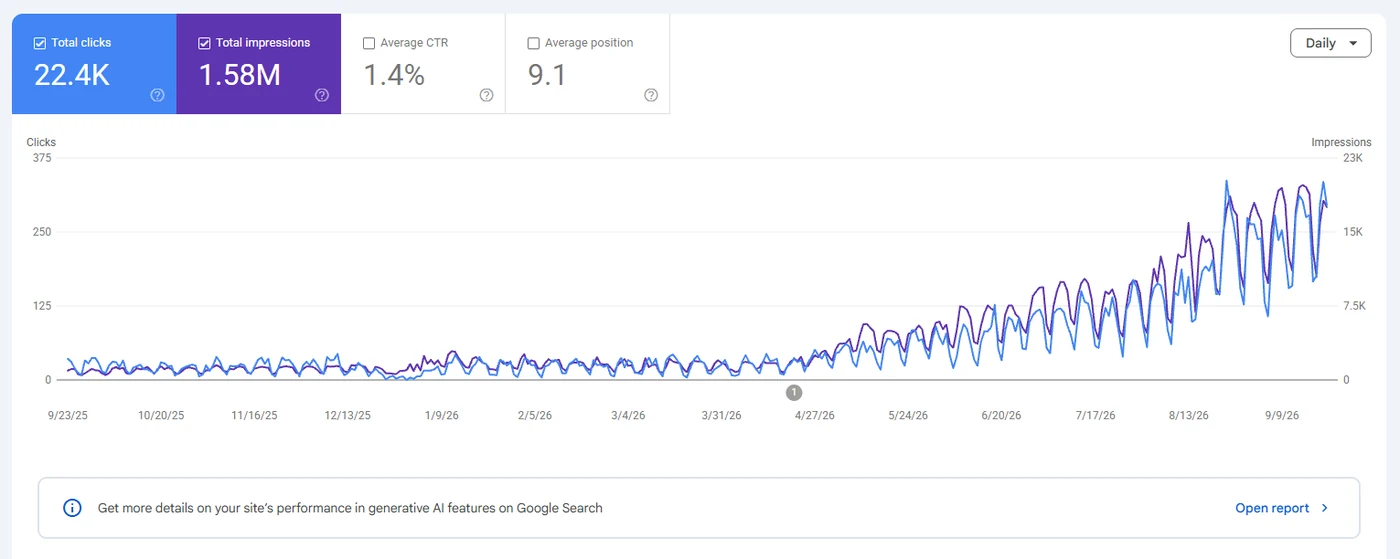
The Search Console view over the full period: 1.58 million impressions and 22,400 clicks, with both lines flat for the six months before the system started and climbing together after it. The impressions line includes the firm's appearances inside AI Overviews, which is the bulk of the growth, and the click line is the share of those appearances that still produced a visit. Both are real, and the gap between them is the 2026 condition described above.
The practical conclusion is that there is no separate "AI SEO". The assistants reward exactly the content Google now rewards: a direct answer, a named author with verifiable credentials, specific jurisdiction detail, and enough of it that the firm is treated as an authority on the topic rather than a site that mentioned it once. The eight signals that drive citation are in the AI search article and we will not repeat them here.
What we got right and wrong in 2025
In February 2025 we published a piece arguing that law firms should shift budget away from SEO. The argument was that broad SEO had become a $50,000-a-year line item with diminishing returns, that ChatGPT and Reddit were absorbing the informational searches, that Google's remaining job was to help someone find a trusted local lawyer when they were ready to hire, and that the money was better spent on Meta video, persona targeting and the Google Business Profile.
Eighteen months on, with the litigation firm's numbers in front of us, this is the honest scorecard.
| Claim from February 2025 | Verdict | Why |
|---|---|---|
| Informational blog traffic is dying | Held up | Ahrefs, Seer and Pew all measured it. A firm whose SEO was "a post a month" has lost most of that traffic |
| Google's remaining job is local hire-intent | Held up | Those query types rarely trigger Overviews, and the map pack is the first thing most legal searchers see |
| The Google Business Profile and reviews matter more than the blog | Held up | Our Business Profile guide is the most-read practical piece we publish for a reason |
| Meta video reaches people before they search | Held up | Meta versus Google has the cost per enquiry by practice area |
| Content SEO is a diminishing-returns line item | Did not hold up | The litigation firm's clicks grew every month in 2026. The problem with the SEO most firms were buying was volume and standard, not the channel |
| High-value clients rarely come through Google | Did not hold up | The litigation firm's commercial matters, the ones with five-figure fees, arrived through question pages signed by the partner who handles them |
The piece stays up with a note at the top, because quietly rewriting history is the kind of thing that makes a reader stop trusting a firm's blog. The conclusion we draw now is narrower and more useful than either the 2025 piece or the "SEO is dead" headlines: the channel works, the way most firms were doing it does not, and the firms that will see results are the ones prepared to do it at a volume and standard that would have been unnecessary five years ago.
What to stop doing and what to do instead
| Stop | Why | Do instead |
|---|---|---|
| 500-word definitional posts | Google answers the definition in the Overview and will not cite a page that adds nothing | One question per page, answered in the first paragraph, with the specifics an Overview cannot generate: the section of the Act, the time limit, the state's variation |
| Unbylined content | Both Google and the assistants weight who wrote it. Legal is YMYL; anonymous legal content is treated as unreliable | The responsible lawyer's name, bio page, admission year and Person schema on every article |
| Rank-only reports | A position is no longer a proxy for clicks or enquiries | Report impressions, clicks, AI-feature impressions and enquiries, month on month |
| FAQ blocks pasted at the bottom of every page | Thin, duplicated across the site, and the question deserved its own page if it was worth asking | A page per question, linked from the hub |
| Bought links and link exchanges | Ignored at best. Ryan Stewart's Webris study of the September update found the firms with paid links were the ones that lost | Digital PR: comment on a scheme change, a podcast, a sponsorship page that names the firm. Link building for law firms has the sources |
| Templated suburb pages | The same page with the suburb swapped is the pattern the spam update targeted | One page per office that is genuinely staffed, with the lawyer who sits there, the court it serves and the local mediation services it refers to |
| Blocking AI crawlers | A firm that blocks OAI-SearchBot and ClaudeBot cannot be cited by the assistants that are increasingly the first place someone asks | Allow the search crawlers; the robots.txt table is in the AI search article |
| Treating the Overview as a competitor | It is the top of the page. Fighting it means being absent from it | Write to be the cited source: short direct answer, table, citation, named lawyer |
Key Point
The content that survives AI is the content that was always best practice and was rarely done: specific, signed, structured, and published at a rate that builds authority on a topic rather than mentioning it once. The firms that did that are growing. The firms that bought a blog post a month have the traffic they deserve.
How this plays out by practice area
The query mix differs enough between practice areas that the answer to "is it dead for us" differs too.
| Practice area | Share of searches that are questions versus hire-intent | AI Overview exposure | Where organic enquiries still come from |
|---|---|---|---|
| Personal injury | Heavily question-led: "can I claim", "how long do I have", "how much is my claim worth" | High on the questions, low on "compensation lawyers [city]" | Claim-type pages, state location pages, the map pack. The questions produce citations and the calls that follow them |
| Family law | Mixed; long research phase before anyone calls | High on "how is property divided", low on "family lawyer [suburb]" | Matter-type pages and the map pack; the questions nurture rather than convert directly |
| Criminal law | Mostly urgent hire-intent, some charge-specific questions | Low | Charge pages and the map pack, often at night. Least affected practice area |
| Commercial and litigation | Question-led and high value: "can I terminate a contract for breach", "how do I recover a debt" | High on the questions | Question pages signed by the partner. This is the litigation firm's whole result |
| Immigration | Question-led and visa-specific | High | Visa-type pages with the current criteria and fees, dated; the Overview cites the page with the numbers |
| Property and conveyancing | Price-led | Medium | Fee pages. The firms that publish prices get cited and get the clicks |
Who should not do SEO right now
Three kinds of firm should put this article down and do something else first.
A firm that needs cases next month. The litigation firm's first meaningful month was its second; an injury firm in a capital city should expect nine to eighteen months to the same stage. Google Ads produce enquiries in the first week and the first six months of law firm advertising describes what that looks like.
A firm whose lawyers will not put their names on pages. Unsigned legal content does not rank in 2026 and will not be cited. If the partners will not be authors, the budget is better spent on the Business Profile and ads.
A firm that will not fund volume. One article a month is below the rate at which authority compounds. If the budget supports one a month, spend it on reviews and the profile instead and revisit SEO when it supports two a week.
For everyone else, the channel is alive, the bar is higher, and the firms clearing it are taking the enquiries the rest used to share. How much SEO costs in Australia covers what clearing the bar costs, and the order of work is in how long SEO takes for a law firm.
Want us to implement these strategies for you?
Book a free strategy call and let's discuss how we can grow your business.
Book Your Free CallContinue reading
More on Law Firm Marketing
Do Facebook Ads Work for Law Firms? Cost per Client by Practice Area
Meta ads produce enquiries for law firms at a fifth to a tenth of the Google Ads cost, and the enquiries are colder. That is the whole trade. What they cost by practice area, which practice areas they work for and which they do not, what you are allowed to say in an ad in each Australian state, lead forms versus landing pages, the budget that lets the account learn, and how to tell within 30 days whether it is working.
Google Business Profile for Lawyers: How to Get Into the Map Pack
The map pack is the first thing most legal searchers see, and the profiles in it have more in common than firms expect. What the ranking factors weigh, the review counts and categories in eight live Australian legal packs, which category to pick by practice area, serviced offices and suspensions, what a Queensland injury firm can and cannot write, review response templates, the tracking that shows whether the profile is producing calls, and a 30-day setup checklist.
The Best Law Firm Landing Pages? 12 Australian Pages Scored Out of 20
A landing page is judged in the first screen on a phone, and most law firm pages fail there. The ten-point rubric we score pages against, twelve real Australian pages across personal injury, family, criminal and conveyancing scored and ranked, what the top scorer does that the rest do not, conversion rates from our accounts, when a form beats a phone number, and the Australian compliance mistakes we found on page one.
SEO for Family Law Firms: What Separating People Actually Click
Family law search is long, private and emotional, and most of it happens weeks before anyone calls a lawyer. How to structure a family law site by matter type, the hire-intent and research-intent keywords for divorce, property settlement, parenting, child support, financial agreements and de facto matters, what a local page needs to be more than a doorway, why the practitioner profile is a ranking asset, and what to expect month by month.