




Every article on this question says "three to six months for early results, six to twelve for meaningful ones", and none of them show you an account. So here is one.
A litigation firm we work with switched on a structured content program in the first week of April 2026. The week before, the site earned 24 clicks from Google. By the week of 24 August it earned 1,681. Impressions went from 2,725 a week to over 114,000. Nothing else changed: same domain, same design, no link building, no paid promotion of the content. The weekly numbers are below, and they are the most honest answer I can give to how long SEO takes for a law firm, because they show the shape of it rather than a range.
The shape is what matters. Impressions move first, within weeks. Clicks follow with a lag. Service pages move last, behind the body of question-led content that lifts them. If you know the shape, you can tell at month three whether your SEO is working, long before the leads arrive, and you can stop paying for the kind that is not.
Key Takeaways
- Impressions move in weeks, clicks in months, service pages in quarters. That sequence is the same on every law firm site we have worked on; only the slope changes.
- For the litigation firm, week 1 produced 189 clicks against a baseline of 24, week 12 produced 550, week 22 produced 1,681. Average position went from 13.6 to under 8.
- Six to twelve months is the realistic window for a boutique firm to see enquiries from SEO. Faster with an existing brand and clean site, slower with a new domain or a thin, unindexed one.
- You can tell by month three whether it is working. Rising impressions on long-tail questions is the leading indicator. Flat impressions at day 90 means something is broken.
- Volume and review turnaround set the slope. Fifty-five articles in a month produced the curve below. Two posts a month would not have.
- Site size bounds what you can win. A 20-page site competes for 20 topics; the firms that own a market have hundreds of pages, every one of them better than the alternatives. Stale content, broken links and missing schema have to be fixed before the clock starts.
- SEO and Google Ads are not either/or on a timeline. Ads produce enquiries in week one; SEO lowers the blended cost from month six. Most firms should run both and let the mix shift.
What six months actually looked like, week by week
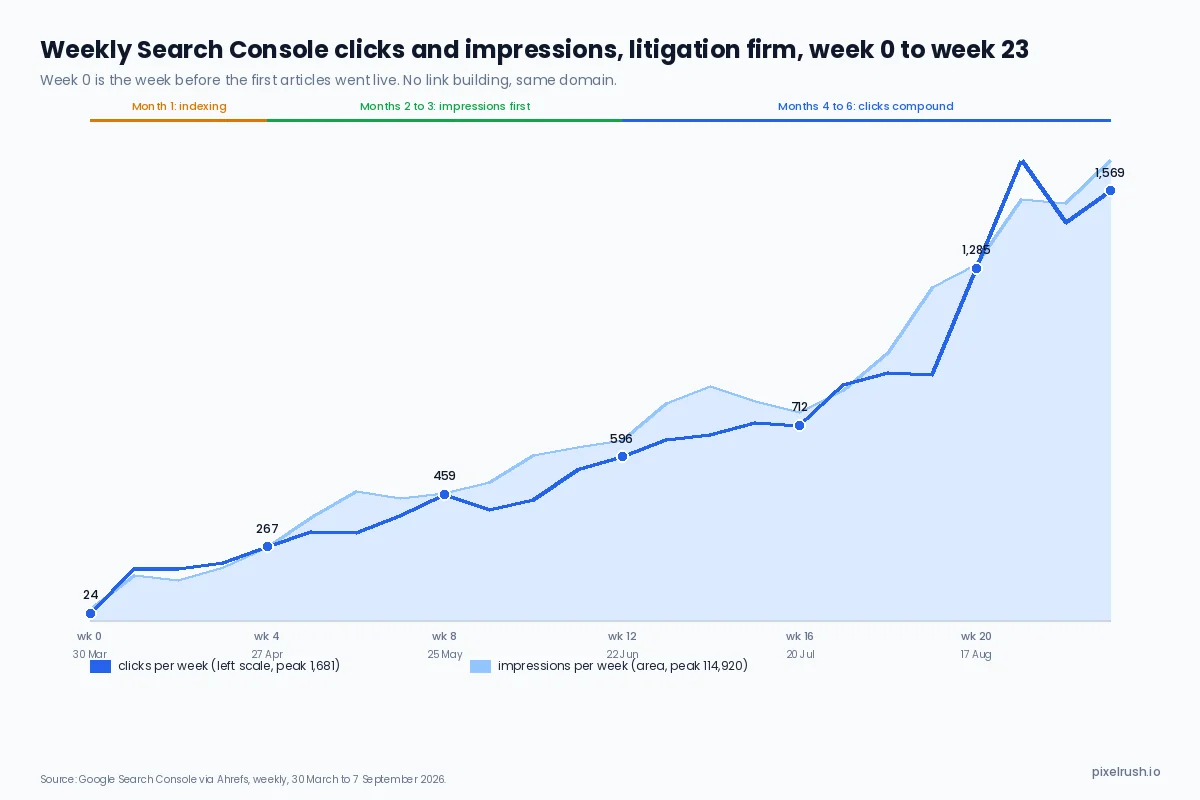
Weekly clicks (line) and impressions (area) from Google Search Console. Week 0 is the week before the first articles went live.
| Week | Weekly clicks | Weekly impressions | Average position | What was happening |
|---|---|---|---|---|
| 0 (30 Mar) | 24 | 2,725 | 13.6 | Baseline. Site had service pages, a thin blog, a strong brand |
| 1 (6 Apr) | 189 | 11,204 | 9.5 | First batch of articles indexed within days |
| 4 (27 Apr) | 267 | 18,088 | 9.9 | Impressions climbing on long-tail questions; clicks lag |
| 8 (25 May) | 459 | 31,695 | 9.0 | First articles in positions 1 to 3 for their questions |
| 12 (22 Jun) | 596 | 44,803 | 7.9 | Average position under 8 for the first time |
| 16 (20 Jul) | 712 | 51,790 | 8.1 | Clicks compounding; impressions briefly plateau |
| 20 (17 Aug) | 1,285 | 88,797 | 8.1 | Second surge as older articles mature |
| 22 (31 Aug) | 1,452 | 104,116 | 7.4 | Service pages starting to move behind the articles |
| 23 (7 Sep) | 1,569 | 114,920 | 7.5 | Week 23 at 65 times the baseline clicks |
Three things in that table are worth more than the totals.
First, the step in week 1. Impressions went from 2,725 to 11,204 in the first full week, which tells you the pages were indexed and shown almost immediately. That is not normal for a law firm site, and the reasons it happened here are in the "what makes it faster" section below. On a site with indexing problems, week 1 looks like week 0.
Second, the lag between impressions and clicks. Impressions quadrupled in a week; clicks took eight weeks to quadruple. Pages enter the results at positions 8 to 15, where almost nobody clicks, and move up over the following weeks as Google measures how they perform. If you are judging SEO by clicks at week four, you will think it is not working when it is.
Third, the second surge around week 20. Content published in April and May matured into top-three positions in August, at the same time as new content was still being added. That compounding is the thing SEO has that paid traffic does not, and it only shows up if you keep publishing through the flat-looking middle.
The month-by-month version
For planning, the same curve as months, with what you should see and what you should be doing. The "what you should see" column is for a firm with a clean site and an existing brand; a weaker starting position shifts everything right by a month or two.
| Month | What is happening | What you should see in Search Console | What you should be doing |
|---|---|---|---|
| 1 | Structure fixed, service pages rewritten, first clusters published, technical blockers removed | New pages indexed within days. Impressions up on long-tail questions. Clicks barely moved | Publishing at volume. Reviewing articles for accuracy in days, not weeks |
| 2 | First articles enter positions 5 to 15 for their questions | Impressions 3x to 8x baseline. Average position improving. Clicks 2x to 4x | Internal linking review across everything published so far |
| 3 | Best articles reach positions 1 to 3 | Clicks compounding. First enquiries attributable to organic if tracking is in place | Remaining clusters. Location pages where the volume justifies them |
| 4 to 6 | Content matures; Google trusts the domain for the topic | Clicks 10x to 60x baseline on a site that started low. Service pages begin to rise | Refresh the best performers. Start PR for links if authority is the limit |
| 6 to 9 | Service pages reach page one for practice area plus city terms in the home market | Enquiries from organic are a line item. Cost per enquiry falling below paid | Secondary services. Second market if multi-location |
| 9 to 12 | Head terms within reach in the home city | Organic competing with paid as the largest source | Maintain cadence; prune and consolidate what did not work |
| 12+ | Compounding | Each new article ranks faster because the domain is trusted for the topic | The system runs; the firm's job is the review loop and the proof |
The dependency in the last column is the one firms underestimate. Everything in the "what is happening" column requires the firm to review content for accuracy within days. The litigation firm published around 70 articles in its strongest month with about 55 going live, and that throughput is what produced the curve. A firm whose partners take three weeks to sign off an article gets a flat line regardless of how good the agency is.
Why this firm moved in week one, and why yours might not
Before taking the curve above as a forecast, be clear about the starting position, because it explains the speed more than anything we did.
The firm is a litigation specialist. Litigation is a narrower and less contested field in search than family, personal injury or commercial, where national brands, directories and dozens of mid-size firms compete for every question. The firm already had a brand that people searched for by name, and its lawyers' names had search volume of their own, which we aligned with the articles they reviewed. It held major litigation awards, it had a clean, fast site with nothing stuck in indexing, and an established link profile from years of practice. In other words, Google already trusted the entity; what it lacked was pages worth ranking. When those pages arrived, in volume, with lawyers' names on them, the response was immediate.
A general-practice firm, or a two-year-old boutique in a contested practice area with no brand search, no awards and a page-builder site, is starting several steps further back. It will see the same shape over a longer period: first clicks in month two or three rather than week one, enquiries in month six to nine rather than month three.
| Factor | Speeds it up | Slows it down | The litigation firm |
|---|---|---|---|
| Practice area competition | Niche or specialist field (litigation, estates, a specific tax area) | Family, personal injury, commercial in a capital city: national brands and directories hold page one | Litigation specialist |
| Brand search volume | People already search the firm by name; Google trusts the domain | New or unknown firm | Strong: brand queries were the top rows in Search Console before we started |
| Lawyer name volume | The lawyers are searched by name and their names sit on the articles | Anonymous content, "Admin" author | Strong: every article attributed to a lawyer with their own search volume |
| Authority signals | Real awards, bios, reviews, schema | None visible on the site | Major litigation awards |
| Indexing health | Clean site, lean build, nothing stuck in "crawled, not indexed" | Page builder theme, dozens of unindexed pages | Clean |
| Site size | Hundreds of pages covering the field | Twenty pages and a blog | Grew from a thin blog to hundreds of pages in six months |
| Content volume | 40 to 70 articles a month in the first quarter | 2 to 4 a month | 55 live in the best month |
| Review turnaround | Days | Weeks | Days |
| Link profile | Established | New domain, few referring domains | Established; no link building needed |
How much real estate you are competing for
The question underneath "how long does SEO take" is "how much are you trying to win". A site's rankings are bounded by its size. A twenty-page site can compete for twenty topics, and in a contested practice area it will compete for them badly, because the firms it is up against have hundreds or thousands of pages on the same subjects. This is as true for AI search as for Google: the engines cite the most complete source, and a small site is rarely the most complete source on anything.
| Site size | What it can realistically compete for | Typical timeline to enquiries |
|---|---|---|
| 10 to 30 pages: services and a short blog | A handful of long-tail questions, the map pack in a regional market, the firm's own brand | Regional: 3 to 6 months. Capital city: often never, for anything beyond brand |
| 50 to 150 pages: service hubs with a cluster of questions under each | Most of the questions in one or two practice areas; service-plus-city terms in a regional or mid-size market | 4 to 9 months |
| 150 to 500 pages: full hubs across every practice area, location pages, lawyer pages | Service-plus-city terms in a capital city; practice-area head terms over 12 to 18 months | 6 to 12 months, compounding afterwards |
| 500+ pages, maintained | Head terms in competitive practice areas; cited in AI answers across the field | The firms that own a market in search are all here |
The caveat is quality. A thousand pages of thin or stale content is a liability, not real estate; Google and the AI engines judge the site by what it finds, and a large site full of 2019 posts that were never good drags the new content down with it. Size counts only when every page is the best available answer to something.
The order of work before anyone can answer "how long"
For a firm that does not start where the litigation firm started, the timeline begins after this list, not before it. Done in this order, each step makes the next one worth doing.
The litigation firm skipped most of step six because it did not need it. Most firms will not be able to skip it, and the order still holds: PR for a site with stale content, broken links and anonymous articles buys mentions for a site Google has already decided not to trust. The SEO for law firms guide covers the content system in steps two and three, and the link building guide for law firms covers step six.
Key Point
How long SEO takes is a function of what you are competing for and what you start with. A specialist firm with a brand, awards, named lawyers and a clean site can see the curve above. A general firm with a thin site in a contested practice area is six steps behind it, and the honest timeline starts after those steps, not with them.
How to tell at month three whether it is working
This is the useful part. You do not need to wait a year to find out whether the money is well spent. The leading indicators arrive early.
If all five are true at month three, the clicks and the enquiries follow; it is the same curve every time. If the first two are false, stop and fix them before paying for another month. Our article on why a law firm site is not ranking is the diagnostic for that situation.
What "working" means at each stage
Clicks are not the goal. The firm wants matters. So the definition of working changes as the months go by, and the measurement has to change with it.
| Stage | Working means | Measured by |
|---|---|---|
| Month 1 to 2 | Indexed, shown, moving | Impressions and average position in Search Console |
| Month 3 to 4 | Earning clicks on the right questions | Clicks by page, and which questions they are |
| Month 5 to 6 | Enquiries attributable to organic | Form and call tracking with source recorded |
| Month 6 to 9 | Qualified enquiries at a cost below paid | Lead register with qualification outcome |
| Month 9 to 12 | Matters opened from organic | CRM with source and matter value |
Most firms cannot measure beyond the second row, so they cannot tell whether their SEO works at month nine, and most SEO reports fall back to rankings for that reason. The tracking needed for rows three to five is the same closed-loop setup we run on paid campaigns, covered in how to tell if marketing is actually working. Set it up in month one, because by month six you will want to know.
When to call it
SEO engagements that are not working rarely get stopped, because the agency has a reason every month and the reason always involves patience. Patience is warranted inside the curve above. It is not warranted outside it.
Stop, or change agency, if:
- At day 90, impressions on question-level queries are not materially above where they started. The content is either not indexed, not about what people search, or not being published.
- At month 6, no article holds a top-three position for anything. The writing is not competitive.
- At month 6, you cannot get a list of what was published and what each piece links to. The structure is not being built.
- At any point, the report is a list of head-term rankings moving from 48 to 41. That is a report of the wrong thing.
- The agency is paid per post and cannot tell you which service page each post supports.
A firm that stops at month three on those grounds has lost three months. A firm that keeps paying for two years on the promise of page one for the head term has lost the two years and the fee.
SEO versus Google Ads on the same timeline
The question behind "how long does SEO take" is usually "should I do SEO or ads, given that I need clients now". The answer for most law firms is both, with the mix changing over the year.
| Month | Google Ads | SEO |
|---|---|---|
| 1 | Enquiries in week one; cost per enquiry high while the account learns | Nothing visible to the firm |
| 3 | Account optimised; cost per enquiry falling; the firm's main lead source | First clicks; first organic enquiries if tracking is in place |
| 6 | Steady; cost per enquiry at its floor | Organic enquiries at a fraction of the paid cost; blended cost falling |
| 12 | Still the lever for volume and for new markets | Often the largest source; paid budget can shift to what organic cannot reach |
Ads buy time while SEO compounds. A firm that does only SEO goes nine months without a reliable lead source. A firm that does only ads pays the auction price forever. We wrote about what the paid side of that first year looks like in what the first six months of law firm advertising really look like, and the economics of each channel for legal in are Google Ads worth it for law firms and is SEO worth it for personal injury firms.
The short answer
For a law firm with an existing brand, a clean site and a content system publishing at volume with fast review, SEO shows impressions in weeks, clicks in two to three months and enquiries by month three to six; the litigation firm's curve above is what that looks like. For a boutique firm starting from a new or thin site, add two to three months to each stage and plan on links as part of the work. Either way, you can tell by day 90 whether it is on the curve, and you should not pay beyond that for one that is not.
If you want us to look at where your site sits on that curve, book a call and bring Search Console. We run this for personal injury, family, commercial and litigation firms in Melbourne, Sydney and Brisbane.
Want us to implement these strategies for you?
Book a free strategy call and let's discuss how we can grow your business.
Book Your Free CallContinue reading
More on Law Firm Marketing
Do Facebook Ads Work for Law Firms? Cost per Client by Practice Area
Meta ads produce enquiries for law firms at a fifth to a tenth of the Google Ads cost, and the enquiries are colder. That is the whole trade. What they cost by practice area, which practice areas they work for and which they do not, what you are allowed to say in an ad in each Australian state, lead forms versus landing pages, the budget that lets the account learn, and how to tell within 30 days whether it is working.
Google Business Profile for Lawyers: How to Get Into the Map Pack
The map pack is the first thing most legal searchers see, and the profiles in it have more in common than firms expect. What the ranking factors weigh, the review counts and categories in eight live Australian legal packs, which category to pick by practice area, serviced offices and suspensions, what a Queensland injury firm can and cannot write, review response templates, the tracking that shows whether the profile is producing calls, and a 30-day setup checklist.
Is SEO Dead for Law Firms? The Firm That Grew 6x While AI Took the Clicks
AI Overviews now sit on every "is SEO dead" search and on most legal questions, and Ahrefs measured a 58% click loss for the top result when one appears. In the same months a Melbourne litigation firm went from 785 to 5,217 organic clicks a month. What actually died, which query types still send clicks, where AI assistants send law firm traffic, and the honest reconciliation with what we wrote in 2025.
The Best Law Firm Landing Pages? 12 Australian Pages Scored Out of 20
A landing page is judged in the first screen on a phone, and most law firm pages fail there. The ten-point rubric we score pages against, twelve real Australian pages across personal injury, family, criminal and conveyancing scored and ranked, what the top scorer does that the rest do not, conversion rates from our accounts, when a form beats a phone number, and the Australian compliance mistakes we found on page one.