




You have paid for SEO, possibly for years. You type your practice area and city into Google, and your firm is on page three, or nowhere. The agency report says rankings are "trending up". You are here because that explanation has worn thin.
This article is the diagnostic we run on a law firm website in the first hour of an audit, in the order we run it. Each step takes minutes in Google Search Console, which is free and which the firm already owns, and each one points at a specific cause with a specific fix. The order matters: a page that is not indexed cannot be fixed by writing more content, and a page with no internal links will not be helped by a backlink campaign. Start at the top, stop at the first thing that fails.
Everything below comes from auditing law firm sites across personal injury, family, litigation, commercial and estates, and from building the ones that do rank, including a litigation firm that went from 785 to 5,217 Search Console clicks a month this year on the same domain. The causes are ranked by how often we find them.
Key Takeaways
- Most "not ranking" problems are one of four things: the page is not indexed, it is not about what the visitor searched, two of your own pages are competing, or nothing links to it. All four show up in Search Console within minutes.
- Brochure service pages do not rank. Four paragraphs about the firm's values and a phone number lose to any competitor who answers the client's questions on the page.
- Chasing head terms with a small site is the most common strategy error. "Personal injury lawyer Brisbane" is owned by national brands. The long-tail questions underneath it are not.
- A traffic drop is not a ranking drop. Impressions steady and clicks falling is AI Overviews; both falling on one date is an algorithm update or a rebuild that lost its redirects.
- The fix is almost never more backlinks. In our audits, links are the limiting factor for fewer than one firm in five. Structure, content and internal linking are the limit for the rest.
How to find the cause in 20 minutes
Before the twelve causes, the order of checks. Open Search Console for the site, pick one page you expected to rank, and go through these.
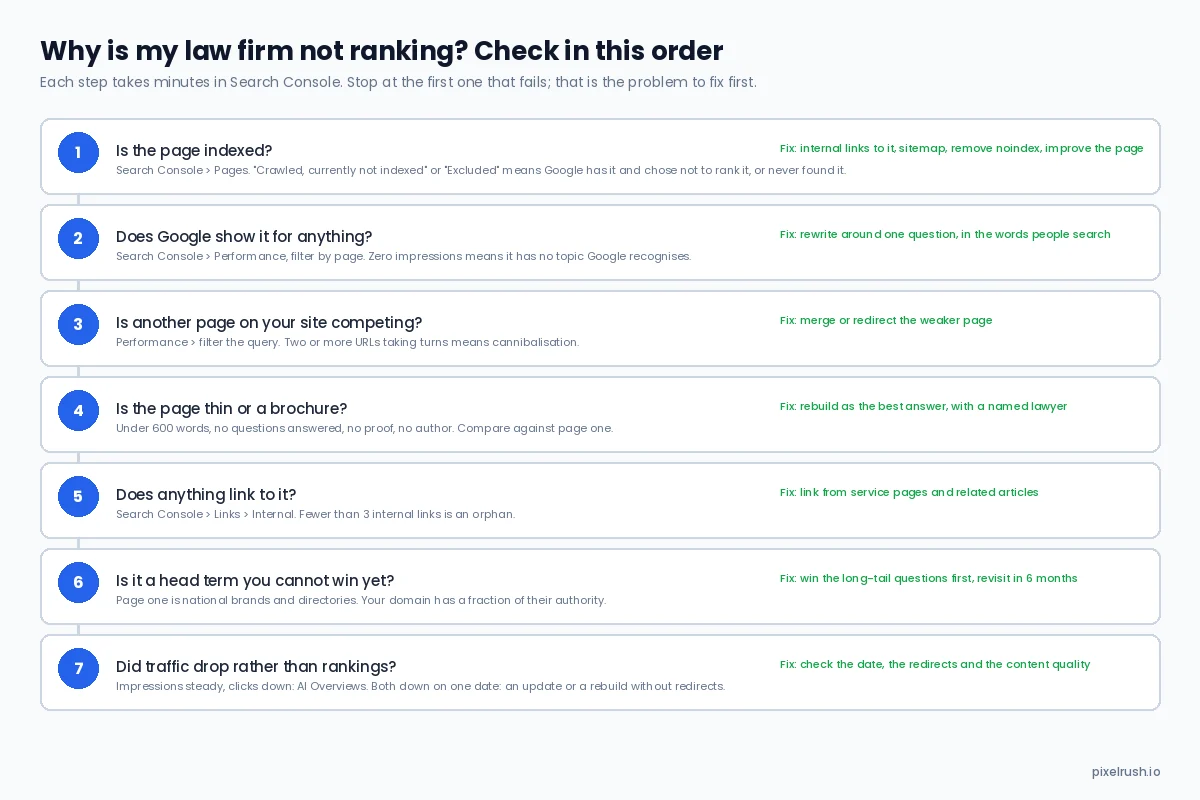
The order we check in an audit. Each step takes a few minutes and the first one that fails is the problem to fix.
| Step | Where to look | What a fail looks like | Likely cause |
|---|---|---|---|
| 1. Is it indexed? | Pages report, or URL inspection | "Crawled, currently not indexed", "Discovered, not indexed", "Excluded by noindex" | Causes 1, 2 |
| 2. Does it get impressions? | Performance, filter by page | Under 50 impressions in 3 months | Causes 3, 4 |
| 3. Is another page competing? | Performance, filter by the query, look at pages | Two URLs alternating positions | Cause 5 |
| 4. Is it thin? | Open it, compare to page one | Under 600 words, no questions answered, no author | Cause 4 |
| 5. Does anything link to it? | Links report, internal links | Fewer than 3 internal links | Cause 6 |
| 6. Is the term winnable? | Search the term, note who ranks | National brands, directories, government | Cause 9 |
| 7. Did traffic drop, not rankings? | Performance, 16-month view | Impressions flat, clicks down, or both down on one date | Causes 10, 11, 12 |
Now the causes, most common first.
1. The page is not indexed
Google cannot rank a page it has not stored. Law firm sites built on heavy WordPress themes with page builders routinely have dozens of pages sitting in "Crawled, currently not indexed", which means Google fetched the page, judged it not worth keeping, and moved on. "Discovered, currently not indexed" means Google knows the URL exists and has not bothered to fetch it, usually because nothing on the site links to it with any weight.
The confirmation is the Pages report in Search Console, or URL inspection on the specific page. The fix depends on which state it is in. A page excluded by a stray noindex tag, a leftover from staging, is a one-line fix. A page Google chose not to index needs to be made worth indexing: more substance, internal links from pages Google already values, and inclusion in the sitemap. On the litigation firm's site, every new article indexes within days, and the difference from an earlier engagement where indexing was a struggle is the structure and linking in the sections below rather than any technical trick.
2. The site is slow or broken on mobile
Not a ranking factor in the way people imagine, but a reason pages get crawled less, indexed less and abandoned faster. Most legal searches are on a phone, often in a stressful moment. A service page that takes six seconds to render on mobile data, with a popup over the top, loses the visitor before Google's measurement of the visit even begins.
Run PageSpeed Insights on the service page, on the mobile tab, and look at the field data rather than the lab score. Oversized images, a page builder, a dozen third-party scripts and cheap hosting account for nearly all of it. Our SEO for law firms guide has the full technical checklist; this is the short version, and it comes early because it blocks everything after it.
3. The page is not about what the visitor searched
Open the page and ask what question it answers. If the honest answer is "it describes our firm", that is the problem.
A person searching "can I claim compensation for a workplace injury" wants to know whether they can claim. A page headed "Workers Compensation Lawyers" that opens with the firm's history and values is not an answer to that question, and Google, which now reads intent rather than keywords, will rank the page that is. This is the single most common content failure on law firm sites: the page targets a phrase and ignores the question behind it.
| What the page says | What the searcher asked | What ranks |
|---|---|---|
| "Experienced workers compensation lawyers serving Brisbane since 1998" | Can I claim if I was hurt at work? | A page that answers yes or no, by scenario, then explains how |
| "Family law services: divorce, property, parenting" | How is property split in a divorce? | A page that explains the four-step process in plain English |
| "Commercial litigation specialists" | How much does it cost to sue someone? | A page with cost ranges and what drives them |
| "Estate planning solutions" | Can I contest a will if I was left out? | A page that explains eligibility and time limits |
The fix is to rewrite the page around the question, in the words the client uses, with the answer in the first paragraph and the firm's credentials after it. Our content writing for law firms guide covers the method.
4. The service page is a brochure
Related to cause 3 but worth its own entry, because it is the most common state of a law firm's money pages.
A brochure page is four to six paragraphs about the firm, a list of sub-services, and a contact form. It does not answer the five questions a prospective client has before they engage: can I claim or do I have a case, how long do I have, what will it cost, what happens first, and why this firm. It has no named lawyer on it, no reviews, no proof. Against twenty competitor pages that look the same, Google has no basis to prefer it, so it ranks on domain authority alone, which for a boutique firm means page three.
A service page that ranks is the best answer on the internet for its practice area in its city. That means it is long, structured by the questions above, written by or attributed to a named lawyer with a bio, and it links down to the deeper question articles for each sub-topic. The SEO guide's section on practice area pages gives the template.
5. Two of your own pages are competing
Search Console, Performance tab, filter by the query you care about, and look at the Pages breakdown. If two or more URLs take turns appearing, you have cannibalisation: Google cannot tell which page is the answer, so it alternates, and neither builds a position.
The usual sources on law firm sites:
- A service page and a blog post on the same topic, written years apart
- Location pages that are the same page with the suburb swapped
- An old URL from a rebuild that was never redirected, still indexed, still competing with its replacement
- A "what is X" explainer and a "X lawyers" service page targeting the same intent
The fix is to merge the weaker page into the stronger one and 301 redirect the old URL, or, for location pages, to give each one content that is actually about that location and the matters there, or remove it. A firm we audited had 3,600 blog posts; the agency that wrote them had been paid per post, and the posts were competing with each other and with the service pages. Pruning is sometimes the fastest win available.
6. Nothing links to the page
Search Console, Links report, internal links, sorted ascending. Pages at the bottom with zero, one or two internal links are orphans. Google finds them rarely, assigns them little weight, and ranks them accordingly.
On most law firm sites the blog is the orphanage: articles are published, listed on a blog index page, and never linked from the service pages or from each other. The service pages, which should be receiving the authority, link to nothing but each other through the menu.
The structure that fixes it, which we cover in the SEO guide, is simple: every article links up to its service page and across to the next question a reader will ask, every service page links down to its cluster of articles, and location pages link to the service and the articles that mention the location. The litigation firm's site runs this as a step in publishing rather than a task someone remembers to do, and it is the single biggest structural difference between that site and the ones that do not rank.
7. The site has no structure Google can read
A services menu and a blog is not a structure. Google looks for a site that owns a topic: a hub page for the practice area, question articles clustered underneath it, locations underneath where the volume justifies them. A site where the family law content is spread across a service page, nine blog posts in a flat list, two location pages and a FAQ page has four weak signals instead of one strong one.
Rebuilding the structure does not require a redesign. It requires deciding the parent of every page, linking accordingly, and using URLs and breadcrumbs that reflect the tree. Done over two or three months, with every changed URL redirected, it lifts every page on the site rather than one.
8. No author, no credentials, no proof
Legal content is in Google's "Your Money or Your Life" category. The quality bar for who wrote the page and whether they are qualified is higher than for almost any other industry. A page by "Admin", or with no author at all, on a site with no lawyer bios, no reviews and no contact details beyond a form, is giving Google nothing to trust.
The signals that matter: a named lawyer on every substantive page with a bio page and Person schema, reviews with a count and rating, real photos of real staff, an address and phone number on every page, and LegalService schema on the service pages. Our best read on why the litigation firm's content indexes and ranks so fast is this combination, plus a brand with existing search volume and real awards. None of it is a trick. It is a credible firm being made legible to Google. The E-E-A-T section of the SEO guide covers the setup.
9. You are targeting head terms you cannot win yet
Search "personal injury lawyer Brisbane" and look at who is on page one: national brands with ten-figure revenues, directories, two decades of links. A boutique firm with a two-year-old domain does not beat them head-on in six months, and an agency that promised page one for that term was promising something it could not deliver.
What a smaller firm can win, quickly, is the long tail: the hundreds of specific questions those brands do not bother to answer, each one a page-one result on its own, each one feeding authority back to the service page. Over twelve to eighteen months, that body of work is what moves the service page toward the head term. The order is long-tail first, head term as a consequence.
| Term type | Example | Who ranks today | Realistic for a boutique firm |
|---|---|---|---|
| Head term | personal injury lawyer brisbane | National brands, directories | 12 to 24 months, if everything else is right |
| Practice area plus modifier | workcover lawyer logan | Mid-size firms, some directories | 6 to 12 months |
| Question | can I claim if I was injured at work in qld | Mixed, often weak | Weeks to months |
| Specific scenario | injured on a labour hire site who is liable | Often nobody good | Weeks |
If your reports show rankings for head terms creeping from 48 to 41, that is the agency reporting the wrong thing. Ask for impressions and clicks on the question-level pages instead, and if there are none, that is the diagnosis.
10. A rebuild lost the old URLs
A firm redesigns its site, the agency changes every URL to a cleaner structure, nobody redirects the old ones, and six weeks later rankings have gone. Every link the old URLs had earned, and every ranking signal attached to them, pointed at pages that now return 404.
The confirmation is the date: a drop in both impressions and clicks that coincides with the launch. The fix is a redirect map from every old URL to its closest new equivalent, including the ones the agency considers unimportant. Crawl the old sitemap, or pull the old URLs from Search Console's historical data, and redirect them all. Recovery after a late fix is partial; redirects put in at launch lose almost nothing.
11. The traffic dropped but the rankings did not
Open Performance in Search Console, set the range to 16 months, and look at impressions and clicks on separate lines.
If impressions are steady or rising and clicks have fallen, the rankings are fine and the clicks are being absorbed above the organic results. In legal queries that is now mostly AI Overviews, which answer the question on the results page, plus the local pack and ads. The response is to be the source the AI Overview cites, which favours exactly the question-led, author-attributed content described above, and to measure what still clicks. We wrote about the shift in Google's warning shot to law firms.
If both impressions and clicks fell together on a date, it is an algorithm update or a site change. Google's helpful content and core updates have repeatedly hit law firm sites carrying hundreds of thin, interchangeable posts. The fix is pruning and consolidation, not more of the same.
12. "Not ranking" means the map pack, not the organic results
When a firm says it is not ranking, it often means it is not in the three map results above the organic listings for "lawyer near me" type searches. Those are driven by Google Business Profile signals, not by the website: category, reviews, proximity to the searcher, completeness of the profile and consistency of the address and phone across the web.
That is a different diagnosis with a different fix, covered in our guide to optimising Google Business Profile for lawyers. The short version: get the primary category right, get reviews that mention the practice area and city, reply to all of them, and make sure the office address on the site, the profile and the directories is identical.
What a page that ranks looks like in Search Console
It helps to know what you are aiming for, so here are real rows from the litigation firm's Search Console for the last quarter, with the firm and the exact topics anonymised. Every one is a question-led article under a service hub, with a named author, published this year.
| Page type | Query it ranks for | Impressions (90 days) | Clicks | Average position |
|---|---|---|---|---|
| Question article under the litigation hub | A costs rule people search by name | 2,483 | 117 | 1.7 |
| Same article, a longer variant of the question | "what does [rule] mean" | 805 | 27 | 2.2 |
| Question article under the estates hub | A broad inheritance dispute question | 5,533 | 16 | 6.5 |
| Question article under the litigation hub | "what is a [court document]" | 2,799 | 19 | 5.0 |
| Question article under the tax hub | A specific tax provision people search by number | 662 | 6 | 5.5 |
| Question article under the estates hub | A specific "can I contest" scenario | 35 | 7 | 1.9 |
Two things to notice. The pages that rank in the top three are the ones that answer one narrow question better than anyone else; the broad inheritance question gets five times the impressions at position six and a tenth of the click-through. And none of these are the head terms. The firm's practice area pages are moving up behind this body of work, which is the sequence the long-tail-first approach predicts.
If your own Search Console has no rows that look like these, with questions in the query column and positions under five, the site does not yet have the content that ranks, whatever the rankings report says.
What to ask your agency
If someone else runs your SEO, the twelve causes above become six questions. The answers tell you quickly whether the work is being done.
| Ask | A good answer | A bad answer |
|---|---|---|
| How many of our pages are not indexed, and why? | A number from the Pages report and a reason for each | "Google takes time" |
| Which questions do our top pages rank for? | A list of queries and positions from Performance | A list of head-term rankings on page 4 |
| Which pages are cannibalising each other? | Specific URL pairs and a merge plan | "That is not a thing" |
| How many internal links point at our main service page? | A number, and what was added this month | Silence |
| What was published last month and what does each piece link to? | A list with parent pages | A count of posts |
| What changed in the account in the last 30 days? | A change log | A rankings report |
What is usually not the problem
Three things firms spend money on that rarely fix a ranking problem:
- Backlinks. In fewer than one in five audits are links the limiting factor. A site with the problems above does not rank better with more links pointing at it; it ranks the same, and the links are wasted. Links matter after the structure and content are right, and for law firms they come from PR, partnerships and professional bodies rather than outreach, which our link building guide covers.
- Keyword density and meta tweaks. Google has not ranked on keyword repetition for a decade. Rewriting a title tag does not fix a brochure page.
- A new design. A redesign without a structure change and with the same content produces the same rankings, often lower, because of cause 10.
What to do this week
Pick the one service page that matters most. Run the seven checks at the top on that page alone. Fix the first failure. Then look at the ten articles that should be supporting that page and check whether any of them links to it; if not, add the links. That is usually a day's work, and it is more than most firms' SEO has done in a year.
If the checks all pass and the page still does not move, the answer is time and volume, which our article on how long SEO takes for a law firm covers month by month, and our SEO guide covers the system. If you want us to run the audit on your site, book a call and bring Search Console access; we do this for personal injury, family and commercial firms in Brisbane, Sydney and Melbourne.
Want us to implement these strategies for you?
Book a free strategy call and let's discuss how we can grow your business.
Book Your Free CallContinue reading
More on Law Firm Marketing
SEO for Law Firms: 12 Strategies That Took a Litigation Firm From 785 to 5,200 Clicks a Month
How we structure, write and link a law firm website so it ranks, from the system that grew a litigation firm's search clicks 6.6x in five months with no link building, plus the PR and partnership work that builds links for firms that need them.
Content Marketing Strategy for Law Firms: How to Create Content That Generates Leads and Clients
A working content strategy for an Australian law firm, from deciding who you are writing for through to auditing what you already have and tracking content to signed matters rather than to traffic.
How Do You Market a Law Firm in Australia? The Rules, the Channels, the Numbers
What actually works for Australian law firms right now, channel by channel, with the real costs from 19 ad accounts, the state advertising rules that decide what you can say, and the order to build it in.
How Much Do Lawyers Spend on Marketing? Setting a Law Firm Marketing Budget
The five to fifteen percent of revenue rule has no research behind it. Here is how to work out what your firm can actually afford to pay for a signed client, and what happens to the money once you spend it.