




Litigation is one of the hardest practice areas to market online, and one of the least crowded. In October 2026 we pulled the Google results for 25 litigation searches across seven cities, the map results in each CBD, and then studied the 26 firms that kept showing up: their authority and links, how much of their traffic actually lands on litigation pages, what sits on their service pages and articles, where and what they post on social media, the individual lawyers posting on their own accounts, and every live litigation ad we could find in the Meta Ad Library.
The short version is that nobody owns litigation online the way the national brands own personal injury. The big national firms rank on their name and their authority, but their litigation pages are short and written for other lawyers. The firms that win litigation enquiries are mostly specialist boutiques with pages built around a specific dispute, enough Google reviews to hold the map pack, and content that answers a real question such as what a Calderbank offer is or whether a text message can create a binding contract. On social media and Meta ads the field is almost empty, which makes it the biggest opening in the market.
If you run or market a litigation practice, use this as the benchmark: what the market has, what the leaders have, and where the gaps are. We ran the same study for injury firms in how personal injury law firms win online, and the comparison is useful throughout.
- Search: Australian results for "litigation lawyers", "commercial litigation lawyers" and "dispute resolution lawyers" in Sydney, Melbourne, Brisbane, Gold Coast, Perth, Adelaide and Newcastle, plus four national searches including "debt recovery lawyers" and "contract dispute lawyer". Ahrefs had no data for eight of the city searches (all of Adelaide and Newcastle among them), so those came from a live Google search. Google Maps top 15 for "litigation lawyer" from each CBD. 210 firms appeared; the 26 that showed up most often became the core set.
- Authority and traffic: Ahrefs Domain Rating, referring domains, ranking keywords, top pages and 25 months of traffic history for each firm. Because most firms do much more than litigation, we also measured how much of each site's traffic lands on pages about disputes, debt recovery, statutory demands, defamation, contested wills, security of payment, costs offers and court process.
- Pages: 132 pages scraped and measured (48 litigation service pages, 58 litigation articles and 26 homepages).
- Social: 90 days of posts on LinkedIn, Facebook, Instagram and TikTok plus YouTube channels. All 697 posts were read and coded by theme and by whether they were about litigation. We also found 29 individual lawyers posting about disputes on their own accounts.
- Meta ads: 241 live litigation ads from 51 advertisers in the Meta Ad Library for Australia, with the ad images saved and the instant form questions recorded.
- Some of the firms in this study are PixelRush clients. They are measured exactly the same way as every other firm.
Who are the litigation firms winning online in Australia?
There is no Maurice Blackburn of litigation. The single most visible firm in our searches is Rose Litigation Lawyers, a Brisbane and Gold Coast boutique with a Domain Rating of 20. It ranked in the organic top 10 for six of the 25 searches, including first for the national search "litigation lawyers", and appeared in the map results in both cities. It gets about 2,000 Google visits a month, and 72% of them land on litigation pages.
The national firms are there, but in a different way. Mallesons, Clayton Utz, HWL Ebsworth and Holding Redlich rank organically in Sydney and Melbourne off their general dispute resolution pages, and none of them appears in a single map result or map pack. Hall & Wilcox, Maddocks, Lander & Rogers, Gadens and Thomson Geer did not make the top 10 for any of our searches.
Total traffic is misleading in this market. Armstrong Legal gets an estimated 38,000 visits a month, but about half of that is criminal and traffic law, and only 12% lands on litigation pages. Johnston Withers gets nearly 13,000, almost all of it from personal injury pages. Across all 26 firms, only 12.5% of their Google traffic lands on pages about litigation. The chart below shows both numbers for each firm.
| Firm | Type | DR | AU visits a month | Visits to litigation pages | Share on litigation | Keywords in top 3 |
|---|---|---|---|---|---|---|
| Armstrong Legal | National | 43 | 38,220 | 4,715 | 12% | 3,537 |
| Clayton Utz | National | 67 | 9,296 | 1,983 | 21% | 945 |
| Rose Litigation Lawyers | Boutique, Brisbane and Gold Coast | 20 | 1,984 | 1,437 | 72% | 130 |
| PCL Lawyers | National | 33 | 4,388 | 1,390 | 32% | 155 |
| Turnbull Hill Lawyers | Sydney and Newcastle | 38 | 6,673 | 1,179 | 18% | 277 |
| Mallesons | National | 60 | 15,862 | 873 | 6% | 698 |
| Aitken Whyte Lawyers | Brisbane | 29 | 6,164 | 859 | 14% | 267 |
| Progressive Legal | Sydney | 34 | 4,691 | 710 | 15% | 185 |
| Boss Lawyers | Boutique, Brisbane | 7 | 1,456 | 585 | 40% | 109 |
| Gibbs Wright Litigation Lawyers | Boutique, Brisbane | 16 | 1,096 | 516 | 47% | 96 |
| Holding Redlich | National | 63 | 4,537 | 465 | 10% | 392 |
| Johnston Withers | Adelaide | 26 | 12,901 | 458 | 4% | 216 |
| CPC Lawyers | Boutique, Adelaide | 6 | 259 | 214 | 83% | 19 |
| Scammell & Co | Adelaide | 30 | 3,014 | 198 | 7% | 64 |
| BlackBay Lawyers | Boutique, Sydney | 33 | 1,521 | 191 | 13% | 44 |
| Cronin Miller Litigation | Boutique, Gold Coast and Brisbane | 30 | 426 | 187 | 44% | 22 |
| Ramsden Lawyers | Gold Coast | 32 | 7,381 | 155 | 2% | 120 |
| Williams + Hughes | Boutique, Perth | 32 | 551 | 121 | 22% | 35 |
| HHG Legal Group | Perth | 32 | 2,199 | 80 | 4% | 117 |
| HWL Ebsworth | National | 66 | 5,816 | 78 | 1% | 337 |
| Marino Law | Gold Coast | 29 | 3,586 | 78 | 2% | 105 |
| AJH Lawyers | Boutique, Melbourne | 2 | 303 | 74 | 24% | 5 |
| Roberts Gray Lawyers | Boutique, Melbourne | 7 | 136 | 20 | 15% | 5 |
| Baker Love | Newcastle | 16 | 560 | 9 | 2% | 43 |
| HCP Lawyers | Boutique, Newcastle | 2 | 102 | 0 | 0% | 3 |
| Johnstone Crouse Lawyers | Boutique, Perth | 1 | 2 | 0 | 0% | 1 |
Armstrong Legal and Clayton Utz hold 40% of all the litigation traffic in the set between them. Armstrong's position is about to change, though. When we scraped its site, every page in its commercial and civil law section, including the "without prejudice" and injunction guides that bring most of its litigation visits, redirected to a services page that lists only criminal, traffic, wills and family law. If those pages stay gone, the second-biggest litigation player in the set will lose most of its disputes traffic.
Treat all of these as estimates. Ahrefs models traffic from keyword volumes, and litigation searches are small and specific, so it tends to undercount firms that win lots of low-volume searches. The comparisons between firms hold up better than any single number.
How much authority does a litigation website need to rank?
Less than you might expect. Domain Rating tracks total traffic closely (a rank correlation of 0.76), because the national firms with DR 60 and above get lots of visits for their name, their careers pages and their other practice areas. It tracks litigation traffic much more weakly (0.53).
Rose Litigation on DR 20 and Gibbs Wright on DR 16 both get more litigation traffic than Mallesons, HWL Ebsworth and Holding Redlich, which all sit above DR 60. Only Clayton Utz turns its authority into real litigation traffic, and it does it with explainer articles rather than service pages. CPC Lawyers in Adelaide has a DR of 6 and still sends 83% of its small amount of traffic to litigation pages.
The strongest predictor of litigation traffic is the number of keywords a firm has in the top three positions (0.75). Article volume barely matters (0.29), and how much a firm published in the last year matters even less (0.14). In litigation, as in injury law, ranking comes from pages built for specific searches, and authority helps those pages rank. Simply publishing more content does neither. Our guide to SEO for law firms covers how to build both.
How much content do litigation firms have, and does more help?
Some firms have a lot. HWL Ebsworth has about 2,600 articles in its sitemaps, Armstrong Legal about 1,900 and Mallesons about 1,800. A typical litigation boutique has 50 to 400.
HWL Ebsworth published about 200 new articles in the last 12 months, more than any firm in the set, and 1% of its traffic lands on litigation pages. Its traffic is down 41% on last year. Its insights are written for clients and other lawyers across dozens of practice areas, and very few target a dispute someone is searching about. At the other end, Rose Litigation has 151 articles and 72% of its traffic is litigation, and Cronin Miller has 110 and 44%.
The difference, again, is what the content is about.
What content brings litigation firms traffic?
Across the 26 firms, 44% of litigation visits land on articles, 39% on service pages, 10% on city pages and 5% on homepages.
Explainers that answer one specific question
The best-performing litigation articles each answer a single question that people in a dispute, or their accountants and in-house counsel, type into Google. Clayton Utz's article on Calderbank offers gets about 466 visits a month. Pages explaining "without prejudice" bring 350 visits to Armstrong Legal and 252 to Clayton Utz. Seven pages on Calderbank and without prejudice offers bring 1,540 visits between them, more than all the debt recovery and statutory demand content in the set combined.
The other explainers that work follow the same pattern: cease and desist letters (Turnbull Hill, 217 visits), quantum meruit (Progressive Legal, 135), misleading and deceptive conduct under section 18 of the Australian Consumer Law (Rose Litigation, 127), and the Masters v Cameron test for when a contract is binding (Aitken Whyte, 119).
Service pages built around a dispute type
Service pages carry the commercial searches. The pages getting traffic are built around a specific dispute and often a city: will dispute lawyers (Aitken Whyte, 218), construction dispute lawyers (CPC, 194), property dispute lawyers in Brisbane (PCL, 194), commercial litigation lawyers in Sydney (Turnbull Hill, 154), contested will lawyers (Johnston Withers, 145) and defamation lawyers in Sydney (BlackBay, 128). A generic "litigation and dispute resolution" page rarely ranks for anything.
Contested wills are the biggest category by far
Contested wills and estate disputes bring 6,387 visits a month across 137 pages, more than every other litigation topic combined. This is the one part of litigation that behaves like personal injury: it involves ordinary people, a specific event, and a question about money. Debt recovery and statutory demands, which every commercial litigation firm says it does, bring very little: 111 visits across ten statutory demand guides and 353 across 24 debt pages.
City pages, done properly
PCL Lawyers has 46 city and suburb pages, and 43 of them rank, for about 1,600 visits a month. Each targets a real dispute in a real city, such as property disputes in Brisbane or shareholder disputes in Sydney. Armstrong Legal shows the opposite approach. It has 2,483 city and town landing pages, including 1,176 near-identical contested wills pages, and only 30 of them rank. Pages like these only work when each one has something specific to say about that place and that dispute.
Nobody answers "how much will it cost?"
In personal injury, the pages carrying the most traffic answer "what is my claim worth?". The litigation equivalent is "how much will this cost me?", and almost nobody answers it. No commercial litigation cost guide ranked for any of the 26 firms. The only cost pages getting traffic are Armstrong Legal's contested wills pages (probate costs, no win no fee will disputes, fixed fee inheritance disputes). Across the wider market, the most detailed litigation cost guide we found, with hourly rates by seniority, barrister day rates and totals by stage, gets about 14 visits a month. That gap is the biggest content opportunity in the market.
How often are litigation firms publishing, and is it working?
HWL Ebsworth (about 200 articles), Turnbull Hill (92) and Boss Lawyers (87) published the most in the last year. Boss Lawyers is the one where publishing clearly paid off: its traffic is up 154% on last year to a two-year high, on a Domain Rating of 7, with how-to guides on statutory demands, winding up and debt recovery. Several boutiques published almost nothing in the year.
The wider trend is down. 16 of the 26 firms get less Google traffic than they did a year ago, and the median firm has lost 20%. Across the whole set, combined traffic fell 18% from October 2025 to October 2026, and most firms peaked between July and September 2025. Some of that is AI Overviews answering definitional questions ("what is a Calderbank offer?") without a click, which hits explainer content hardest. We look at what this means in is SEO dead for law firms and how to rank in AI search.
What goes into a litigation page that ranks?
We took each firm's main litigation page, a second dispute-type page and its three highest-traffic litigation articles, and measured what was on them.
42% are under 600 words
middle half: 740 to 1,693
17% have none
PI pages sit at grade 8
Litigation pages are much thinner than injury pages. A typical litigation service page has about 760 words, two or three H2 headings and 12 internal links, and 42% of them are under 600 words. The typical injury service page in our earlier study had 1,400 words and eight H2s. Litigation articles are closer, at about 1,250 words, but the structure is flat: a median of three H2s, and a quarter have none at all.
Litigation pages are also hard to read. The median sits at a school grade of 10.4, two grades harder than injury pages, and some pages read at grade 15. Turnbull Hill is the plain-English exception at grades 3 to 7.
What litigation pages leave out matters most. None of the 48 service pages has a table, and none has a video. Only 4% name a lawyer, and only 6% mention a fixed fee. No firm in the set has a cost estimator, calculator or quiz anywhere on the pages we checked. For a client deciding whether a dispute is worth fighting, the questions are how much, how long and what are my chances, and almost every page avoids all three.
National firm pages and local firm pages are built for different readers. National firm articles are partner-bylined, dated case notes written for other lawyers. 73% name a lawyer and 93% show a date, but none has a table of contents, a free consultation offer or a star rating, and their service pages are short blurbs. Clayton Utz's main litigation page is 193 words and HWL Ebsworth's is 375. They rank on authority. The local firms and boutiques are the only ones building pages with prices, reviews, call bars and consultation offers, which is why they win the enquiries the national firms don't want.
What does the best litigation article in Australia look like?
To answer this properly we went beyond the 26 firms. We searched around 40 questions people in disputes ask Google, collected every law firm article ranking in the top 10, and read and scored the 39 that ranked for the most searches.
The best we found is O'Brien Solicitors' defamation damages in Australia: how much can you claim?. It answers the money question in its opening lines. It explains the cap on damages for non-economic loss under section 35 of the Defamation Act 2005 ($443,000 when it was written), sets out the three types of damages in a table showing which are capped, gives a realistic range of $20,000 to $180,000 for social media cases, and walks through real outcomes, including Geoffrey Rush's award of about $2.87 million and Rebel Wilson's $4.5 million award being cut to $600,000 on appeal. It has a named partner byline and was updated in June 2026. Its weakness is reach: it gets about 57 visits a month.
| Page | Ranks for | Visits a month | What it does well | What it's missing |
|---|---|---|---|---|
| O'Brien Solicitors, defamation damages in Australia | #2 "how much can I claim for defamation" | 57 | The cap, a damages table, a realistic range, real cases, named author, updated date | Reach |
| LegalVision, what is a Calderbank offer? | #6 "calderbank offer" (1,400 searches a month) | 112 | Summary box, worked example, business tips, FAQ schema, author, updated date | No numbers on the costs at stake |
| Clayton Utz, Calderbank offers | #2 "calderbank offer" | 458 | Built on two 2021 Queensland Supreme Court decisions; traffic from 616 words on the firm's authority | Written for lawyers, no worked example |
| OMB Solicitors, letter of demand in Queensland | #5 "letter of demand" (1,800 searches a month) | 106 | What a demand must contain, the six-year limitation period, 7 days for a $2,000 invoice against 21 for a complex dispute, debts up to $25,000 going to QCAT | No author |
| Stonegate Legal, libel, slander and defamation | #5 "what is defamation" (700 searches a month) | 284 | Author bio, every state's Act listed, a long FAQ | No damages or cost figures |
The pattern is clear. The best-written litigation articles answer one question with numbers, cases and the rules in the reader's state, and the articles getting the most traffic are short explainers ranking on authority. Nobody in the market has put both together yet, which is the opening for any firm that does.
What do weak litigation pages have in common?
- Blurb service pages. Clayton Utz's litigation page is 193 words with no internal links. AJH Lawyers' is 157 words at a reading grade of 15.5. Williams + Hughes' is 108 words.
- Long articles with no headings. Aitken Whyte's article on Calderbank offers runs to 1,841 words with no H2s, and still gets about 83 visits a month. Rose Litigation's article on caveats is 1,897 words with none.
- Thin posts. All three Scammell articles we checked are 400 to 500 words, and a PCL article on professional negligence gets about 97 visits a month on 429 words.
- No links out. 17% of service pages have no internal links in the body. Holding Redlich's 10,543-word Queensland security of payment guide has none, and no author or date.
- No name, no date. 55% of litigation articles name no lawyer, 24% show no date, and only one of 58 shows an updated date.
- Heavy pages. One Perth construction disputes page is 1.6 MB for 181 words. Some boutique sites built on Wix run to 1.5 MB with more than 100 scripts.
What does the user experience look like on litigation websites?
On a typical litigation service page you'll find an enquiry form (73%), a reviews or testimonials widget (44%), a sticky call bar on mobile (33%), a star rating (21%) and a free consultation offer (19%). Chat is rare: only two firms in the set run a chat widget on these pages. Any signal about fees or costs, even a sentence, appears on only about a third of pages.
Most homepage headlines are brand lines. Only a few name the service and the place.
| Firm | Homepage headline | First call to action | Reviews shown above the fold |
|---|---|---|---|
| Rose Litigation Lawyers | Brisbane and Gold Coast Litigation Lawyers | Obligation free consultation (form in the hero) | None |
| Boss Lawyers | Leading Commercial Litigation Lawyers Brisbane-wide | Schedule a call / Get a consultation | "35 reviews" |
| Progressive Legal | Fixed-priced legal services in plain English for the modern Australian business | Enquire now / phone | 4.9 stars, 180 reviews |
| Roberts Gray Lawyers | Specialists in Complex Litigation & High Stakes Disputes | Form only, no phone link | None, despite about 300 Google reviews |
| BlackBay Lawyers | Australia's Boutique Litigation Firm | Become a client | Google reviews plugin |
| PCL Lawyers | Looking for a Lawyer or Law Firm in Melbourne? | Phone / request a meeting | None, despite about 300 Google reviews |
| Mallesons | Mallesons, the top-tier independent law firm from Australia | None | None |
| Clayton Utz | For wherever your business takes you | None | None |
| Holding Redlich | Much more than great law | None | None |
Only Boss Lawyers and Progressive Legal state a review count above the fold. Several firms with strong map listings, such as Roberts Gray and PCL with about 300 Google reviews each, don't mention them on their homepage at all. Our guides to law firm website design and law firm landing pages go further into layout and conversion.
Does it change from city to city?
A lot. The national firms take 27% of the page-one firm results in Sydney and 39% in Melbourne, and almost none anywhere else: 13% in Brisbane, 8% in Adelaide, 4% on the Gold Coast and none at all in Perth or Newcastle.
The map results belong to boutiques with lots of Google reviews and almost no website authority. Johnstone Crouse in Perth has a Domain Rating of 1.4 and about two organic visits a month, and holds a spot in all three Perth map packs on 113 reviews. In Sydney, the map packs go to firms such as MGL Lawyers and Truth Lawyers, with Domain Ratings below 1 and 369 to 496 reviews. In Melbourne, Roberts Gray (297 reviews) is first on Google Maps and in two of the three map packs.
| City | National firms' share of page one | #1 on Google Maps | Reviews on that listing | Median reviews, Maps top 15 | Who holds the map packs |
|---|---|---|---|---|---|
| Sydney | 27% | Brander Smith McKnight | 140 | 140 | Review-heavy boutiques such as MGL Lawyers, Truth Lawyers and Executive Law Group, plus Progressive Legal |
| Melbourne | 39% | Roberts Gray Lawyers | 297 | 152 | Roberts Gray and AJH Lawyers in two packs each, plus local commercial firms |
| Brisbane | 13% | Prosper Law | 86 | 86 | Litigation boutiques: Gibbs Wright in two packs, Rose Litigation and ADVIILAW |
| Gold Coast | 4% | Rose Litigation Lawyers | 48 | 88 | Local firms: Rose Litigation, Ballantyne, Marino Law and others |
| Perth | 0% | Solomon Hollett Lawyers | 155 | 50 | Johnstone Crouse in all three packs, plus Tang Law (605 reviews) and Solomon Hollett |
| Adelaide | 8% | YLP Legal | 50 | 136 | No map pack data (no Ahrefs results for Adelaide litigation searches) |
| Newcastle | 0% | Lamont Law | 132 | 31 | No map pack data. The weakest market in the study: page-one firms have a median DR of 9 |
Review counts are much lower than in injury law. The biggest single profile we captured is Tang Law in Perth with 605 reviews, against 1,588 for the top injury listing in Sydney. That makes litigation map results easier to win. A boutique with 150 to 300 genuine reviews and a properly set up profile is competitive for a map pack spot in every city we checked. Our guides to getting Google reviews for a law firm and Google Business Profile for lawyers cover how, and our Sydney, Melbourne, Brisbane, Perth and Adelaide pages cover each market.
Directories are also a bigger factor here than in injury law. Best Lawyers appears in 12 of the 25 top 10s, LawConnect in six and Doyle's Guide in four, so directory listings take about 16% of page-one results. Two of the three map pack spots for "debt recovery lawyers" went to debt collection agencies, not law firms.
Where do litigation firms post on social media?
Mostly on LinkedIn. All 26 firms have a LinkedIn page and 20 posted in the last 90 days. Facebook and Instagram are patchy, YouTube is mostly dormant and TikTok is almost empty: only one core firm posted on TikTok in the window, and that was family law.
uploads/wkMallesons·0.97.8·0.3Boss Lawyers00.47.5·0HHG Legal01.63.8·0Rose Litigation1.81.81.8·0Baker Love1.92.11.2·0.2BlackBay Lawyers·1.43.7·0.6Holding Redlich<0.1<0.14.9·0Clayton Utz0<0.14.4·0.2PCL Lawyers1.61.31.4·0Progressive Legal0.92.20.9·0HWL Ebsworth··3.0··Scammell & Co1.8·0.500Johnston Withers0.70.70.7·0Armstrong Legal0.50.70.7·0Ramsden0.40.30.50.50AJH Lawyers1.5·0·0Cronin Miller0.40.60.5··Marino Law0.50.50.3··Turnbull Hill0.5·0.3·0.4Williams + Hughes··0.7··CPC Lawyers0.30.2<0.1··Gibbs Wright000·0Aitken Whyte0·0··Roberts Gray·00··Johnstone Crouse000··HCP Lawyers··0··
Most of what litigation firms post is not about litigation. Only 23% of the 697 posts we coded were about disputes. Boutiques post the most litigation content, and the national and state firms post about their people, their awards and their other practice areas.
What do litigation firms post, and what gets engagement?
The pattern matches injury law. Legal explainers are the biggest category, at 32% of posts, and the weakest performer, earning 0.6 times a typical post. Sponsorship (2.1x), staff and recruitment (1.4x) and firm news (1.4x) do best. Only three of 697 posts reported a case result. The best litigation post from any firm brand account drew 64 engagements, and it was Rose Litigation welcoming a new solicitor. Six of the top ten litigation posts were about new hires into litigation teams.
Firms do occasionally share a win, and it works when they do. Holding Redlich's post about a case win for its client drew 2.4 times its usual engagement.
Clayton Utz (68,800 followers) and HWL Ebsworth (43,200) have the biggest LinkedIn pages, and HWL and Mallesons get the most engagement per post. Boss Lawyers posts more litigation content than any other firm, at 7.5 posts a week, for a median of one engagement a post. Volume without a person behind it does very little on LinkedIn.
YouTube is close to dormant. Only five of the 17 channels uploaded anything in the last 12 months. BlackBay Lawyers has the biggest channel (2,320 subscribers), but its most-viewed videos have thousands of views and three or four likes, which points to paid views. Clayton Utz posts recorded talks. The most useful format is Turnbull Hill's lawyer-fronted explainers, such as how to contest an estate in NSW when there is no will.
Which individual litigation lawyers are building an audience on social?
The firm accounts are only half the picture. We found 29 Australian lawyers posting about disputes on their own TikTok, LinkedIn, Instagram and YouTube accounts. As in injury law, the ones with real reach on TikTok all work at small firms.
Who is posting on TikTok?
| Lawyer | Firm | Followers | Posting rate (last 90 days) | Typical video | Best video | What they make |
|---|---|---|---|---|---|---|
| Fadi Chahine | Innova Legal, Sydney | 7,990 | About one a week | 79,900 plays | A dad cuts one daughter out of his will: 517,300 plays | Case breakdowns in 60 to 90 seconds; about two-thirds are disputes |
| Kingsford Lawyers principal | Kingsford Lawyers, Melbourne and Brisbane | 10,700 | Two a week | 8,100 plays | Estate claim, who gets the house: 91,900 plays, 396 comments | "Guess the verdict" case videos plus explainers |
| Twomey Dispute Lawyers | Twomey Dispute Lawyers, Sydney | 1,920 | Two a week | 450 plays | "He is sick every second Monday": 81,800 plays | Question-and-answer videos built from real enquiries |
| Dean Charalambous | Bastion Legal, Melbourne | 2,080 | Two a week | 7,600 plays | Building disputes are all about leverage: 53,400 plays | Building and construction dispute explainers, many made with a builder account |
| Nour Salama | Salbridge Lawyers, Sydney | 1,660 | One every two weeks | 1,900 plays | An agent said "OK" by text: is the contract binding?: 126,700 plays | Everyday contract questions to camera |
| Damon Laffin | Odyssey Legal, Queensland | 600 | Two a week | 230 plays | A celebrity defamation case: 360,100 plays | Humour clips, plus occasional real case breakdowns |
| Tarek Elamine | Elamine Lawyers, Melbourne | 370 | Rarely | 1,000 plays | Security of payment deadlines: 34,100 plays | Explainers for builders and subcontractors |
The type of video matters far more than how often it's posted. Across 296 videos from lawyers posting about disputes, real case breakdowns had a median of 41,900 plays. Explainers had 1,904 and humour clips 427. Damon Laffin's account shows it inside one feed: his humour clips average about 230 plays, and his breakdown of a celebrity defamation case reached 360,000.
The case videos that work follow the same pattern as in injury law. They open on a situation people recognise (a will that leaves one child out, a text message that might be a contract, an employee who is sick every second Monday), tell the facts quickly, and end on a question. Kingsford's "guess the verdict" format turns that into a game, and drew 396 comments on one estate case.
Twomey Dispute Lawyers is the only firm account that behaves like a creator. It posts nothing but disputes, built from real questions people send in, and its best video reached 81,800 plays.
Everyday contract questions work too. Nour Salama's video on whether a real estate agent's "OK" by text created a binding contract drew 126,700 plays.
Who is posting on LinkedIn?
LinkedIn is where lawyers at the established firms post. At boutiques and state firms, the lawyer usually has a bigger audience than the firm and gets more engagement per post. At national firms, the firm page wins.
| Lawyer | Firm | Followers | Posts in 90 days | Median engagement | What they post |
|---|---|---|---|---|---|
| Blair McNamara | Brockhill & Usherwood, Melbourne | 17,100 | 30+ | 16.5 | An opinion series on insurance claims, building reform and the cost of litigation |
| Amanda Lees | Mallesons | 7,000 | 11 | 36 | Arbitration events and case notes |
| Adrian Corbould | Baker Love, Newcastle | 6,400 | 30+ | 31.5 | Daily posts: estate case stories, litigation-life humour |
| Derek Cronin | Cronin Miller Litigation, Gold Coast | 6,300 | 5 | 47 | Speaking events such as "Debt Recovery 101" |
| Victoria-Jane Otavski | BlackBay Lawyers, Sydney | 4,000 | 1 | 296 | An award thank-you |
| Michael Douglas | Barrister, Perth | 3,900 | 5 | 36 | Case notes on defamation and procedure |
| Mark Harley | Boss Lawyers, Brisbane | 3,800 | 5 | 20 | Reflections on 17 years in commercial litigation, recruitment |
| Christopher Rowden | HFW, Brisbane | 1,600 | 7 | 72 | Reflective practice posts and dispute commentary |
Adrian Corbould is the clearest example. He posts about six times a week, has 12 times the followers of his firm's page, and his estate posts earn far more than the firm's do. His best post in the window, on how every NSW estate can be challenged, drew 96 engagements, about 14 times the firm page's typical post.
What about Instagram?
Almost nothing. We found three litigation lawyers with personal Instagram accounts, none posting litigation content regularly. The largest belongs to an employment lawyer whose Instagram audience mirrors her TikTok. On Instagram, the firms that post are reaching people through the firm account, and very few of them post about disputes.
What do the lawyers with real reach have in common?
They are one person on camera talking about a real case or a real question, in a lane people recognise: wills and estates, building disputes, contracts, workplace disputes. None of them works at a national firm, only a handful of the 26 core firms have a lawyer posting personally at all, and none of those lawyers makes short video. For a litigation firm, the opportunity is the same one we found in injury law: put one of your own lawyers on camera each week, talking about real disputes in plain language, under their own name. Our guide to video marketing for law firms covers how to make it work.
What are litigation firms running on Meta ads?
Very little, compared with injury law. We found 241 live litigation ads from 51 advertisers in the Meta Ad Library, about a seventh of the personal injury market. Only three of the 26 core firms run litigation ads at all: Marino Law (12 ads), Rose Litigation (9) and Ramsden (2).
personal injury: 1,602
personal injury: 83
personal injury: 16 of 25
personal injury: 37%
The advertisers who do use Meta are not the firms that win in search. The biggest are specialists in getting businesses paid. Twomey Dispute Lawyers (TDL) runs 46 ads, all about unpaid invoices and all to one receivables landing page. Foresight Law Group runs 28 for builders and subcontractors chasing payment. Greenhalgh Pickard on the Sunshine Coast runs 29 across estate disputes, commercial disputes and building adjudication, each to its own landing page, which is the most complete litigation funnel in the data.
Unpaid money is to litigation what TPD is to injury law on Meta. Unpaid invoices, construction payment claims and being left out of a will are problems people already feel, so the ad doesn't have to explain why they need a lawyer. Defamation doesn't appear at all, and employment disputes barely do.
The hooks are different from injury law too. No win no fee appears in 2% of litigation ads against 30% of injury ads. Instead, litigation ads lean on deadlines and urgency (41%), free consultations (30%) and the cost of doing nothing, especially cash flow (29%). Dollar figures, when they appear, describe the amount owed rather than a settlement.
Litigation ads are mostly new. The median ad is 24 days old, only seven advertisers have an ad that has run for six months, and three have one past a year.
Where do the ads send people?
Litigation advertisers send far fewer people to instant forms than injury firms do (20% against 37%), and far more to dedicated landing pages, often on their own subdomain. The forms that are used qualify on the size of the dispute: Foresight's asks "What is the value of the amounts in dispute?", and the security of payment forms ask about jurisdiction, the amount owed, the date served and whether a defence has been filed. Our guides to Facebook ads for law firms and law firm landing pages cover how to set this up.
Which litigation ads are worth studying?
These are the longest-running litigation ads, plus the current style of the biggest advertisers. Images are saved copies from the Ad Library on 22 October 2026, and each card links to the ad's Ad Library record, which Meta removes once an ad is switched off.



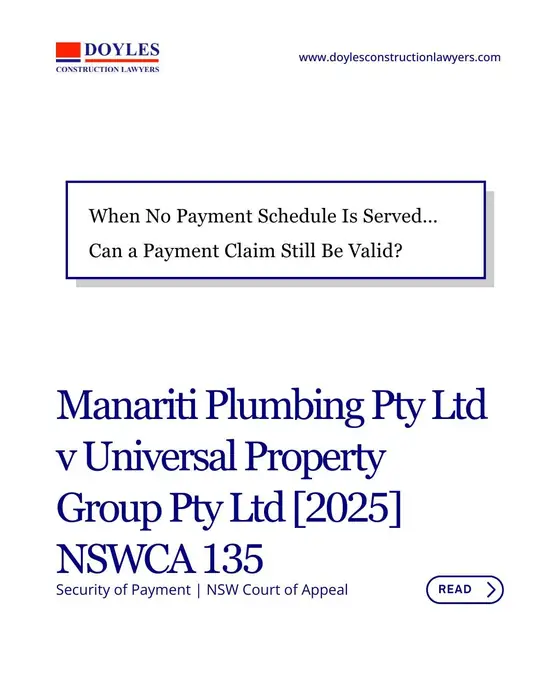



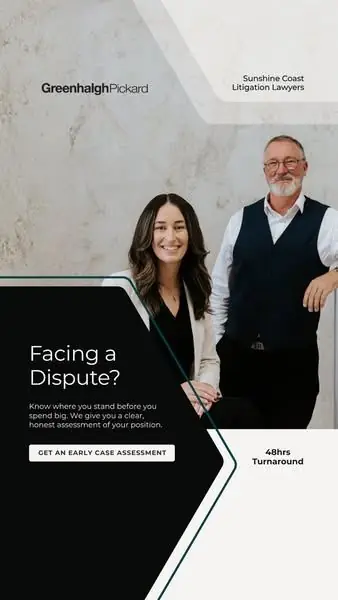

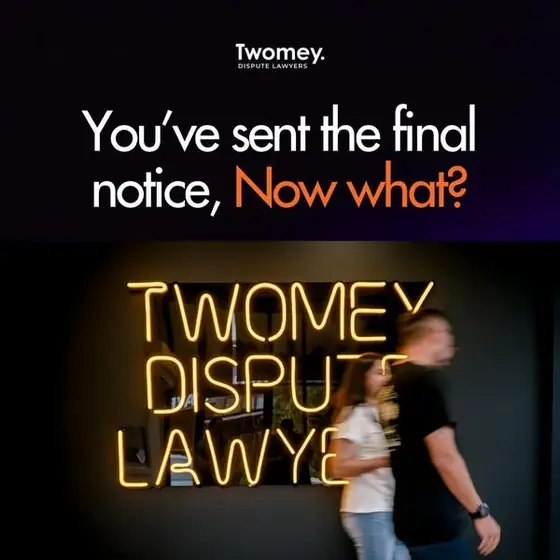

Non-lawyers are moving in. An arbitration centre ("what if a $100,000 legal battle could become a $2,000 arbitration?"), a security of payment service and debt collectors all started ads in the 45 days before our snapshot, selling on price and speed. Firms that don't explain their costs are leaving that argument to them.
A few cautions from the same data. Claims such as "100% success rate", "1000+ five-star reviews", "leading" and "award winning" all need to be accurate and backed up under the conduct rules and the Australian Consumer Law, and the success rate claim is the riskiest line in the set. Ads aimed at people under financial pressure ("Has a creditor applied to wind up your company?") are the most exposed to Meta's rules on personal attributes. Our guide to lawyer advertising rules in Australia covers the detail, and our Meta ads for law firms page explains how we run them.
What does a litigation firm need to compete?
Here is the full benchmark in one table: the typical figure across the 26 firms, what the leaders have, and a sensible target for a state firm or boutique trying to take market share.
| Area | Market typical | The leaders | Target for a challenger firm |
|---|---|---|---|
| Domain Rating | 30 | 60 to 67 (national firms) | 25 to 35 is enough. Rose Litigation leads the market on 20 |
| Visits to litigation pages | About 200 a month | 1,400 to 2,000 (Clayton Utz, Rose, PCL) | 1,000 or more, with at least a third of the site's traffic on litigation pages |
| Service pages | One generic litigation page of about 760 words | A page for each dispute type, and for each city served | One page per dispute type (commercial, debt, building, estate, defamation, contracts), then one per city you can genuinely serve |
| Service page content | 2 or 3 H2s, no table, no named lawyer, no costs | Specific disputes, process, reviews, consultation offer | 1,200 to 2,000 words, a cost and timeline table, a named lawyer, reviews and a date |
| Articles | About 250 on the site, mostly for other lawyers | Explainers on one question (Calderbank, without prejudice, binding contracts) | Two to four a month, each answering a question a client or their accountant types into Google, including what it will cost |
| Article features | Author on 45%, table on 3%, video on 2% | Named author, updated date, a damages or cost table, real cases | All of those plus tables and a real cost range |
| Google reviews (main city listing) | 50 to 150 | 300 to 600 | 150 to 300 genuine reviews, which is enough for a map pack spot in every city studied |
| Social posting | LinkedIn about once a week; 23% about litigation | Boutiques posting about disputes several times a week | Two or three posts a week, built around people, results and real disputes |
| Lawyers posting personally | A handful of the 26 firms, LinkedIn only | Lawyers at small firms with 50,000 to 500,000 plays on TikTok | One lawyer posting real case breakdowns every week, on LinkedIn and short video |
| YouTube | 5 of 17 channels uploading | No one with an audience | Lawyer-fronted explainers on wills, building and contract disputes, cut into Shorts |
| Meta ads | 3 of 26 core firms advertising | Debt and building payment specialists with 20 to 46 live ads | One dispute type, one landing page, five to ten tested ads, refreshed monthly |
The temptation with a table like this is to start on every row at once. The firms pulling ahead in this study each did one thing properly first: Rose Litigation on litigation-only content and its map listings, PCL on city pages, Clayton Utz on explainers, Boss Lawyers on how-to guides, and Twomey on one Meta message about unpaid invoices.
For most litigation boutiques and state firms, the order that makes sense is reviews and the map listing first, then a service page for each dispute type you want more of, then explainer and cost content, then a lawyer on camera, then paid social for the disputes people already feel, such as unpaid invoices, building payment claims and contested wills. We set out how to plan that one channel at a time in how to write a law firm marketing plan, and how much lawyers spend on marketing covers the budget side.
If you'd like to see how your firm compares with these benchmarks, our litigation marketing team can run the same analysis on your site and your competitors in your city, and our commercial law work covers the advisory side of the same clients. Book a call and we'll show you where you stand and which channel to fix first.
About this data. Search, traffic and authority figures are Ahrefs estimates taken between 20 and 22 October 2026. Eight city searches with no Ahrefs data were taken from a live Google search, so Adelaide and Newcastle have no map pack data. Traffic history uses Ahrefs' all-country figure because the Australian history was unavailable. "Litigation pages" are classified by URL and top keyword and are an estimate. Posting rates come from sitemap dates and are indicative. Social figures cover 24 July to 22 October 2026, capped at 30 posts per account. Meta ad counts are live ads on 22 October 2026 and show no spend. Firms and creators are named from public information. Some firms in this study are PixelRush clients and are measured the same way as every other firm. Nothing here is legal advice.
Want us to implement these strategies for you?
Book a free strategy call and let's discuss how we can grow your business.
Book Your Free CallContinue reading
More on Law Firm Marketing
How Do Personal Injury Law Firms Win Online in Australia? (The 2026 Benchmark Guide)
We studied 25 Australian personal injury firms across Google, Maps, their websites, Facebook, Instagram, LinkedIn, TikTok, YouTube and 1,602 live Meta ads. This guide shows how much authority, content and review volume it takes to compete, what the leading firms put on their pages, what they and their lawyers post on social, the ads that have run for over a year, and how it all changes from Sydney to Newcastle.
How Do Criminal Lawyers Get More Clients? (It Comes Down to What a Matter Is Worth)
How Australian criminal lawyers get more paying clients. Why the value of the matter decides which marketing works, what Google Ads clicks really cost, why reviews and the map listing matter so much, how the leading firms do content without stuffing it, the lawyers getting millions of views on social media, and why referrals carry the serious matters.
How Should Law Firms Use Email Marketing? (The Six Emails Worth Sending)
Email rarely wins a law firm a new client on its own, but it decides what happens to the enquiries, past clients and referrers you already have. The six emails worth sending, what to send leads who don't sign, getting reviews and referrals, the Spam Act and privacy rules for Australian firms, what Queensland's injury advertising law means for email, deliverability, tools and what to measure instead of open rates.
How Do You Write a Law Firm Marketing Plan? (Build One System at a Time)
A law firm marketing plan that works is a series of marketing systems, built one at a time. How to work out who your clients are and where they look for help in each practice area, check capacity, set a ceiling per signed client, crack one channel before adding the next, turn each channel into a system that runs without the partners, scale it to compete with top-tier firms, and spot the systems that are costing money without doing their job.