




A prospective client types "do I have a claim if I was partly at fault for a car accident in Queensland" into ChatGPT, or asks Google and reads the AI Overview at the top without scrolling. The answer names two or three sources. If your firm is one of them, you have been recommended by the most trusted referrer the client has. If it is not, the client may never see your name, however well your service page ranks underneath.
This article covers how a law firm gets into those answers. It is written from running a content system for a Melbourne litigation firm whose organic clicks went from 785 to 5,217 a month this year, and whose new enquiries now include a growing number of people who say an AI assistant sent them. The short version is that the same work produces both results, and most of what is sold as "GEO" or "AI optimisation" is ordinary SEO with a new invoice attached. The longer version, including what is actually different for AI, is below.
Key Takeaways
- Every AI answer engine reads a search index first. Google AI Overviews, AI Mode and Gemini use Google's index. ChatGPT uses Bing's plus its own crawl. Claude uses Brave. A page that is not indexed and ranking somewhere cannot be cited anywhere.
- The signals that earn a citation are the same signals that earn a ranking, with three additions: a direct answer in the first sixty words, a named lawyer the engine can verify elsewhere, and crawler access in robots.txt. Most law firm sites fail at least one.
- AI Overviews cut clicks, not demand. Pew Research found users click a result on 8% of searches with an AI summary versus 15% without. The firms that win are cited inside the summary, and the client arrives already sold.
- You can now measure it. Since June 2026 Search Console reports impressions in AI Overviews, AI Mode and Discover AI features at page level. Pair it with a "how did you hear about us" field and a monthly prompt test.
- Use in Australia is mainstream. Roy Morgan puts 13.6 million Australians on AI tools in a four-week period, with ChatGPT at 10.5 million and Gemini at 5 million. AI Mode has been live in Australia since October 2025, the UK since July 2025 and the US since May 2025.
What actually happens when someone asks an AI a legal question
Each of the major engines works the same way at the level that matters to a law firm. The model does not "know" who the best family lawyer in Sydney is. It turns the question into one or more search queries, runs them against a search index, reads the top results, and writes an answer with citations to the pages it relied on.
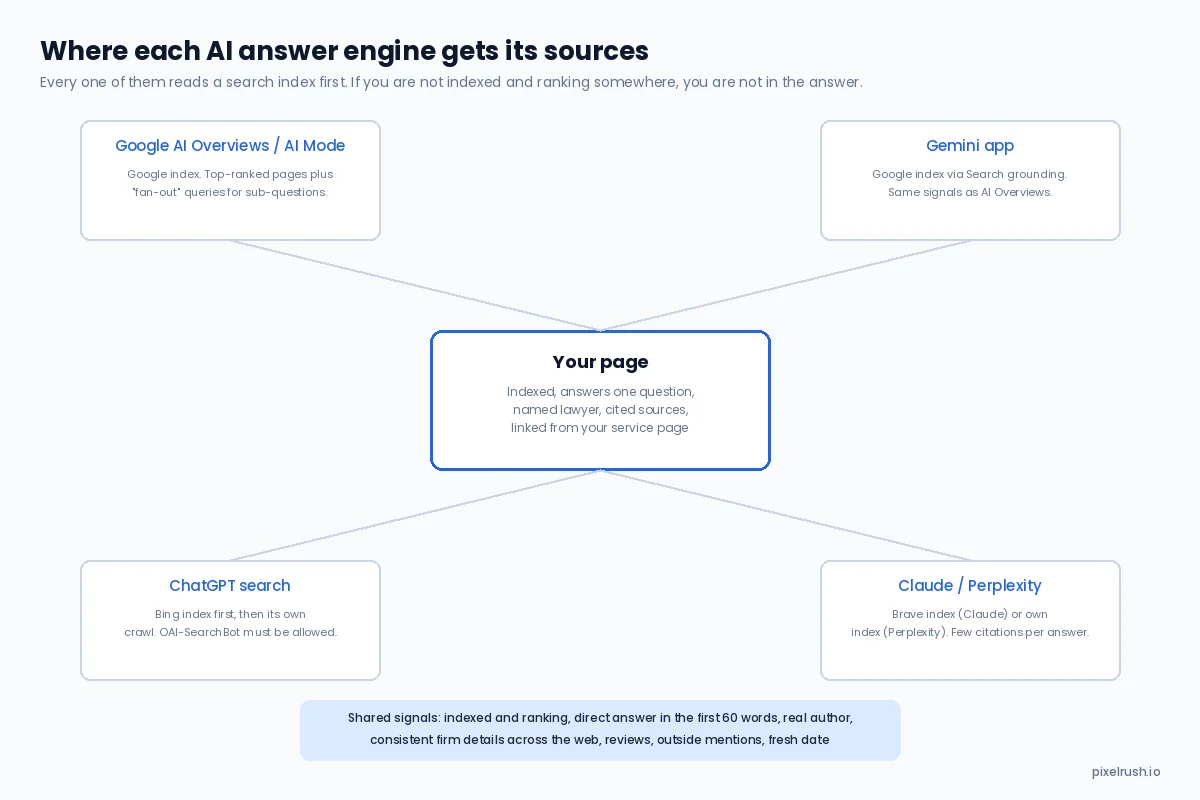
The four engines that matter and where each gets its sources. The page in the middle is the only part you control.
| Engine | Index it reads | How many sources it cites | What that means for you |
|---|---|---|---|
| Google AI Overviews | Google's index, plus "fan-out" searches for sub-questions | Typically 3 to 8, often from pages already on page one | Rank for the question, or for one of the sub-questions it fans out to |
| Google AI Mode | Google's index, with heavier fan-out and longer conversations | Varies, more than AI Overviews | Pages that answer one narrow question cleanly get pulled in for sub-queries |
| Gemini app | Google's index through Search grounding | A handful | Same signals as AI Overviews; a separate set of citations in practice |
| ChatGPT (with search) | Bing's index first, plus OpenAI's own crawl | Usually 2 to 6 | Bing Webmaster Tools matters again, and OAI-SearchBot must not be blocked |
| Claude | Brave Search's index | 2 to 7 | Fewer slots, so the most complete single answer wins |
| Perplexity | Its own index, built by PerplexityBot | 5 to 10 with visible footnotes | The most citation-heavy engine; the best for testing your visibility |
Two consequences follow from this and they settle most of the arguments about AI search.
The first is that a firm with no organic presence has no AI presence. There is no separate door. The litigation firm's pages started being cited by AI assistants in the same months they started ranking, because the engines were reading the same index everyone else was. Our SEO guide for law firms is the foundation this article sits on, and if you are not ranking at all, why your law firm is not ranking comes first.
The second is that the engines read Google's index differently from how Google ranks it. An AI Overview for "how long do I have to make a TPD claim" will often cite a 900-word article from a mid-sized firm over the practice-area page of a national brand that outranks it, because the article answers the question in its first paragraph and the brand page does not. That is the opening for a smaller firm, and it is the part of this that is actually new.
How big a deal is AI search for a law firm right now?
Big enough to plan for and not so big that it replaces anything. The numbers, with sources, because the ones circulating in agency pitches rarely have any.
| What we know | Figure | Source |
|---|---|---|
| Australians using AI tools in a four-week period | 13.6 million, 58% of people 14+ | Roy Morgan, January to March 2026 |
| Of which ChatGPT / Gemini / Copilot / Claude | 10.5m / 5m / 4m / 0.8m | Roy Morgan |
| Click rate on Google results when an AI summary is present vs absent | 8% vs 15% | Pew Research Center, 2025 |
| Fall in click-through for the top-ranking result when an AI Overview appears | About 58% | Ahrefs, 300,000 keywords, late 2025 |
| Share of US consumers who used AI for a local business recommendation | 45%, up from 6% a year earlier | BrightLocal, 2026 |
| Share of those who double-check AI recommendations against reviews | 97% | BrightLocal, 2026 |
| Google AI Mode monthly users | Over one billion | Google I/O, May 2026 |
| Share of overall site traffic still from organic search | Around 43% | SE Ranking, 2026 |
Read together, these say three things. People use AI tools heavily, and in Australia almost half the adult population uses ChatGPT in a given month. When Google shows an AI answer, roughly half the clicks that used to go to the results disappear. And people still verify a lawyer before calling, which is where your reviews and your Google Business Profile do the second half of the job.
What the numbers do not say is that organic search is finished. Organic still delivers the largest single share of traffic to law firm sites we manage, and the AI-referred visitor, where we can attribute one, converts at a higher rate because they arrive having read a summary that named you. The practical position is that AI citations are an addition to the ranking you already need, and a firm that is not ranking has a bigger problem than AI.
Key Point
The question for a law firm in 2026 is not "SEO or AI search". A page either earns a place in the index that all of these engines read, or it does not. The AI-specific work is a layer on top of that, and it is a thin layer.
The eight signals that get a law firm cited
The engines are different products but they are reading for the same things. These are the eight we build into every page in the litigation firm's system, in the order of how much difference each one makes.
1. The page answers one question, and answers it in the first sixty words
An engine assembling an answer wants a sentence it can quote. A page titled "Contesting a Will in Victoria" that opens with three paragraphs about the firm gives it nothing. A page titled "Can I contest a will in Victoria if I was left out?" that opens with "Yes, if you are an eligible person under Part IV of the Administration and Probate Act and you apply within six months of probate" gives it exactly what it needs, and the explanation can follow.
The litigation firm's articles that are cited are the ones built this way: one question, a direct answer, then the detail. The articles written as general overviews rank but are rarely quoted. Our content writing guide covers the structure.
2. A named lawyer with a verifiable footprint
Every substantive page carries the name of the lawyer who practises in that area, with a bio page, a photo, their admission and their experience, marked up with Person schema. The engines cross-check this. A named author who appears on the Law Institute register, in Doyle's Guide, on LinkedIn and in a couple of press mentions is an entity the model can trust; "the team at [firm]" is not.
The firm in our example has the advantage of real brand volume and real awards, and lawyers whose names people search. That is not something an agency can manufacture, and it is a large part of why its content is trusted so quickly. If your firm has these assets and they are not on the page, you are leaving your strongest signal off.
3. Cited sources inside the content
The Princeton study on generative engine optimisation found that adding statistics lifted a page's visibility in AI answers by around 40%, and adding citations to authoritative sources by more than that for lower-ranked pages. For a law firm this is natural: link to the legislation, the court's own guidance, the regulator, the ABS. A page that cites the Act it is explaining looks like an authority to a model in a way a page that paraphrases it does not.
4. Consistent firm details everywhere
Name, address, phone, practice areas and lawyer names, identical across the website, Google Business Profile, the Law Society or Law Institute listing, Doyle's, LinkedIn and the directories. Engines resolve a firm as an entity by matching these; inconsistency breaks the match. Our Google Business Profile guide for lawyers covers the profile side.
5. Reviews, with volume and recency
The BrightLocal finding that 97% of people check AI recommendations against reviews is the reason this is in the top five. The engines also read reviews directly when answering "best X lawyer in Y" prompts, and a firm with 40 reviews at 4.9 beats a firm with 6 at 5.0. Reviews on Google first, then on the legal directories the engines index.
6. Outside mentions
Third-party pages mentioning the firm by name in the context of its practice area: local press, a podcast, a bar association piece, a sponsorship page, an industry body. One analysis of Gemini citations found that around 90% went to third-party editorial content rather than firm-owned pages, which means that for "who is a good X lawyer" prompts the engine is often quoting someone else talking about you. The link building guide for law firms covers how to earn these without buying them.
7. Structure a model can parse
Question headings, short paragraphs, tables for anything comparative, numbered steps for anything procedural, a defined term where the law uses one. This is the same formatting that makes a page readable on a phone, and it is why tables appear in every article we publish. Schema on top: Article with an author, Person for the lawyer, LegalService and LocalBusiness for the firm. Schema does not get you cited on its own, and it helps the engine confirm what it has read.
8. Freshness that is real
A visible "last updated" date, a dateModified in the schema, and content that actually changed. Ahrefs found AI-cited pages skew newer than the standard results for the same query. Legal content has a natural reason to update: thresholds, limitation periods, fee scales and case law move every year. A page refreshed with the current figure and the current date beats an identical page from 2023.
The robots.txt mistake that removes you from ChatGPT
This one is worth its own section because it is silent, common and takes five minutes to fix.
When AI crawlers first appeared, a lot of developers and some SEO agencies added blanket blocks to robots.txt to keep sites out of model training. That is a legitimate choice. The problem is that the search crawlers were blocked along with the training crawlers, and the search crawlers are the ones that fetch your page to cite it.
| Company | Crawler | What it does | Block it? |
|---|---|---|---|
| OpenAI | GPTBot | Collects pages for model training | Your call |
| OpenAI | OAI-SearchBot | Indexes pages for ChatGPT search results | No, if you want to be cited |
| OpenAI | ChatGPT-User | Fetches a page when a user asks ChatGPT to read it | No |
| Anthropic | ClaudeBot | Training | Your call |
| Anthropic | Claude-SearchBot, Claude-User | Search index and live fetches for Claude | No |
| Perplexity | PerplexityBot, Perplexity-User | Index and live fetches | No |
| Google-Extended | A control for Gemini training and Vertex AI; does not affect Search, AI Overviews or AI Mode | Your call, and it changes nothing for AI Overviews | |
| Googlebot | Search, AI Overviews, AI Mode | Never |
Check your robots.txt now. If it contains User-agent: * followed by Disallow: / under a block meant for AI, or lists OAI-SearchBot or Claude-SearchBot as disallowed, you have opted out of being cited in ChatGPT and Claude. We find this on roughly one law firm site in ten, usually with nobody at the firm aware it was done. A firewall that challenges unknown bots (common on managed WordPress hosting) can have the same effect without a line in robots.txt; the test is to request a page as OAI-SearchBot and see what comes back.
Expert Tip
Blocking GPTBot for training and allowing OAI-SearchBot for search is a reasonable position for a law firm that is cautious about its content being used to train models. Blocking both is a decision to be invisible in ChatGPT.
What is different in Australia, the US and the UK
The engines are global and the mechanics above apply everywhere. The differences are in rollout, regulation and what the engines cite.
| Australia | United States | United Kingdom | |
|---|---|---|---|
| AI Overviews live since | Late 2024 | May 2024 | August 2024 |
| AI Mode live since | October 2025 | May 2025 | July 2025 |
| Search Console AI performance data | Yes, from mid 2026 | Yes | Yes, first market to get it |
| Lawyer directories engines lean on for "best lawyer" prompts | Doyle's Guide, Law Society / Law Institute registers, Google reviews | Avvo, Justia, Super Lawyers, Martindale, state bar lookups | Legal 500, Chambers, SRA register, Law Society Find a Solicitor |
| Advertising rules that touch AI-cited content | State rules on personal injury advertising, strictest in Queensland and NSW | State bar advertising rules, testimonials and "specialist" claims regulated | SRA Transparency Rules, price information mandatory for some services |
| Ads inside AI answers | Not yet | Limited tests in AI Mode and AI Overviews | Not yet |
The Australian point that matters most is the personal injury advertising rules. An AI Overview quoting your page about compensation amounts is republishing your content; the content has to comply in the first place, and ours does because we write to the rule rather than around it. Our piece on whether personal injury lawyers can advertise in Queensland covers the boundaries.
For UK firms, the SRA's price transparency requirement means pages for conveyancing, probate and some other services carry mandatory pricing information; those pages are, in our testing, cited heavily for "how much does X cost" prompts precisely because they contain a concrete figure. For US firms, the directory layer is deeper and the engines lean on it more for "best lawyer" prompts, so the Avvo and Justia profiles need the same attention as the website.
How to measure whether it is working
Until this year, the honest answer was "ask every new client how they found you". That still matters, and there is now data to put beside it.
| Measure | Where | What it tells you | Limits |
|---|---|---|---|
| Impressions in AI Overviews, AI Mode and Discover AI | Search Console, Performance report, AI features filter (rolled out from June 2026) | Which pages are appearing inside Google's AI answers, by country and device | Impressions only: no clicks, no queries, no position, and no data before 18 May 2026 |
| Referral traffic from chatgpt.com, perplexity.ai, gemini.google.com, claude.ai | GA4, Traffic acquisition, filter by source | Visits that came through a citation link | ChatGPT and Gemini strip or vary the referrer, so this undercounts |
| "How did you hear about us" | Your enquiry form and intake script, as a free-text or dropdown field | The number that matters: enquiries that credit an AI assistant | Depends on intake actually asking |
| Monthly prompt test | A fixed list of 20 to 30 real client questions run in ChatGPT, Gemini, Perplexity and Google AI Mode | Whether and where you are cited, and who is cited instead | Manual; answers vary by session and location, so run from the client's city |
| AI visibility tools | Ahrefs Brand Radar, Semrush AI toolkit and others | Share of answers across prompts at scale | Paid, and their prompt sets are not your clients' questions |
The litigation firm runs the prompt test monthly against a question list built from Search Console and from the enquiries its lawyers field. The firms cited beside it are, nearly always, the firms with the next-best question articles rather than the firms with the biggest brand, which is consistent with everything above.
Pro Tip
Add the AI features filter in Search Console to your monthly report now, even though it is impressions only. Six months from now you will want the trend line, and Google is not backfilling the data.
What the "GEO" pitch gets wrong
A new discipline has produced a new set of invoices. Some of the advice is sound and some of it is a way of charging for ordinary SEO twice. The claims we would push back on:
| The claim | What is actually true |
|---|---|
| "GEO is a separate strategy from SEO" | The engines read search indexes. The content that ranks is the content that gets cited. The AI-specific layer is the eight signals above, which are a formatting and authorship standard, not a separate programme. |
| "Add an llms.txt file" | Almost no AI crawler requests it, none of the major engines has said it uses it, and server logs across the sites we manage show the same. It does no harm and it does nothing. |
| "Submit your site to ChatGPT" | There is no submission. ChatGPT reads Bing's index and its own crawl. Verify the site in Bing Webmaster Tools, submit the sitemap there, and allow OAI-SearchBot. |
| "Write FAQ sections on every page for AI" | Engines cite the page that answers the question best, not the page with the most questions. A page of ten shallow FAQs loses to a page that answers one question properly. We stopped adding FAQ blocks for this reason. |
| "Keyword density for AI" | Models work on meaning, not repetition. Writing the question in the words a client uses matters; repeating it does not. |
| "AI search makes links irrelevant" | Outside mentions are one of the strongest citation signals, and for "best lawyer" prompts they are most of it. What changed is that the mention matters more than the hyperlink. |
The honest version of GEO is a checklist, and most of it was already on the SEO checklist. Where a firm is paying separately for it, the question to ask is which of the eight signals the work actually changes.
The 90-day plan
This assumes the firm already has a site that is indexed and some content that ranks. If it does not, the first ninety days belong to the SEO guide and to how long SEO takes for a law firm.
The firm in our example did not do this as a 90-day project. It did it as the standing way the site is run, with articles going out weekly, each reviewed by the responsible lawyer, each linked into its hub, and the measurement in the monthly report. The AI citations arrived as a by-product of that work rather than as a separate project. Our article on how law firms are using AI in marketing covers the production side, including what to systemise and what has to stay with the lawyers.
What to expect, and when
AI citations lag rankings by a few weeks, because the engines are reading an index that has to pick the page up first. On the litigation firm's timeline, pages that reached the top five for their question were being cited in AI Overviews and Perplexity within the following month, and in ChatGPT somewhat later, since Bing's index moves more slowly than Google's for a mid-sized Australian site.
The leads follow the citations, and they are a different kind of lead. Someone who read an AI answer that named you and quoted your explanation of their problem arrives knowing what you do and trusting that you know it. The first call is shorter and the conversion rate is higher. That is the business case, and it is the same business case as ranking, made stronger because fewer firms are in the answer than on the page.
If you want to know where your firm stands today, book a call and we will run the baseline prompt test and the Search Console check with you. We do this for personal injury, family, litigation and commercial firms in Brisbane, Sydney, Melbourne and Perth, and for firms in the US and UK.
Want us to implement these strategies for you?
Book a free strategy call and let's discuss how we can grow your business.
Book Your Free CallContinue reading
More on Law Firm Marketing
How Do You Market a Family Law Firm? What Worked Across $1.5 Million of Family Law Campaigns
Family law has its own marketing economics: urgent but not instant, high legal aid noise, matter values from $3,000 to $300,000 and a client who is researching at midnight. What we have learned running Google Ads, Meta and SEO for family law firms from Townsville to New Zealand, with the cost per lead from each account.
How Do Google Ads Work for Law Firms? The Complete Guide From $7 Million of Managed Spend
What happens between a search and a signed matter, with the real cost at each stage from accounts we run. Campaign structure, the budget maths done backwards from the fee, the tracking that lets Google find clients rather than form fills, the junk lead problem, landing pages, compliance in AU, US and UK, and what the first year looks like.
How Long Does SEO Take to Work for a Law Firm? A Week-by-Week Answer From a Real Account
The honest timeline for law firm SEO, from the weekly Search Console data of a litigation firm that went from 24 clicks a week to over 1,500 in six months, what you should see at each month, what makes it faster or slower, and when to call it.
SEO for Law Firms: 12 Strategies That Took a Litigation Firm From 785 to 5,200 Clicks a Month
How we structure, write and link a law firm website so it ranks, from the system that grew a litigation firm's search clicks 6.6x in five months with no link building, plus the PR and partnership work that builds links for firms that need them.