




Type "personal injury lawyer" into Google from any Australian capital and page one belongs to three or four national brands, two directories and the ads. The same search in Houston or Manchester returns the same shape with different names. A click on the ads costs $33 on average in Australia and $63 to $81 for the "no win no fee" phrases; in a US metro it is $100 to $300. Every injury firm that has looked at those numbers has asked whether SEO is the way around them.
It is, with conditions. The firms on page one did not get there with a blog and a services menu. They have hundreds of pages, named lawyers on every one, state-by-state structures that match how compensation schemes actually work, and years of compounding. This article is how a mid-sized firm competes with that, drawn from building SEO systems for law firms, from the current rebuild of a Brisbane compensation firm's site, and from the Google Ads accounts that tell us what injured people search and what each claim type is worth. Our earlier piece on whether SEO is worth it for personal injury firms covers the decision; this one covers the work.
Key Takeaways
- Page one for the head terms is held by national brands and directories with hundreds to thousands of pages. A 20-page site cannot compete for "personal injury lawyer Brisbane", and should not try first. It competes for the hundreds of questions underneath, then the claim-type terms, then the head terms.
- Structure the site by claim type and by state, because that is how the law works and how people search. Motor accident, workers compensation, TPD, medical negligence, public liability and dust disease are separate schemes with separate questions, and most of them are state based.
- Injured people search weeks after the injury, with a problem that has persisted. "What to do at the accident scene" is a wasted article. "Can I claim if the accident was partly my fault" is the search that converts.
- Advertising rules shape the pages. In Queensland the firm we are rebuilding cannot use the word "injury" on its site at all, and still has to rank for it. Every state and every country has a version of this and the content has to be written inside it.
- Expect a longer curve than other practice areas. A litigation specialist we work with went from 785 to 5,217 clicks a month in six months; an injury firm in a capital city should plan on nine to eighteen months to the same stage, because the competition is a different order of magnitude.
Who holds page one, and why
Before planning anything, look at who you are up against. The pattern is the same in every market we have audited.
| Market | Who holds the head terms | What they have that you do not |
|---|---|---|
| Australia (capital cities) | Three to four national injury brands with nine-figure revenue, Doyle's Guide, Law Society directories, Google's own map pack | Hundreds of claim-type and location pages, decades of domain age, thousands of referring domains, television brand search |
| United States (major metros) | FindLaw, Justia, Avvo, Super Lawyers, then the billboard firms | Rankings.io's study of 112,000 injury SERPs: directories dominate, domain rating above 75 gets a disproportionate benefit, the average top-ranking page runs about 3,000 words, and one in four page-one results has no page-level links at all because the domain carries it |
| United Kingdom | Claims management companies, the national firms, Legal 500 and Law Society Find a Solicitor | The same shape, with the claims management layer added since the 2013 referral fee ban moved acquisition online |
Three things follow. The head term is a year-two or year-three goal, not a starting point. Treat the directories as places to be listed rather than competitors to beat; they outrank you and they send referrals. And the national brands are weakest on the long tail: their claim-type pages are templated, their question content is thin, and a well-written answer to a specific question from a firm with a named lawyer beats them on that question within months. That is the opening, and it is where every injury firm we have taken from nothing has started.
Why personal injury SEO is different from other practice areas
The general SEO system for law firms applies. Four things about injury work change how it is applied.
| Difference | What it means for the site |
|---|---|
| The client searches late, not at the scene | The searchable moment is weeks or months after the injury: the insurer has rejected something, the employer has stopped paying, the pain has not gone. Content pitched at the day of the accident gets no traffic and the wrong readers |
| The law is scheme based and state based | A TAC claim, a CTP claim and a workers compensation claim are different systems with different limitation periods, thresholds and words. One "personal injury" page cannot answer any of them, and a Queensland answer is wrong in Victoria |
| Advertising is regulated more tightly than any other practice area | Queensland's PIPA, NSW's restrictions, US state bar rules on results and testimonials, the UK's referral fee ban. The content has to be compliant before it is optimised |
| The competition is national and well funded | The spend behind the brands means you cannot out-publish them on head terms; you can out-answer them on specifics |
The second row is the one most agencies miss. They build a site with a "personal injury" page and a "compensation" page and wonder why nothing ranks. The claimant does not search "personal injury"; they search "how long do I have to make a TAC claim" or "can I claim workers comp if I was casual". The site has to be built the way the law is organised.
The site structure that ranks
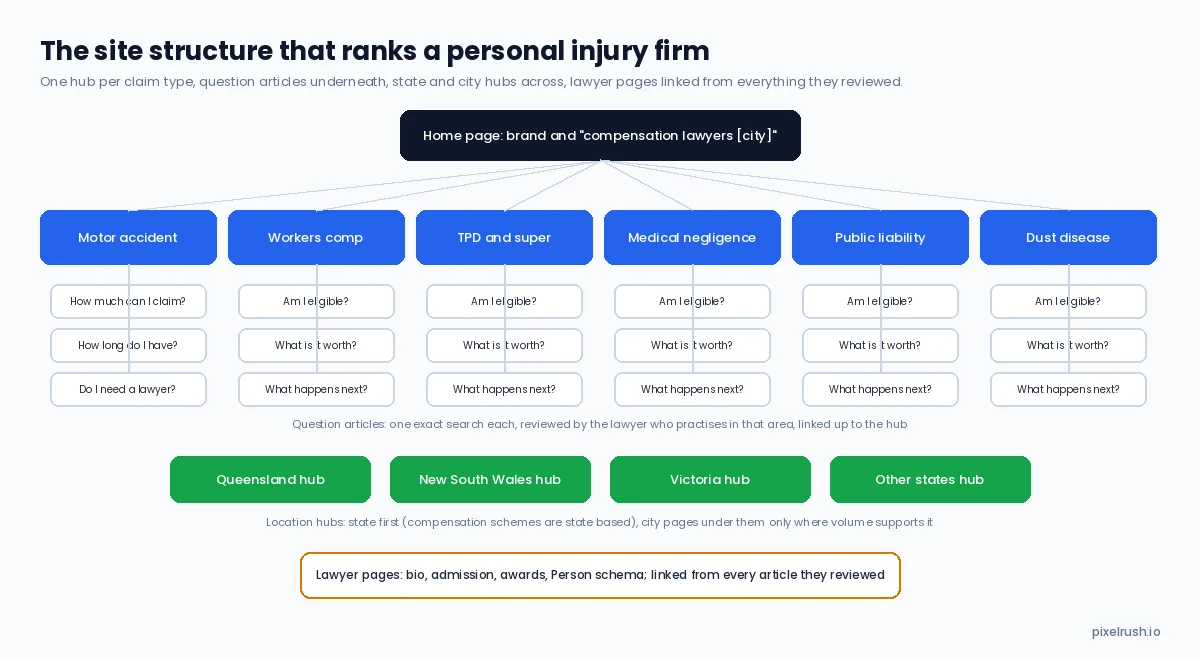
One hub per claim type, question articles underneath, state hubs across, lawyer pages linked from everything. This is the structure we are building for a Brisbane compensation firm now: two pillars, nine service pages, and 408 question topics planned under them.
The home page carries the brand and the city term it already ranks for, and nothing else; moving an established firm's home page off the term Google already associates it with is a rankings hit for no gain. Each claim type gets a hub page that answers the questions a claimant has before they call, in plain language, with the lawyer who runs that work named on it. Under each hub, a cluster of articles that each answer one exact search. Across the site, a hub per state, because the schemes are state based and a claimant in Perth needs the Western Australian answer. Lawyer pages with bio, admission, awards and Person schema, linked from every article that lawyer reviewed.
| Page type | How many | What it ranks for | Who writes it |
|---|---|---|---|
| Home | 1 | Brand, "[compensation] lawyers [city]" | The firm, with us |
| Claim-type hubs | 6 to 9 | "[claim type] lawyer", "[claim type] claim", the top questions | Written for the search, reviewed by the practice lead |
| Question articles | 40 to 70 per hub over a year | One exact question each | Written to the question, reviewed by the lawyer who does that work |
| State hubs | One per state served | "[claim type] lawyer [state]", scheme-specific terms | Built once, maintained when the scheme changes |
| City pages | Only where volume supports them | "[claim type] lawyer [city]" | Under the state hub, never standalone |
| Lawyer pages | One per lawyer | Their name, which has search volume once the articles carry it | The lawyer |
The firm in Brisbane has an extra constraint that makes the point about structure better than any theory: under Queensland's personal injuries legislation, as the firm and its advisers read it, the word "injury" does not appear on the site at all. The home page targets "compensation lawyers Brisbane", the hubs are named for the claim type and the scheme, and the question articles rank for injury searches by answering injury questions without the word. It costs some search volume. It is also a demonstration that the structure, the questions and the authority signals do the ranking, and that a site can carry a compliance constraint most agencies would call fatal.
The questions injured people actually search
The question list for a claim-type hub comes from Search Console, from the firm's enquiry forms and from the lawyers' first conversations with clients, in that order. It never comes from a keyword tool, because the keyword tool returns "personal injury lawyer" variants and the claimant does not type those until the end. The list below is a sample of the kind of question that ranks and converts, by claim type, with the Australian search demand where we have it.
| Claim type | Monthly AU demand (head term) | Question articles that convert | Why they convert |
|---|---|---|---|
| Workers compensation | "workers compensation lawyer" about 4,600 | Can I claim if I was casual? What if my employer disputes it? How much is a permanent impairment payout? Can I be sacked while on workers comp? | The employer or insurer has done something; the worker needs to know their position tonight |
| Motor accident (CTP, TAC, MAIB) | "tac claim" about 1,700 | Can I claim if the accident was partly my fault? How long do I have to lodge? What is a minor injury under the NSW scheme? Do I need a lawyer for a CTP claim? | The insurer has made an offer or a decision; the claimant is checking whether it is right |
| TPD and superannuation | "tpd claim" about 2,100 | What is TPD? Can I claim TPD if I am still working? How much does a TPD claim pay? Does a TPD payout affect Centrelink? | 13.4 million Australians hold TPD cover through super and almost none know; the search is the first discovery |
| Medical negligence | Lower, high value | How do I know if it was negligence? How long do I have to sue a hospital? What is a medical negligence claim worth in Australia? | Research-stage, months long, high matter value |
| Public liability | Lower | Can I sue if I slipped in a shopping centre? Who is liable if I was injured at a rental? | The claimant does not know it is a claim type until they read it |
| Dust disease and asbestos | Low volume, very high value, national | What is silicosis compensation? Can I claim for asbestos exposure decades ago? | A diagnosis has just been made; the search is urgent and national |
Two rules from the table. First, every question is asked at a moment someone would actually type it, after a problem has persisted; "what to photograph at the scene" is not on the list because nobody searches it at the scene and at that point they may not know they have a claim. Second, the articles are written for prospects in the stages before they engage a lawyer, which keeps the firm on the right side of the touting and case-farming rules in every state. Our content writing guide for law firms covers how each one is built.
The advertising rules that shape every page
No other practice area has this layer. The content has to be compliant first and optimised second, and the rules differ enough by jurisdiction that a US template cannot be used in Australia.
| Australia | United States | United Kingdom | |
|---|---|---|---|
| The rule set | Queensland's PIPA is the strictest: no TV, radio or cinema advertising; third-party ads limited to name, contact details and areas of law; own website may explain rights and conditions. NSW restricts advertising of personal injury services similarly. Other states apply the general Legal Profession rules | State bar rules under the ABA Model Rules: results and testimonials restricted or require disclaimers in many states; solicitation rules | SRA rules; the 2013 ban on referral fees in personal injury; claims management regulation |
| What it does to SEO content | Content must inform rather than solicit; one firm chooses not to use the word "injury" at all; "no win no fee" is allowed on your own site but not in third-party ads | Case results pages are a ranking asset in some states and a compliance risk in others; attorney review of every page | Pricing transparency on some services; referral and lead-gen arrangements affect what can be published |
| The practical approach | Write to the rule from the first draft. A lawyer reviews every page before publication. Keep the lawyer's name on it | Same, with the strictest state the firm advertises in setting the standard | Same, with SRA Transparency Rules built into the service pages |
Our article on whether personal injury lawyers can advertise in Queensland goes through PIPA in detail, including the TPD position, which arises under an insurance contract rather than as a personal injury claim and so sits outside the regime; that is the reason Queensland firms lean on it.
Local: the map pack and the state hubs
For "compensation lawyer near me" and the city terms, the map pack appears above the organic results and takes a large share of calls. The Google Business Profile is a page in its own right: category, services, hours, the lawyers' photos, and reviews with volume and recency. An injury firm with 80 reviews at 5.0 wins the pack over a national brand's suburban office with 12. Our Google Business Profile guide for lawyers covers the setup; the reviews come from a request built into the matter, at resolution rather than at the end.
The state hub model matters more in injury than anywhere else because the schemes are state based. A firm with offices in Brisbane, Sydney and Melbourne needs a Queensland hub, a New South Wales hub and a Victorian hub, each answering the claim-type questions under that state's law, before it needs a page for every suburb. City pages go under the state hub only where the search volume supports a separate page; a Queensland firm does not need "Toowoomba" named in every article, only where people in Toowoomba are searching.
Authority: what makes Google and the AI engines trust an injury firm
In a practice area this contested, the authority signals decide which of two equally good answers ranks. The ones that matter, in order:
How long it takes, and what the curve looks like
The honest comparison is with the litigation specialist whose site we run: 785 to 5,217 Search Console clicks a month in six months, with the week-by-week numbers in how long SEO takes for a law firm. That firm started with a brand, awards, named lawyers with search volume and a clean site, in a practice area far less contested than injury. An injury firm in a capital city, starting with a thin site, should expect the same shape over a longer period.
| Stage | Litigation specialist (actual) | Injury firm, capital city (plan for) | What is happening |
|---|---|---|---|
| Impressions rising on question queries | Week 1 to 4 | Month 1 to 3 | Hubs and first clusters indexed; Google testing the pages |
| First articles in positions 1 to 3 | Week 8 | Month 3 to 5 | Specific questions won against thin brand content |
| Clicks compounding | Month 3 to 4 | Month 5 to 9 | Older articles maturing while new ones publish |
| Claim-type hub pages on page one | Month 5 to 6 | Month 9 to 15 | The body of question content lifting the hub |
| City and head terms within reach | Month 9 to 12 | Month 15 to 24 | Domain trusted for the topic; still behind the national brands on the broadest terms |
The variables that move an injury firm along that line faster are the ones in the general guide: existing brand search, named lawyers, review turnaround in days, and volume. Forty to seventy articles a month in the first quarter produced the litigation curve; two a month produces a flat line in injury, where the competition publishes constantly.
SEO and Google Ads together for an injury firm
The question behind "how does SEO work" is usually "can we stop paying $400 an enquiry". The answer is eventually, and not by switching one off for the other.
| Google Ads for injury | SEO for injury | |
|---|---|---|
| Cost per click | $33 average in Australia; $63 to $81 on "no win no fee" phrases; $55 to $60 on TAC terms; $100 to $300 in US metros | Nil per click; the cost is content, review time and the system |
| Cost per enquiry | About $400 on our personal injury search account; $18 to $254 on Meta by claim type | Falls every month the content compounds; by month twelve typically a fraction of paid |
| Time to first enquiry | Week one | Month three to five |
| What it is good at | Capturing the person searching "TAC lawyer" today; new markets; claim types the site does not rank for yet | The long tail of questions, the map pack, the claim-type hubs, AI citations, and the authority that makes the ads convert better |
| Compliance | Ad copy restricted by PIPA and state rules; Performance Max can quietly serve non-compliant placements | Own-site content, where the rules allow more |
Our Google Ads guide for personal injury firms in Australia covers the paid side, and personal injury marketing by claim type has the cost per signed client for each scheme. The firms that run both let the mix shift: paid carries the first year, organic takes over the questions and the hubs, and the paid budget moves to what organic cannot reach.
What to do this quarter
If you want us to map this against your firm's site, book a call and bring Search Console. We run SEO and paid for personal injury firms in Brisbane, Sydney, Melbourne, Perth and Adelaide, and for injury firms in the United States and the United Kingdom.
Want us to implement these strategies for you?
Book a free strategy call and let's discuss how we can grow your business.
Book Your Free CallContinue reading
More on Law Firm Marketing
What Do the Best Personal Injury Law Firm Websites Do Differently? Ten Sites Scored Above the Fold
Ten injury firm home pages from Australia, the US and UK, screenshotted on the same day and scored on the ten things that decide whether an injured person calls. The US firms put the form in the hero; the Australian national brands gate the page behind a state picker; the boutiques win on the specifics. What to copy and what to avoid.
Can Law Firms Advertise on ChatGPT? What OpenAI Allows, What It Costs and Who Can Use It
OpenAI reversed its ban on legal services ads on 31 August 2026. US-licensed lawyers can now advertise inside ChatGPT to Free and Go users; Australian and UK firms cannot yet. What the policy says, how the ads work, what the early bids look like, the personal injury complication, and what a firm in each market should do now.
How Do Personal Injury Firms Improve Intake? Speed to Lead, Screening and the Script, From the Trackers
The lead trackers behind our injury accounts show where enquiries die: half of first calls go to voicemail, the enquiry that is not reached in 48 hours has spoken to another firm, and one principal doubled her sign rate by taking the calls back. The cadence, the 60-second screening script by claim type, after-hours cover, and the numbers to track.
How Do You Market a Family Law Firm? What Worked Across $1.5 Million of Family Law Campaigns
Family law has its own marketing economics: urgent but not instant, high legal aid noise, matter values from $3,000 to $300,000 and a client who is researching at midnight. What we have learned running Google Ads, Meta and SEO for family law firms from Townsville to New Zealand, with the cost per lead from each account.