




A family law firm's marketing problem is not finding people who need a family lawyer. Separation is one of the most searched legal events in the country and the demand never stops. The problem is that most of the people searching cannot pay, are not ready, or are looking for the wrong thing, and the firm pays for every one of them who calls.
We have run family law campaigns for a national firm that grew from 20 to 42 lawyers on $1.25 million of Google Ads, for boutiques in Townsville and the Sunshine Coast, for a Sydney practice drowning in legal aid enquiries, and for a firm in New Zealand. This article is what those accounts have in common, what the numbers were, and the order in which a family law firm should spend its money depending on its size. Where a figure is from a specific account, the case study is linked.
Key Takeaways
- Family law leads cost $40 to $137 each on Google Ads across our accounts, and $55 to $78 on Meta. The spread within one channel is wider than the spread between channels, and it is explained by the landing page, the lead screening and the market, not by bidding.
- Legal aid screening is the single biggest lever on lead quality. Half or more of raw family law enquiries in some markets are people who need Legal Aid or a community legal centre. Negative keywords, form questions and ad copy that states fees remove most of them before they cost a phone call.
- The landing page is worth more than the budget. CK Family Lawyers' custom pages converted at 9.7%; the same traffic to the firm's website converted at a fraction of that. Melbourne Family Lawyers' leads rose 575% in month one with no increase in spend.
- SEO is the long game that wins. Dorter went from 995 to 1,873 ranking keywords on 144 articles; the national firm published 477. The firms that dominate a city in family law have hundreds of pages answering the questions separating people ask.
- Speed to lead decides who signs. A separating spouse calls two or three firms. The one that answers, and books a first appointment on the call, gets the matter.
Why family law marketing is different from other practice areas
Three things about family law change the maths relative to personal injury or commercial work.
| Factor | Personal injury | Commercial | Family law |
|---|---|---|---|
| Who pays | No win no fee, the firm carries the cost | The business, on invoice | The client, personally, often while their finances are being divided |
| Matter value range | $20,000 to $500,000+ | $5,000 to $100,000+ | $3,000 for a consent order to $300,000+ for a contested property and parenting matter |
| Time from search to instruction | Days, often same day | Weeks | Hours to months; many research for weeks before calling anyone |
| Share of searchers who cannot pay | Low, cost is not the barrier | Low | High; legal aid and self-represented litigants are a large part of the search volume |
| Emotional state of the enquirer | Injured, worried | Rational, comparing | Frightened, angry or grieving, often at night |
| Repeat and referral | Rare | Common | Common; every client knows someone separating |
The first and fourth rows drive the advertising economics. In personal injury the firm's problem is finding the qualifying injury; in family law the firm's problem is finding the person who can and will pay for private representation among a crowd who cannot. Every system below is a filter for that.
The fifth row drives the creative. Most people searching "how does child custody work" are doing it at 11pm, on a phone, after an argument. The page they land on needs to answer the question they typed, in plain language, and offer a next step that does not feel like a commitment. "Book a free 15 minute call" outperforms "Contact us" by a wide margin in every family law account we have run.
What family law leads actually cost
Figures from our own accounts, because the published benchmarks are mostly US numbers that do not travel.
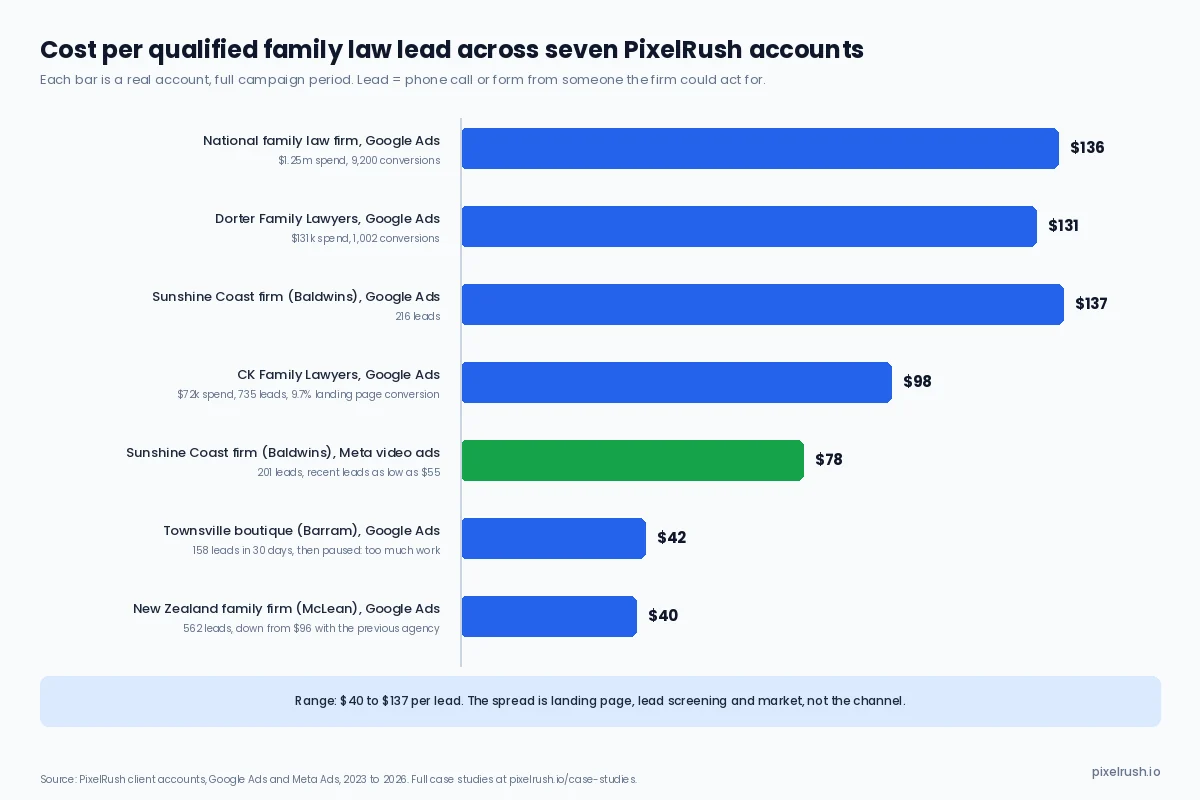
Cost per qualified lead across seven family law accounts. The two cheapest are a regional Queensland boutique and a New Zealand firm, both in markets where few competitors advertise well.
| Account | Channel | Spend | Leads | Cost per lead | What drove the number |
|---|---|---|---|---|---|
| National family law firm | Google Ads | $1.25m | 9,200 conversions, 2,632 calls | $136 | Multi-state, competing in every capital city at once; scaled to support hiring 22 lawyers |
| Dorter Family Lawyers | Google Ads | $131k | 1,002 | $131 | Heavy legal aid filtering; the account was rebuilt around paying clients |
| Baldwins Family Lawyers | Google Ads | 216 | $137 | 5,000+ negative keywords; fixed-fee messaging in ads | |
| CK Family Lawyers | Google Ads | $72k | 735 | $98 | Custom landing pages at 9.7% conversion; conversions weighted by matter value |
| Baldwins Family Lawyers | Meta video ads | 201 | $78, recent leads $55 | Principal on camera, pre-qualifying creative, three screening questions on the form | |
| Barram Family Law | Google Ads | $6.7k | 158 in 30 days | $42 | Townsville, a new site built to convert, campaign paused because the firm could not take more work |
| McLean Law | Google Ads | Five figures | 562 | $40, down from $96 | New Zealand, less competition, "smart" campaigns replaced with proper search campaigns |
What the table says, read as one dataset: a capital-city family law firm competing properly should budget around $100 to $140 per qualified Google Ads lead, a regional firm can expect well under that, and Meta with the right creative comes in lower still but with a different quality profile. Our piece on how much a family law firm should spend on Google Ads turns these into budget tiers and a reverse-engineered budget from the firm's own capacity.
The number the firm should care about more than cost per lead is cost per signed matter, and that depends on the next two sections.
The legal aid problem, and the three places to fix it
Dorter came to us with an account that was generating enquiries at a reasonable cost, most of which were from people who needed Legal Aid NSW, a community legal centre or a duty lawyer. The firm's receptionist was spending hours a week explaining that the firm did not do legal aid work. The account was not broken; it was unscreened.
Family law has more of this than any other practice area because the people with the least money are often in the most urgent situations, and Google does not distinguish "family lawyer" typed by a partner in a $2 million property pool from the same words typed by someone who needs a protection order tonight. Three fixes, in the order they pay off.
The firms that skip step three and judge the campaign on raw lead count always conclude that advertising does not work for family law. It works; it needs a filter.
Key Point
In family law, a lead is not an enquiry. A lead is a person who needs private representation, has a matter the firm acts in, and can pay. Build every campaign and every report around that definition and the numbers become comparable.
The landing page is the budget multiplier
Two accounts make the point.
Melbourne Family Lawyers, a large firm in a capital city, had run Google Ads with several agencies and was close to switching them off for good. Traffic was being sent to text-heavy website pages. We built dedicated landing pages, set up proper tracking and rebuilt the campaigns. Leads rose 575% in the first month and cost per lead fell 52%, and the conversion rate rose 208%. The spend was scaled 224% afterwards because the economics now supported it. The firm later rebuilt its website in the landing page's image.
CK Family Lawyers were working with multiple agencies and sending paid traffic to a website that did not convert. Custom landing pages took the conversion rate to 9.71% on the same traffic, and 735 qualified leads came in at $97.51 each.
What a family law landing page that converts has on it, in order from the top:
| Element | Why it matters in family law specifically |
|---|---|
| A headline that names the matter type and the city ("Property settlement lawyers, Brisbane") | The visitor searched for exactly this; a generic "Family lawyers" headline makes them check they are in the right place |
| A free or fixed-fee first step, with the price if fixed | Removes the fear of an open-ended bill, the main reason separating people delay calling |
| Phone number and a short form above the fold on mobile | Most family law traffic is mobile, outside business hours |
| Three to five reviews, above the fold | A frightened person wants to know other people in their situation were looked after; moving testimonials below the fold measurably reduces conversion in our tests |
| The lawyers' faces and names | The visitor is about to tell a stranger the worst year of their life; they want to see who |
| Plain-language answers to the three questions this matter type always raises | "How long does it take", "what will it cost", "will I have to go to court" |
| What happens after they enquire, step by step | Reduces the perceived commitment of the first call |
Our guide to improving website conversion rate covers the testing behind these, including the testimonial placement finding.
Google Ads for family law: the structure that works
Every family law account we run has the same four campaign types. The split between them changes with the firm.
| Campaign | What it targets | Role | Typical share of spend |
|---|---|---|---|
| Brand | The firm's name and the lawyers' names | Stops competitors buying your name; cheapest conversions in the account | 5 to 10% |
| Service | "Property settlement lawyer", "child custody lawyer", "divorce lawyer", "binding financial agreement" plus city | The core; matched to a landing page per service | 50 to 60% |
| Location | "Family lawyer Mitcham", "family lawyer Chermside" and every suburb the firm serves, with the suburb inserted into the page | High-intent, low-competition, converts well because the page matches the search exactly | 20 to 30% |
| Question | "How is property divided in a divorce", "can I move interstate with my child" | Lower intent, cheaper clicks, feeds remarketing and the SEO content; run only when the service campaigns are saturated | 5 to 15% |
Two practices make the structure work. Conversion tracking that records phone calls, forms and, where the firm will share it, which enquiries became consultations and matters. CK's account optimises to matter value rather than lead count, so the algorithm learns to find the property settlement enquiry over the consent order. And a monthly search term review that feeds the negative list; family law search terms drift constantly and the legal aid variants multiply.
The reporting standard we hold ourselves to is covered in how to tell if marketing is actually working, written for personal injury but the same for family law. Our Google Ads for lawyers page covers the service.
Meta ads for family law: cheaper leads, different leads
Baldwins is the clearest case. Google Ads produced 216 leads at $137. Meta, with a video-first strategy built around the principal speaking to a specific type of prospect, produced 201 leads at $78, and the most recent leads, qualified on three criteria, at $55.
Meta works in family law for a reason it does not work in most legal niches: the audience is identifiable and the problem is on their mind for months. A person who has separated but not yet filed anything is not searching every day, but they are scrolling every day, and a 45-second video of a family lawyer explaining what happens to the house if one of you moves out stops the scroll.
What the Meta leads are not is urgent. They convert more slowly, need more follow-up, and a share of them are six months from instructing anyone. The firms that do well with Meta have an intake process that nurtures, not one that calls once and gives up. Our Meta ads versus Google Ads for law firms comparison covers the quality difference in detail, and the Meta ads for lawyers page covers what we run.
Expert Tip
Film the principal, not an actor and not a stock clip. Baldwins' best-performing creative was the lawyer on a phone with a teleprompter app, answering the three questions clients ask in a first appointment. Production quality mattered far less than the fact that it was obviously the person the enquirer would speak to.
SEO for family law: the firms that own a city have hundreds of pages
Paid traffic stops when the budget stops. The family law firms that dominate a market organically got there by answering, in depth, every question a separating person asks, and by having lawyers' names on those answers.
Dorter's ranking keywords went from 995 to 1,873, an 88% increase, on the back of 144 family law articles. The national firm published more than 477. Barram, a Townsville boutique, reached page one for "Townsville family lawyer", one of the most competitive terms in its market, on a rebuilt site with a fraction of that content, because regional competition is thinner.
The structure, which our SEO guide for law firms covers in full, is a service hub for each matter type (divorce, property settlement, parenting, financial agreements, spousal maintenance, child support, domestic violence orders, de facto) with a cluster of question articles under each, every one written for the exact question people type and reviewed by the lawyer who practises in that area. The questions come from Search Console and from the lawyers' own first appointments; they are rarely the ones a keyword tool suggests. A sample from a family law content plan, with the kind of search volume each attracts:
| Hub | Question article | Why it converts |
|---|---|---|
| Property settlement | How is property divided in a divorce in Australia? | The first question every separating person with assets asks; the article that answers it ranks for dozens of variants |
| Property settlement | Is superannuation split in a divorce? | Specific, high intent, and the answer surprises people |
| Parenting | Can I move interstate with my child after separation? | Urgent, emotional, and the answer usually requires a lawyer |
| Parenting | What is a parenting plan versus a parenting order? | Research-stage; captures people months before instruction |
| Divorce | How long do you have to be separated before divorce in Australia? | Enormous volume; low intent on its own, essential for topical authority |
| Financial agreements | Are binding financial agreements worth it? | High-value matter type, few firms answer it well |
| De facto | What are my rights in a de facto relationship breakdown? | A large share of family law searchers do not realise they are covered |
| Domestic violence | How do I apply for a protection order? | Must be answered carefully and with referral information; builds trust and rankings for the parenting cluster |
A family law firm that publishes two of these a week, properly, for a year, has a hundred pages its competitors do not. Our content marketing strategy for law firms covers production, and how long SEO takes for a law firm shows the week-by-week curve from a litigation firm running the same system.
Reviews and Google Business Profile: the family law multiplier
More than in any other practice area, the family law client reads reviews before calling, because they are about to trust someone with their children and their house. The Google Business Profile is also where a large share of "family lawyer near me" enquiries come from directly, without a website visit.
Three practices that matter here. Ask for the review at the right moment, which in family law is at the resolution of the matter rather than at the end, since many clients are still raw at the end. Reply to every review, including the one-star reviews from the other party's relatives, which are a feature of family law and which prospective clients read closely for how the firm responds. And keep the profile's categories, hours, services and photos current, with the lawyers' photos rather than stock. Our Google Business Profile guide for lawyers covers the setup, and why a 4.4-star rating hurts ad performance explains the effect on paid campaigns.
Intake: the step that decides whether any of this pays
Family law enquirers call more than one firm. The one that answers the phone, speaks to them like a person, and books a first appointment on the call is usually the one that signs them.
| Intake practice | Why it matters | What we see when it is missing |
|---|---|---|
| Answer within three rings, or call back within five minutes | The enquirer is on the phone to the next firm by minute six | Signed-matter rate halves |
| Book the appointment on the first call | A "we will call you back to schedule" loses a third of enquiries | Leads marked "no answer" in the CRM |
| The screening script, 60 seconds, before legal discussion | Separates private clients from legal aid, and urgent from research-stage | Lawyers spending consult time on non-clients |
| After-hours coverage, at least a call-back promise by SMS | A large share of family law enquiries arrive after 6pm and on weekends | Monday morning voicemail queue, half of it cold |
| A follow-up sequence for research-stage leads | Meta leads and question-article leads instruct weeks later | Marketing blamed for leads that were never worked |
Barram paused its Google Ads because it could not handle the enquiries. That is the right problem to have, and the intake table is how a firm gets there without drowning. The first six months of law firm advertising covers what intake needs to be ready for before a campaign launches.
What is different in Australia, the US and the UK
The practice is the same in each market; the terminology, the rules and the costs are not.
| Australia | United States | United Kingdom | |
|---|---|---|---|
| The main search terms | "family lawyer", "divorce lawyer", "property settlement", "parenting orders" | "divorce attorney", "child custody attorney", "family law attorney" | "family solicitor", "divorce solicitor", "financial settlement", "child arrangements" |
| What the law is called | Family Law Act 1975, Federal Circuit and Family Court | State law; 50 sets of rules | Matrimonial Causes Act, Children Act, Family Court |
| Paid search competition | Capitals heavily contested; regional cities often lightly | Highest CPCs in legal outside personal injury in major metros | Moderate; London and Manchester contested |
| Advertising constraints | Legal Profession Uniform Law; ads must not be false or misleading | State bar rules; testimonials and "specialist" claims restricted in some states | SRA Transparency Rules; some services require published prices |
| Legal aid noise | High; Legal Aid commissions and CLCs are well known | Moderate; Legal Aid and pro bono less visible in search | High; legal aid for family law is restricted but searched for constantly |
| Fixed fees | Common and effective in ads | Less common; hourly norms | Very common; "fixed fee divorce" is a major search term |
For UK firms, the fixed-fee divorce market is so established that a firm without a published fixed fee on its divorce page is at a disadvantage in both search and conversion. For US firms, the state-by-state variation means the location campaigns and location pages carry more weight, and the legal aid filter is lighter but the "free consultation" expectation is heavier. For Australian firms, the biggest single edge is still the legal aid screening, because most competitors have not done it.
The channel order by firm size
Where to put the first dollar depends on capacity, not ambition.
| Firm | First | Second | Third | Why this order |
|---|---|---|---|---|
| Sole practitioner or two lawyers, regional | Google Business Profile and reviews, then a small Google Ads location campaign | A site that converts, built once | SEO content, one article a week | Barram's 158 leads in 30 days from $6,700 shows how fast a regional firm fills up; capacity is the constraint, not leads |
| Three to eight lawyers, capital city | Google Ads service and location campaigns with screening, on a landing page that converts | SEO hubs and question articles, two a week | Meta video with the principal | This is the CK and Dorter profile: paid gets the pipeline predictable, SEO makes it durable |
| Multi-office or national | All of the above, run as a system with matter-value tracking | Brand campaigns in every market, location pages for every suburb | PR, podcasts and partnerships for authority | The national firm's $1.25m supported hiring 22 lawyers because every dollar was tracked to a matter |
The mistake at every size is doing SEO first because it is "free". SEO costs money and takes months, and a firm with no enquiries this month needs enquiries this month. The second mistake is doing Google Ads without a landing page and without screening, concluding it does not work, and never finding out that it does.
What to do this month
Pull the last 50 enquiries and mark each one: private client or legal aid, matter type, did they book, did they sign. That one spreadsheet shows which of the problems above the firm has. If most of the 50 were legal aid, the fix is screening. If most were private and few booked, the fix is intake. If there were not 50 enquiries, the fix is the campaign.
If you want us to look at it with you, book a call. We run family law marketing for firms in Brisbane, Sydney, Melbourne, Perth and Adelaide, and the case studies above are the ones we can show you in full.
Want us to implement these strategies for you?
Book a free strategy call and let's discuss how we can grow your business.
Book Your Free CallContinue reading
More on Law Firm Marketing
How Do Google Ads Work for Law Firms? The Complete Guide From $7 Million of Managed Spend
What happens between a search and a signed matter, with the real cost at each stage from accounts we run. Campaign structure, the budget maths done backwards from the fee, the tracking that lets Google find clients rather than form fills, the junk lead problem, landing pages, compliance in AU, US and UK, and what the first year looks like.
How Long Does SEO Take to Work for a Law Firm? A Week-by-Week Answer From a Real Account
The honest timeline for law firm SEO, from the weekly Search Console data of a litigation firm that went from 24 clicks a week to over 1,500 in six months, what you should see at each month, what makes it faster or slower, and when to call it.
How Do You Get a Law Firm Into ChatGPT, Gemini and Google AI Overviews?
What each AI answer engine actually reads, the signals that get a law firm cited, the robots.txt mistake that silently removes you from ChatGPT, and how to measure it now that Search Console reports AI impressions. With a 90-day plan for AU, US and UK firms.
SEO for Law Firms: 12 Strategies That Took a Litigation Firm From 785 to 5,200 Clicks a Month
How we structure, write and link a law firm website so it ranks, from the system that grew a litigation firm's search clicks 6.6x in five months with no link building, plus the PR and partnership work that builds links for firms that need them.