




Most SEO advice for law firms is a list of ranking factors with "lawyer" inserted into it. Technical SEO, local SEO, content, links, repeat. It is rarely wrong, and it almost never tells you what to do first, which is why firms spend two years and a six-figure retainer and still cannot find themselves on page one for their own practice area.
This article is the order we do it in. It comes from the content and search system we built for a litigation firm this year, which took them from 785 Search Console clicks in April to 5,217 in August on the same domain, with no link building, and from the work we are now doing for compensation and family law firms in Brisbane, Sydney and Melbourne. I will not hand over every detail of the system, because it is what clients pay us for, but the structure, the priorities and the reasoning are all here, and they are the part most firms get wrong.
Where a number comes from our own accounts I will say so. Where it is an observation rather than a measurement, I will say that too.
Key Takeaways
- Structure before content. A law firm site needs one page per service, locations underneath where the search volume justifies them, and question articles clustered under each service. Most firms have a services menu and a blog, which is a different thing.
- Service pages are the money pages. Articles exist to send authority and visitors to them. If your blog ranks and your practice area pages do not, the plan is upside down.
- Write for the person with the problem, not the profession. Plain English, real questions in the headings, an author who exists. The firm in the case study publishes in the language its clients search in, and it indexes and ranks within days.
- Internal linking is a system, not a chore. Every article links to its service page and to the next question the reader will ask. Done by hand it decays within a month; it has to be built into publishing.
- Volume matters more than most firms accept. The litigation firm published around 55 articles in its strongest month. Two blog posts a month will not move a practice area.
- Links come from PR, not outreach. Podcasts, local sponsorships, referral partners and awards produce the links that matter for law firms. Buying guest posts does not.
- Measure matters, not rankings. The only report that counts is enquiries by source and what they were worth.
What is different about SEO for law firms?
Three things, and they shape every decision below.
First, legal queries sit in what Google calls "Your Money or Your Life" territory. The quality bar for who wrote the page, whether they are qualified, and whether the firm is real and contactable is higher than for a plumber or a cafe. That favours firms willing to put named lawyers, credentials and real contact details on every page, and punishes anonymous content farms.
Second, the economics are extreme. A single personal injury or commercial litigation matter can be worth tens of thousands of dollars in fees, which is why the paid click for the same query costs $30 to $150 and why the organic result is worth fighting for. We covered the paid side in our Google Ads cost data; the short version is that organic traffic for legal terms has a cash value most other industries never see.
Third, advertising rules. Queensland's Personal Injuries Proceedings Act restricts how personal injury firms can advertise, and the rules reach into what a web page can say and show. Content that educates a person about their rights sits comfortably inside those rules; content that solicits a claim does not. We wrote about where the line sits in can personal injury lawyers advertise in Queensland, and it changes the wording of every page a Queensland firm publishes.
| Factor | Typical local business | Law firm |
|---|---|---|
| Google's quality bar | Standard | YMYL: author, credentials and contact details weigh heavily |
| Value of one organic enquiry | $50 to $500 | $2,000 to $50,000+ in fees |
| Paid alternative | $2 to $10 a click | $30 to $150 a click for competitive terms |
| Competition for head terms | Local | National brands, directories and legal aid sites on page one |
| Advertising restrictions | None | State-based, strictest for personal injury in Queensland |
| Where the real volume is | Head terms | Long-tail questions, by a factor of ten or more |
1. Decide what the firm is for before you touch the site
Every failed legal SEO engagement I have reviewed started with a keyword list. The ones that worked started with a decision about what the firm actually wants more of.
A firm that does family law, wills, conveyancing and the occasional commercial dispute can rank for one of those in a reasonable time, not four. Pick the practice area with the highest matter value, the strongest existing reputation and the least brutal competition, and build out from there. The others get a service page each so Google knows they exist, and they wait their turn.
The clarifying questions we ask at the start of every engagement:
- Which matters are most profitable, and which does the firm wish it had fewer of?
- Where do current clients come from, and what do they type into Google before they call?
- Which practice areas does Google already associate with the domain? Search Console will tell you in ten minutes.
- Who is really on page one for the head terms, and is there a realistic path past them?
That last question needs honesty. For "personal injury lawyer Brisbane" the first page is national brands with ten-figure revenues, directories and two decades of links. A boutique firm does not beat them head-on. It wins the hundred long-tail questions those brands do not bother answering, and over time that body of work lifts the service page too.
Key Point
Search Console, filtered to the last three months and sorted by impressions, is the single most useful document in law firm SEO. It shows what Google already thinks the site is about, which is the starting point for everything, and it costs nothing.
2. Build the site as services first, then locations, then questions
This is the part most firms never do, and it is why the rest underperforms.
A law firm website for search has a shape. Service pages sit directly under the home page, one per practice area. Under each service sit location pages, state first and city second, but only where the search volume justifies a page. Under each service also sits a cluster of question articles, the things people actually type before they know they need a lawyer. Every article links up to its service page and across to the next question in the sequence.
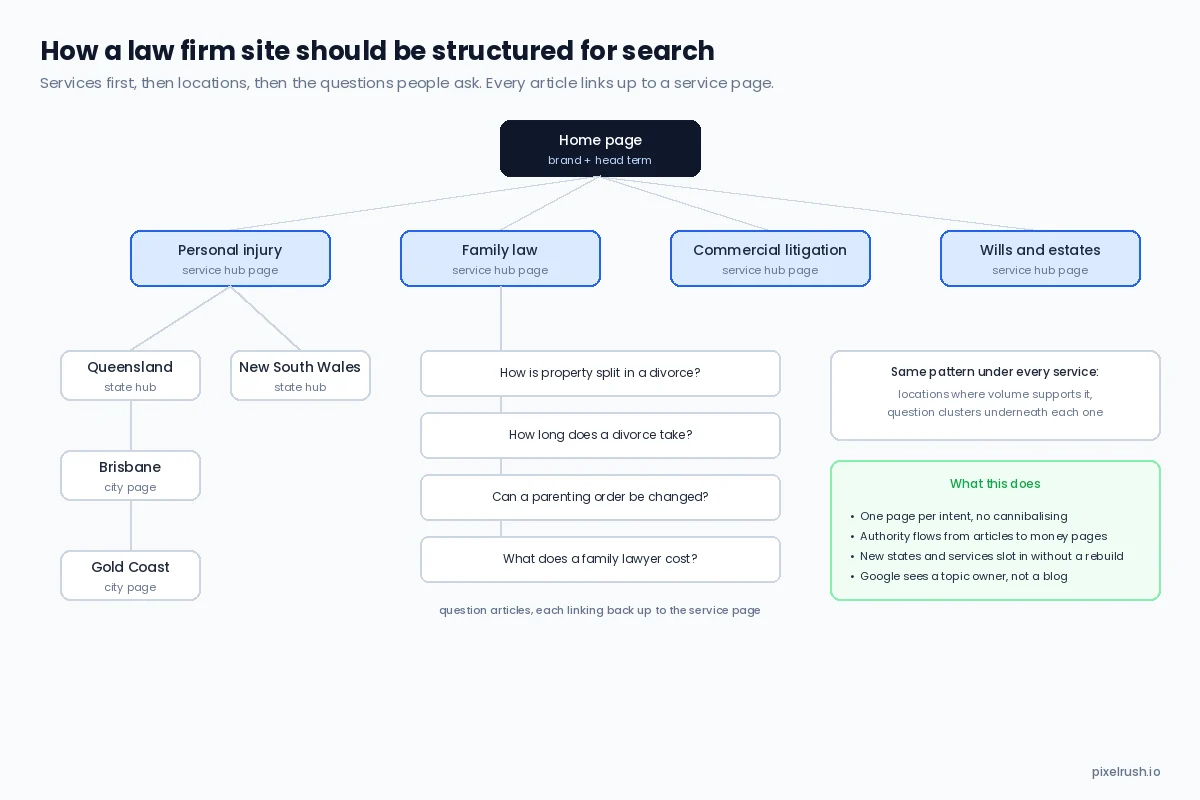
Services first, locations where the volume supports them, question clusters underneath. Every article has one parent.
What this does for ranking:
| Structure decision | Why it matters |
|---|---|
| One page per service, no overlap | Two pages targeting the same intent split the authority and neither ranks |
| Locations under services, not the reverse | "Family lawyer Brisbane" is a family law query with a location modifier, not a Brisbane query about law |
| State hubs before city pages | A firm serving all of Queensland needs a Queensland page; it only needs a Gold Coast page if Gold Coast searches exist in volume |
| Questions clustered under one service | Google sees a topic owner rather than a blog that mentions everything once |
| Hub pages that link down and articles that link up | Authority flows to the service page, which is the page that converts |
For the litigation firm in the case study, the clusters sit under each practice area, and the firm's three city hub pages sit under those. For a Brisbane compensation firm we are building now, the same tree applies: nine service pages, a state hub for each state they serve, and several hundred question topics grouped under the nine services. The content plan is the structure. They are not separate documents.
If you are rebuilding, our guide to how much a website costs in Australia covers what to budget. If you are not, the structure can be imposed on an existing site over two or three months without a redesign, as long as every URL that changes is redirected.
3. Make each service page the best answer, not a brochure
Service pages are where the enquiries come from, and on most law firm sites they are the weakest pages. Four paragraphs about the firm's values, a list of sub-services, a phone number. Google has no reason to rank that above the twenty identical pages from competitors.
A service page that ranks answers the questions a person has before they engage a lawyer in that area, in the order they ask them: can I claim, how long do I have, what will it cost, what happens first, why this firm. It links to the deeper question articles for anyone who wants more. It carries proof: reviews, named lawyers, case results where the rules allow, and the credentials that YMYL rewards.
The pattern we use:
For personal injury firms in Queensland, the same page has to do all of that without the word "injury" in some cases and without anything that reads as soliciting. We have built pages that rank under those constraints; it takes more care with wording and a single "free case review" action rather than a phone number in every paragraph.
4. Plan content as the questions people ask, grouped under each service
Here is where the litigation firm result came from, and where I will describe the shape of the system rather than the mechanics.
Most law firm blogs are written from the firm's point of view: a new case note, an update on legislation, a partner's opinion. The people who search are at a different point. They have a problem that has persisted long enough to type it into Google, and they do not know yet whether it is a legal problem. The content that reaches them answers the exact question they typed, in their words, and it is grouped so that the next question they ask is one link away.
The planning model we use is three levels deep: pillars that match the firm's practice groups, clusters that match the service pages, and topics that are real questions people ask Google, phrased as questions. For the Brisbane compensation firm, that is two pillars, nine clusters and 408 question topics. For the litigation firm it is the practice areas and the three city hubs.
Two rules govern which questions make the list. The question has to sit at a moment someone would really search, with a problem that already exists; nobody Googles what to photograph at the scene of a crash, so that topic is out. And the cluster has to be the service as it exists on the site, not a stage of the matter or a theme, because the goal is for the service page to become the authority, and every article is working for it.
| Content approach | Who it serves | What it ranks for | What it does for the service page |
|---|---|---|---|
| Case notes and legislation updates | Other lawyers | Almost nothing | Nothing |
| Generic "what is X law" explainers | Students | Head terms you will not win | Little |
| Question-led articles clustered under a service | The person with the problem | The long-tail, by the hundred | Feeds it authority and links with every article |
| Location pages with real local content | The person with the problem nearby | Service plus city terms | Extends it to each market |
The litigation firm's content is written in plain English rather than legal-speak, carries a named author with a bio and credentials, and is marked up with schema. Our best read on why it indexes and ranks so quickly, when an earlier SEO engagement on a similar firm struggled to get pages indexed at all, is that combination plus a brand with existing search volume and a firm that had won real awards that send authority signals of their own. None of those are tricks. They are a credible firm being made legible to Google.
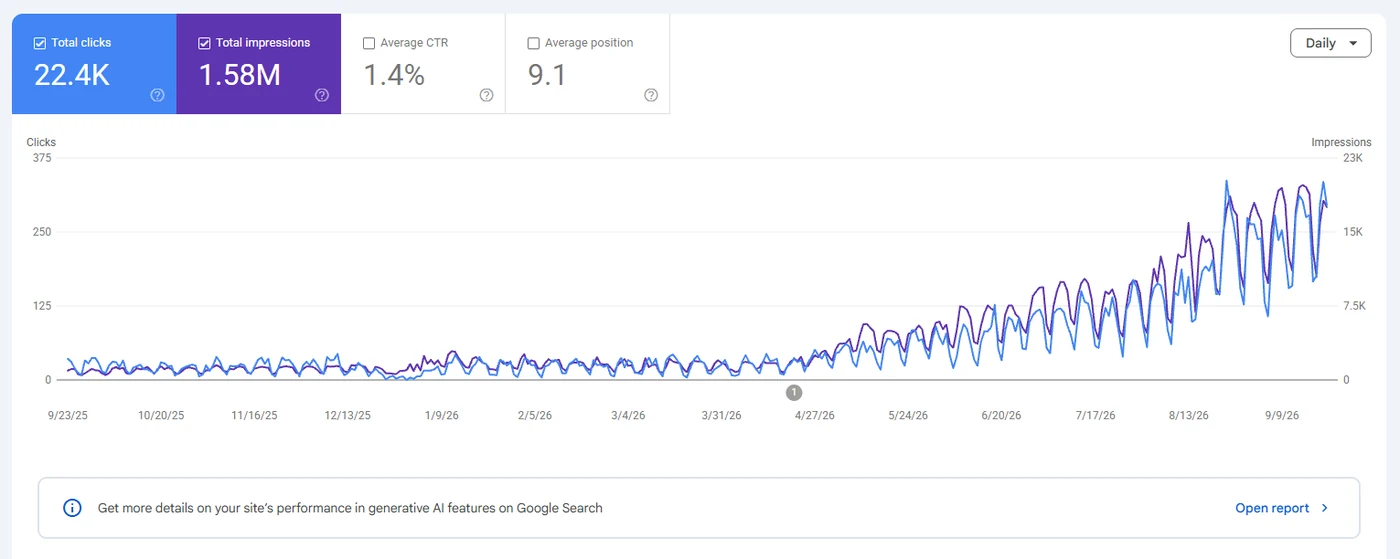
The litigation firm's Search Console over the period the content system has been running. Flat for six months, then the climb.
We wrote about how the production side works, including where AI fits and where it does not, in how law firms are using AI in marketing, and about the strategy layer in content marketing strategy for law firms.
5. Write in the language clients search in, with a lawyer's name on it
This is the single change that most firms resist and that moves results most.
Lawyers write the way the profession speaks, and the profession does not search Google for a lawyer. "Statutory compensation under the relevant scheme" is how the firm describes it. "Can I claim if I was hurt at work" is what the client types. The article that ranks uses the second phrasing in the heading, answers it in the first paragraph, and only then introduces the correct terminology. We wrote the full method in content writing for law firms.
The other half is authorship. YMYL means Google wants to know who wrote the page and whether they are qualified to. Every article on the litigation firm's site carries the author's name, photo, position and a bio page, with Person schema linking them together. Anonymous legal content, or content "by Admin", is leaving authority on the table that the firm has already earned.
| Element | Weak version | Version that ranks |
|---|---|---|
| Heading | "Statutory Compensation Entitlements" | "Can I claim compensation if I was injured at work?" |
| Opening | Firm history and values | A direct answer in two sentences, then the detail |
| Author | "Admin" or none | Named lawyer, credentials, photo, bio page, Person schema |
| Reading level | Professional | Year 7 to Year 9, with the legal terms introduced after the plain-English version |
| Proof | "We are experienced" | Years, matters, outcomes where permitted, reviews |
| Next step | "Contact us" | "Find out in 60 seconds if you can claim" with the form in view |
Expert Tip
Read your service page aloud to someone outside the law. If you have to explain a word, the page needs to explain it first. The litigation firm's pages are reviewed by the lawyers for accuracy and by a non-lawyer for whether they make sense; both passes are needed.
6. Treat internal linking as a system, not a chore
If I had to name the one thing that separates sites that rank from sites that have a lot of content, it is internal linking, and specifically whether it survives beyond the first month.
The job is simple to describe. Every article links to its service page with descriptive anchor text. Every article links to the two or three related questions a reader will want next. Every service page links down to its cluster. Location pages link to the service and to the articles that mention that location. Done once by hand, this works. Done by hand for the fiftieth article, it stops happening, and the new content floats unattached to the pages it was meant to lift.
So we built it into publishing. Every article that goes through our system is scanned against the whole site for linking opportunities before it goes live, with the service pages treated as the priority targets, and the team reviews the suggestions rather than inventing them. The mechanics are ours; the principle is that linking has to be a step in the process rather than a good intention.
The test for your own site: open Search Console, find your best-ranking article, and count how many internal links point to it and how many it sends to a service page. If either number is zero or one, that is the first fix.
7. Fix the technical problems that actually block ranking, and ignore the rest
Technical SEO audits produce long lists. Most items on them do not affect a law firm's rankings. A handful do, and they are worth checking before any content is published.
| Check | Why it matters for a law firm | How to test |
|---|---|---|
| Indexing | Pages that are not indexed cannot rank, and law firm sites built on heavy themes often have dozens that are not | Search Console, Pages report, "Crawled, currently not indexed" |
| Mobile speed | Most legal searches are on phones, often in a stressful moment | PageSpeed Insights on the service page, on mobile data |
| One URL per page | www and non-www, trailing slash variants and http all serving the same page splits authority | Site crawl, canonical tags |
| Redirects on every changed URL | Rebuilds that drop old URLs lose the links and rankings those URLs had | Crawl the old sitemap after launch |
| XML sitemap and robots | Google needs to find new articles quickly when you are publishing at volume | Search Console sitemap report |
| Schema | LegalService, Person, Article and BreadcrumbList are the four that matter | Rich results test |
| Location data | Address, phone and hours identical on the site, Google Business Profile and directories | Manual check |
The litigation firm's site is a static build on a modern framework, which removes most speed and indexing issues by default. That is not required. A WordPress site with a lean theme and the checks above handled will rank. A WordPress site with twelve plugins, a page builder and 40 unindexed pages will not, however good the content is.
On rebuilds, one rule: a URL changes only when the change improves search, and every changed URL redirects. Redirecting for tidiness alone loses more than it gains.
8. Own the local results with Google Business Profile and reviews
For any firm whose clients come from a city or region, the map pack above the organic results takes a large share of the clicks, and it is driven by signals that have little to do with the website.
The profile has to be complete, categorised correctly (primary category matching the main practice area, secondary categories for the rest), with real photos of the office and the lawyers, and with the services listed as Google defines them. Reviews are the ranking lever the firm controls most directly: volume, recency and whether the review text mentions the practice area and the city. A firm with 83 five-star reviews that mention "compensation" and "Brisbane" outranks a firm with 12 reviews that say "great service".
We covered the full setup in optimising Google Business Profile for lawyers, and the reason it matters beyond the map in why your 4.4-star rating is hurting your ad performance: the rating follows the firm into the ads, the organic result and the enquiry form.
The review process that works for law firms, where asking at the wrong moment is awkward:
- Ask at matter close, from the lawyer who handled it, by name, with a direct link
- Follow up once by SMS a week later
- Reply to every review, including the bad ones, in the lawyer's voice
- Never incentivise, and never ask clients whose matters were sensitive in ways that make a public review inappropriate
9. Publish at a volume that can move a practice area
This is the uncomfortable one. The litigation firm published around 70 articles in its strongest month, with about 55 going live after review. That volume is what produced the curve in the chart below. Two posts a month, which is what most firms manage, will not move a practice area with any competition, because the long-tail only pays when you cover enough of it to become the obvious authority.
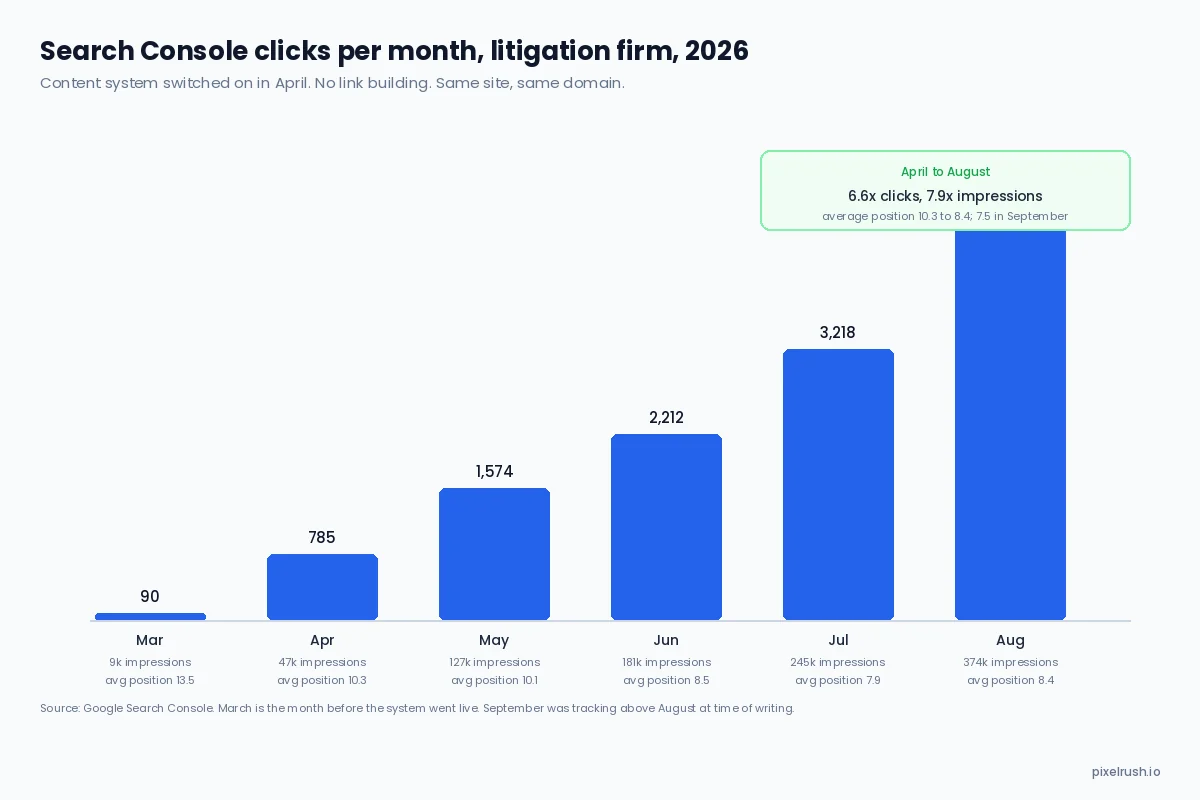
Monthly clicks before and after the content system went live in April. Impressions went from 8,600 in March to 374,000 in August, and September was tracking higher again at the time of writing.
Volume without the structure in sections 2, 4 and 6 is just a bigger blog. Volume with it is what compounds. The sequencing we use:
| Month | Focus | What you should see |
|---|---|---|
| 1 | Structure, service pages rewritten, technical fixes, GBP | Indexing of the new pages, no traffic change |
| 2 to 3 | First clusters published, 10 to 20 articles a week where the firm can review that fast | Impressions climbing on long-tail questions, first page-one articles |
| 4 to 6 | Remaining clusters, location pages, internal links reviewed across the whole site | Clicks compounding, service pages starting to move |
| 6 to 12 | Refresh of the best performers, new clusters for secondary services, PR for links | Service pages ranking for head terms in the home city |
The bottleneck is almost never production. It is review. A firm that can turn around ten articles a week for accuracy gets the curve above. A firm where every article waits three weeks for a partner's sign-off gets a flat line, however good the articles are.
10. Build links through PR, partnerships and referral relationships
The litigation firm needed no link building, because the brand already carried the authority. Most firms are not in that position, and for them links still decide who ranks for the head terms once the content and structure are right.
What does not work for law firms is the standard SEO menu: guest posts on marketing blogs, directory submissions by the hundred, paid placements on sites nobody reads. Google discounts them and the Law Society would not love them either. What works is the same thing that builds a firm's reputation offline, pointed at the web.
| Link source | How it works | Effort | Link quality | Side benefit |
|---|---|---|---|---|
| Podcast appearances | A partner guests on industry, business or local podcasts; show notes link to the firm | Low once you have a pitch | High, topical | Referrals from listeners, content to reuse |
| Local sports and community sponsorship | Club websites list sponsors with a link; local news covers the sponsorship | Money rather than time | Medium, strongly local | Brand visibility in the firm's catchment |
| Referral partners | Accountants, financial planners, physios, brokers, unions, with a "trusted partners" page each way | Ongoing relationship | High, highly relevant | The referrals themselves, which are worth more than the link |
| Industry awards and lists | Legal awards, Doyle's Guide, Best Lawyers; winners get listed with a link | Application effort | High authority | The badge on the service page |
| Local press and expert commentary | Journalists need a lawyer to comment; be the one who answers the phone | Low per story | High | Reputation, more podcast invitations |
| Professional memberships and panels | Law societies, specialist accreditation bodies, panel listings | Already held, often unlisted | Medium to high | Credentials for YMYL |
| Chambers, university and alumni pages | Speaking at a law school, mentoring programs, alumni profiles | Occasional | High authority | Recruitment |
The pattern is that every one of these produces something a client would value even if Google did not exist, and the link is a by-product. That is why they hold their value when the next algorithm update arrives and the guest-post networks do not. We expanded on the practical side in link building strategies for law firms.
One place firms consistently miss: existing relationships. Most firms already have referral partners, memberships, sponsorships and past speaking engagements, none of which link to the site. Listing them and asking takes an afternoon and often doubles the referring domains.
11. Measure enquiries and matters, not rankings
A ranking report is the easiest thing in SEO to produce and the least useful. What the firm needs to know is how many enquiries search produced, what proportion qualified, how many became matters, and what those matters were worth. That is the only report that justifies the spend.
Three things make it possible:
- Form and call tracking that records source, with phone calls tracked through a provider rather than guessed
- Every enquiry into a register with its source, qualification outcome and, when it closes, its value
- A review of that register monthly, by practice area, against the content published
For the litigation firm, that register is where we learned that their Google leads qualify at the same 10 to 40% rate we see across the legal clients in our closed loop system, and that leads arriving through AI search tools were being under-counted because they look like direct traffic. Neither insight was visible in a ranking report.
The metric to watch in the first six months is impressions on long-tail questions, because it moves first. Clicks follow, then enquiries, then matters. If impressions are flat at month three, something in sections 2 to 7 is broken. If impressions are climbing and enquiries are not, the problem is the service page or the form, which our conversion rate guide covers.
12. Decide whether to run it in-house or outsource it, and what either costs
Both can work. The question is who owns the system.
In-house works when the firm has someone whose job is the publishing cadence, the review loop and the linking, and when a partner is willing to be the reviewer who turns articles around in days rather than weeks. It fails when it is a marketing coordinator's fifth responsibility.
Outsourcing works when the agency brings the structure and the system, and the firm commits to the review loop. It fails when the agency is paid for a fixed number of posts a month and nobody is accountable for the service page rankings. Before hiring anyone, ask to see the Search Console curve of a firm they have done this for, with dates, and ask who reviewed the content for accuracy. Our guide to what SEO costs in Australia covers the market, and is SEO worth it for personal injury firms covers the practice area where the economics are most extreme.
For firms that want the whole function run rather than a channel, this is the work our outsourced CMO engagement does, alongside Google Ads and Meta Ads where they fit.
Where to start this week
Open Search Console and export the last three months of queries by impressions. That tells you what Google already thinks the site is about. Then open the site and count: how many service pages, how many of them answer the five questions in section 3, how many articles link to each, and how many URLs on the site are not indexed. Those four numbers are the audit.
If the structure is wrong, fix that first. If the structure is fine and the content is thin, start the clusters under the most valuable service. If both are in place and the curve is flat, it is the review loop or the links.
We do this for personal injury, family, commercial and litigation firms in Brisbane, Sydney and Melbourne, and the results above are from the same system. If you want us to look at your site against the twelve points here, book a call and bring your Search Console.
Want us to implement these strategies for you?
Book a free strategy call and let's discuss how we can grow your business.
Book Your Free CallContinue reading
More on Law Firm Marketing
Why Is My Law Firm Not Ranking on Google? The 12 Causes, in the Order to Check Them
A diagnostic for law firms that have paid for SEO and still cannot find themselves on page one. Twelve causes ranked by how often we find them in audits, what each one looks like in Search Console, and the fix for each.
Content Marketing Strategy for Law Firms: How to Create Content That Generates Leads and Clients
A working content strategy for an Australian law firm, from deciding who you are writing for through to auditing what you already have and tracking content to signed matters rather than to traffic.
How Do You Market a Law Firm in Australia? The Rules, the Channels, the Numbers
What actually works for Australian law firms right now, channel by channel, with the real costs from 19 ad accounts, the state advertising rules that decide what you can say, and the order to build it in.
How Much Do Lawyers Spend on Marketing? Setting a Law Firm Marketing Budget
The five to fifteen percent of revenue rule has no research behind it. Here is how to work out what your firm can actually afford to pay for a signed client, and what happens to the money once you spend it.