





Family law is one of the most searched areas of law in Australia, and one of the most crowded online. We pulled the Google results for 25 family law searches across seven cities and the map results in each CBD, then studied the 28 firms that kept showing up or stood out: their authority and links, how much of their traffic lands on family law pages, which pages bring it, what sits on their service pages and articles, where and what they post on social media, the individual lawyers posting on their own accounts, and every live family law ad we could find in the Meta Ad Library.
The short version is that family law search rewards specialists. Almost every firm that wins does family law and nothing else, and most of them do it on modest authority. The homepage carries far more weight than in any other practice area we've studied, because people search "family lawyers" plus their city and Google sends them straight to the firm. Beyond that, the traffic goes to plain answers to definitional questions (what is a de facto relationship, what is a prenup, what is the divorce process), and one of the biggest pages in the set is a child support calculator, the only one any of these firms has built. On social media firms post a lot about family law and get very little back, while a handful of lawyers at small firms get tens of thousands of views per video. On Meta the market is busy and fragmented, and non-lawyers are now pricing themselves against law firms.
If you run or market a family law practice, use this as the benchmark: what the market has, what the leaders have, and where the gaps are. We ran the same study for personal injury firms and litigation firms, and the comparisons are useful throughout.
- Search: Australian results for "family lawyers", "divorce lawyers" and "family law firm" in Sydney, Melbourne, Brisbane, Gold Coast, Perth, Adelaide and Newcastle, plus four national searches including "child custody lawyer" and "property settlement lawyer", taken from a live Google search. Google Maps top 15 for "family lawyer" from each CBD. 158 law firms appeared, and 27 became the core set, alongside JB Solicitors in Sydney, which has one of the largest traffic histories and video outputs in family law.
- Authority and traffic: Ahrefs Domain Rating, referring domains, ranking keywords, top pages and 25 months of traffic history for each firm. Because some firms do much more than family law, we also measured how much of each site's traffic lands on pages about family law. Every visit figure in this guide is an Ahrefs estimate modelled from rankings and search volumes, not the firm's own analytics. Real traffic is often much higher, especially for sites that win lots of small, specific searches, and only a firm's own analytics can show how its site and articles actually perform.
- Search demand: Ahrefs search volumes for about 680 family lawyer, divorce lawyer, custody, property settlement and family law searches, grouped by city and suburb.
- Pages: 150 pages scraped and measured (49 family law service pages, 75 family law articles and 26 homepages), plus a separate study of the 42 best-ranking law firm articles across 40 family law questions.
- Social: 90 days of posts on LinkedIn, Facebook, Instagram and TikTok plus YouTube channels. 876 posts were read and coded by theme and by whether they were about family law. We also checked 41 individual family lawyers posting on their own accounts.
- Meta ads: 696 live family law ads from 90 advertisers in the Meta Ad Library for Australia, with the ad images saved and the instant form questions recorded.
Who are the family law firms winning online in Australia?
Australian Family Lawyers is the biggest by a distance. It gets an estimated 11,200 Google visits a month, about 10,700 of them to family law pages, and has 616 keywords in the top three positions, more than four times any other firm in the set. Most of that comes from its information centre, a library of plain-English answers to questions like "what is the divorce process?" and "am I in a de facto relationship?", plus location pages for cities where it has an office. It's part of AF Legal Group, which also owns Watts McCray, and the two sites between them take about 30% of all the family law traffic in the set.
The most visible firm in our searches is a much smaller one. Blackwood Family Lawyers in Melbourne ranked in the top 10 for six of the 25 searches, including first for the national searches "family lawyers" and "divorce lawyer", and holds the number one spot on Google Maps in Melbourne with 329 reviews. It has a Domain Rating of 19 and no blog at all. Its homepage alone brings about 1,650 visits a month.
Total traffic is misleading for the multi-practice firms. Johnston Withers gets nearly 13,000 visits a month, but only about 580 land on family law pages, because most of its traffic comes from personal injury and wills. Turnbull Hill sends 17% of its 6,700 visits to family law, Scammell 15% and Lindbloms 20%. JB Solicitors in Sydney gets about 2,300 visits a month, but only about 220 land on family law pages; most of the rest go to articles on NSW driver licences, fine checks, criminal charges and questions like whether edibles are legal. Across all 28 firms, 60% of their Google traffic lands on family law pages, against 13% for the firms in our litigation study. The chart below shows both numbers for each firm.
| Firm | Type | City | DR | AU visits a month | Visits to family law pages | Share on family law | Keywords in top 3 |
|---|---|---|---|---|---|---|---|
| Australian Family Lawyers | Multi-office family firm | National | 35 | 11,242 | 10,680 | 95% | 616 |
| Unified Lawyers | Multi-office family firm | Sydney | 36 | 3,624 | 3,294 | 91% | 137 |
| Forte Family Lawyers | Family boutique | Melbourne | 27 | 2,699 | 2,678 | 99% | 104 |
| Blackwood Family Lawyers | Family boutique | Melbourne | 19 | 2,649 | 2,642 | 100% | 69 |
| Brisbane Family Law Centre | Family boutique | Brisbane | 26 | 2,258 | 2,171 | 96% | 39 |
| James Noble Law | Family boutique | Brisbane | 34 | 2,215 | 2,096 | 95% | 50 |
| Watts McCray | Multi-office family firm | Sydney | 25 | 1,591 | 1,531 | 96% | 42 |
| Ramsden Family Law | Multi-office family firm | Sydney | 16 | 1,541 | 1,453 | 94% | 37 |
| SB Family Lawyers | Family boutique | Sydney | 8 | 1,493 | 1,449 | 97% | 41 |
| Nolan Lawyers | Family boutique | Sydney | 7 | 1,432 | 1,426 | 100% | 41 |
| Sage Family Lawyers | Family boutique | Melbourne | 11 | 1,221 | 1,188 | 97% | 26 |
| Turnbull Hill Lawyers | Multi-practice | Newcastle | 38 | 6,673 | 1,119 | 17% | 277 |
| Smith Family Law | Family boutique | Melbourne | 6 | 1,213 | 901 | 74% | 49 |
| Swan Family Lawyers | Family boutique | Adelaide | 12 | 1,064 | 880 | 83% | 31 |
| Aston Legal | Multi-office family firm | Melbourne | 4.8 | 796 | 764 | 96% | 14 |
| Meredith Family Lawyers | Family boutique | Sydney | 6 | 752 | 746 | 99% | 16 |
| Collective Family Law | Family boutique | Gold Coast | 20 | 1,148 | 669 | 58% | 71 |
| Kim Wilson & Co | Family boutique | Perth | 10 | 685 | 664 | 97% | 13 |
| Johnston Withers | Multi-practice | Adelaide | 26 | 12,901 | 576 | 4% | 216 |
| Perth Family Lawyers | Family boutique | Perth | 11 | 537 | 487 | 91% | 17 |
| Lindbloms Lawyers | Multi-practice | Adelaide | 5 | 2,284 | 460 | 20% | 26 |
| Scammell & Co | Multi-practice | Adelaide | 30 | 3,014 | 442 | 15% | 64 |
| The Law People | Family boutique | Brisbane | 7 | 428 | 408 | 95% | 4 |
| Dimond Family Lawyers | Family boutique | Perth | 33 | 495 | 405 | 82% | 3 |
| Richardson Murray | Family boutique | Gold Coast | 12 | 381 | 330 | 86% | 10 |
| Delaney Roberts Family Lawyers | Family boutique | Newcastle | 16 | 382 | 274 | 72% | 13 |
| JB Solicitors | Multi-practice | Sydney | 23 | 2,328 | 222 | 10% | 98 |
| Clark Panagakos | Family boutique | Adelaide | 1.8 | 183 | 172 | 94% | 5 |
The specialists dominate. Of the 18 firms with more than 600 family law visits a month, only one, Turnbull Hill, does anything other than family law. The multi-practice firms rank in Adelaide and Newcastle, where the field is thinner, mostly off one family law service page each.
Treat all of these as estimates. Ahrefs models traffic from keyword volumes, so it tends to undercount firms that win lots of low-volume searches. The comparisons between firms hold up better than any single number.
Do the best-regarded family law firms win online?
Doyle's Guide ranks family law firms from peer and client nominations, so it's a useful check on whether online visibility follows reputation. Mostly it doesn't. Doyle's ranks 147 family law firms across its 2026 national and city lists. Only 47 of them appeared in any of the 25 searches or seven map results we checked, and of the 20 firms in the top tier on any list, only eight appeared at all.
The gap is widest in the two biggest markets. None of Sydney's four first-tier firms (ATW, Barkus Doolan Winning, Broun Abrahams Burreket and Pearson Emerson) appeared in a single Sydney or national result, and of Melbourne's five, only Kennedy Partners appeared, once. The top-tier firms that do show up are mostly in the smaller markets: Evans Brandon on the Gold Coast, Orbell in Newcastle, Howe Jenkin in Adelaide, Phillips Family Law in Brisbane and O'Sullivan Davies in Perth.
| Firm | Doyle's Guide 2026 (firm ranking) | Appearances in our 25 searches | Appearances in 7 map results | Google reviews on Maps |
|---|---|---|---|---|
| Lander & Rogers | First tier national and Melbourne | 0 | 0 | n/a |
| Pearson Emerson | First tier national and Sydney | 0 | 0 | n/a |
| Taussig Cherrie Fildes | First tier national and Melbourne | 0 | 0 | n/a |
| Barry Nilsson | First tier national and Brisbane | 1 | 0 | n/a |
| Phillips Family Law | First tier Brisbane | 2 | 1 | 33 |
| Evans Brandon Family Lawyers | First tier Gold Coast | 3 | 1 | 24 |
| Forte Family Lawyers | Second tier Melbourne | 4 | 0 | n/a |
| Kim Wilson & Co | Third tier Perth | 4 | 0 | n/a |
| Nolan Lawyers | Recommended Sydney | 3 | 1 | 155 |
| Blackwood Family Lawyers | Recommended Melbourne | 6 | 1 | 329 |
| Unified Lawyers | Not ranked | 1 | 2 | 575 |
| Australian Family Lawyers | Not ranked | 3 | 1 | 53 |
It works the other way too. 18 of the 28 firms in this study aren't on any Doyle's list, including Unified, Collective, Brisbane Family Law Centre, Smith Family Law, JB Solicitors and the four other multi-practice firms. Of the ten that are, only Forte (second tier) and Kim Wilson (third tier) rank above Recommended, and Blackwood, the strongest search performer in the data, is Recommended.
This mostly reflects how the top-tier firms get their work. Firms that handle high-value property and complex parenting matters get much of it through accountants, barristers, other lawyers and former clients, and those clients don't start with a Google search. The searches in this study are the other half of the market: people who have just separated and are looking for a lawyer themselves. Doyle's itself ranks for some of those searches (fourth for "family law firm Sydney" and eighth for "family lawyers Brisbane"), and Nolan Lawyers puts "Doyles-Recommended" in its page title, so a peer ranking can still be put to work online.
How much authority does a family law website need to rank?
It needs less than you might expect. Domain Rating tracks total traffic reasonably well (a rank correlation of 0.63, where 1.0 would mean the firm with the higher DR always gets more traffic), but it tracks family law traffic more weakly (0.39).
SB Family Lawyers on DR 8 and Nolan Lawyers on DR 7 each get about 1,400 family law visits a month, more than Turnbull Hill on DR 38, Scammell on DR 30, Dimond on DR 33 and JB Solicitors on DR 23, which gets about 220. Meredith Family Lawyers has a Domain Rating of 6 on a domain that started getting traffic in November 2025, and already gets about 750 visits a month, most of it to a homepage that ranks for "family lawyers Sydney". Aston Legal does the same in Melbourne on DR 4.8.
The strongest predictor of family law traffic is the number of keywords a firm has in the top three positions (0.58). Article volume barely matters (0.15), and how much a firm published in the last year matters even less (0.12). It's the same pattern we found in injury and litigation: ranking comes from pages built for specific searches, and authority helps those pages rank. Our guide to SEO for family law firms covers how to build both.
How much content do family law firms have, and does more help?
A typical firm in the set has about 134 articles. JB Solicitors has by far the most, at about 1,880, and only about a third of them are about family law. After it come James Noble Law (383), Turnbull Hill (367, across all its practice areas), Unified (251), Collective (244) and Watts McCray (232). Apart from JB and the multi-practice firms, almost everything these firms publish is about family law, so the relevance problem we saw in litigation mostly doesn't apply. Even so, the number of articles does little to explain traffic.
The chart puts each firm's article count next to its family law traffic. Blackwood has no articles and gets about 2,640 family law visits a month. JB Solicitors, with about 1,880, gets about 220. James Noble, with 383, gets about 2,100 and Smith Family Law, with 145, gets about 900. Nolan Lawyers has 39 articles and gets more family law traffic than Collective with 244. Australian Family Lawyers stands apart because its 184 articles are short, single-question answers, each built to rank for one search.
What content brings family law firms traffic?
The homepage does far more work in family law than in any other practice area we've studied. In the top pages we pulled, 43% of family law visits land on homepages, 33% on articles, 11% on service pages, 11% on city pages and 2% on a single calculator. In litigation, homepages took 5%.
Homepages that rank for "family lawyers [city]"
The reason is the search itself. People looking for a family lawyer type "family lawyers" and their city, and Google often answers with the firm's homepage. 13 of the 23 family firms have a homepage whose top search is a generic one like "family lawyers Melbourne", "family law solicitor Brisbane" or "family lawyers Perth" rather than the firm's own name. Brisbane Family Law Centre's homepage brings about 1,830 visits a month, 83% of its whole site, and ranks second for "family law solicitor Brisbane". Blackwood's ranks second for "family lawyer Melbourne" (about 1,650 visits), Forte's second for "family lawyers Melbourne" (1,420) and Nolan's fourth for "family lawyers Sydney" (1,190, 83% of its site).
That makes the homepage the most valuable page on a family law site, and it changes how it should be built: the service and the city in the main heading and page title, proof such as reviews and accreditation near the top, and enough copy about the firm's family law work for Google to treat it as the best answer to "family lawyers [city]". Most of the homepages ranking well do exactly that. The ones built around a brand line, such as Johnston Withers' "When experience matters", don't rank for anything except the firm's name.
Explainers that answer one specific question
The articles that work answer one plain question, usually a definition. Australian Family Lawyers' guides to the divorce process (about 1,030 visits a month, second for "divorce"), de facto relationships (930), prenups (740) and alimony (370) are four of the five biggest family law articles in the set, and its guide to postnuptial agreements adds another 230. Watts McCray's definition of a de facto relationship gets 234, and Smith Family Law's "when does my relationship become de facto?" gets 279. De facto questions alone bring about 2,600 visits a month across 30 pages.
The other big article is a how-to. James Noble Law's guide to filing on the Commonwealth Courts Portal gets about 690 visits a month. Together with a homepage that now ranks for "family law solicitor Brisbane", it's why the firm's traffic has grown nearly eightfold in a year. Unified's guide to getting a copy of family court orders gets 346. Both answer a practical question that people in the middle of a matter have, and both send them straight to a family law firm.
The one calculator in the set
Unified Lawyers' child support calculator gets about 620 visits a month, ranking fifth for "child support estimator", and its care percentage calculator and calculator hub add another 80. That's about a fifth of Unified's traffic from the only working calculator any of the 28 firms has built. In personal injury, compensation calculators were among the biggest pages in the market. In family law, people ask "how much child support will I pay?", "what am I entitled to?" and "how much will this cost?" every day, and almost nobody gives them a tool.
Traffic that doesn't bring clients
Some of the biggest articles in the set have little to do with hiring a family lawyer. Collective Family Law's biggest page is "is OnlyFans illegal?" (about 230 visits a month, twice its homepage). Australian Family Lawyers gets 153 visits to an article on polygamy and 153 to divorce rates by country, Swan gets 146 for why divorce rates are increasing, and James Noble gets 89 for traits of a narcissist. JB Solicitors takes this furthest: its biggest articles are about driver licences, fine checks and whether edibles are legal, and family law pages bring about 10% of its traffic. They count as traffic, but very few of those readers are about to brief a lawyer, which is why we've left them out of the family law visits in this guide.
Property and parenting are the matters most people hire a family lawyer for, and they bring less traffic than you'd expect: about 1,500 and 1,540 visits a month across 46 and 54 pages. The definitional topics (de facto relationships, financial agreements and prenups, the divorce process) each bring more per page. The searches people make when they're ready to hire, such as "family lawyers [city]" or "divorce lawyer [city]", go mostly to homepages, service pages and city pages, which together bring about 3,700 visits a month before homepages are even counted.
Where is the search demand for each matter and city?
A city page only works if people search for that matter in that place. We checked monthly Google searches for family lawyer, divorce lawyer, child custody lawyer and property settlement lawyer combined with each city, adding together every version people type ("family lawyer Brisbane", "Brisbane family lawyer", "best family lawyer in Brisbane", "family law firms Brisbane").
Brisbane has the most demand of any city, at about 6,400 searches a month across the four matters, ahead of Sydney (5,900) and Melbourne (4,500). Much of Brisbane's lead comes from how people there search: "family law firms Brisbane" (700 a month) and "family law solicitor Brisbane" (600) are bigger than the same searches anywhere else. Perth has about 2,900 and the Gold Coast 2,550, while Adelaide (850) and Newcastle (540) have very little. Child custody searches are concentrated in Sydney (700), Melbourne (560) and the Gold Coast (370).
Outside the capitals the numbers are smaller, but so is the competition. The Sunshine Coast is the standout. "Family lawyer Sunshine Coast" gets about 600 searches a month on its own, and with Maroochydore, Caloundra and Noosa added the region gets about 2,500 searches a month, almost as many as Perth and three times Adelaide. Townsville (1,250), the Central Coast (1,090) and Cairns (740) are all bigger than Adelaide too. A firm that can properly serve one of these places has a real reason to build a page for it.
What does it cost?
The question almost nobody answers well is cost. Searches like "family lawyer cost", "how much does a family lawyer cost in Australia", "divorce lawyer fees" and "fixed fee family lawyer" add up to about 2,800 a month, and searches for legal aid, affordable and free consultation family lawyers add about 1,000 more. Only a few pages in the core set rank for them: Unified's article on what a family lawyer costs gets about 60 visits a month, The Law People's legal fees page about 40, and Meredith's guide to family lawyer costs about 12. Ramsden published a 2026 guide to the cost of divorce in Melbourne in the week of our crawl. The best family law article we found anywhere is a cost guide, which we cover below, so the format clearly works when it's done properly.
How often are family law firms publishing, and is it working?
The typical firm publishes about one article a month. Across the 28 firms, 543 articles went up in the last 12 months, and three firms wrote 43% of them: JB Solicitors (97), Collective (76) and Ramsden (60). Four firms published nothing at all in the year: Blackwood (which has no blog), Kim Wilson & Co (last article August 2022), Perth Family Lawyers (January 2023) and Swan (March 2022).
Publishing more hasn't meant growing more. JB Solicitors (97 articles, traffic down 70%), Ramsden (60, down 36%) and Unified (43, down 57%) were three of the four busiest publishers and three of the biggest fallers. JB's traffic peaked at about 22,000 visits a month in September 2024, more than Australian Family Lawyers gets today, and most of it came from general legal questions with little link to its work. Nolan Lawyers published four articles and is up 235%, mostly because its homepage climbed to fourth for "family lawyers Sydney" and its Sydney prenup page took first place for "prenuptial agreement Sydney". Aston Legal is up 266% on 24 articles, driven by a homepage ranking for "family lawyers Melbourne". James Noble is up nearly eightfold on 16, mostly from the Courts Portal guide and its homepage. Across the set, the number of articles a firm published in the last year has, if anything, a slightly negative link with how its traffic changed (a correlation of -0.18).
Unlike litigation, where most firms were losing traffic, the family law market is growing. 16 of the 27 firms with a year of history get more Google traffic than they did a year ago, and the median firm is up 12%. Combined traffic across the set is still down 13% on October 2025, because some of the biggest sites fell: Australian Family Lawyers is down 20%, Unified 57% and JB Solicitors 70%. Some of that is AI Overviews answering definitional questions at the top of the page without a click, which hits sites built on explainers hardest. We look at what this means in is SEO dead for law firms and how to rank in AI search.
What goes into a family law page that ranks?
We took each firm's main family law page, a second page on property settlement, divorce or parenting, and its three newest family law articles, and measured what was on them.
litigation: 790
middle half: 685 to 1,754
8% have none
19% have none
litigation: 10.4
2 firms link to one
Family law pages are longer than litigation pages and shorter than injury pages. A typical family law service page has about 1,090 words, five H2 headings and 15 internal links, and only 20% are under 600 words, against 40% of litigation pages. Articles run to about 1,220 words with five H2s, but the median article has only four internal links in the body and 19% have none. The median reading level is grade 9.3, easier than litigation (10.4) and a little harder than injury pages.
Family law firms sell harder on the page than litigation firms do. 37% of service pages offer a free consultation, 47% show a star rating and 47% carry some signal about fees, and 8% have a quick exit button for people reading in an unsafe situation. What they leave out is the same as everywhere else: only 4% of service pages have a table, 14% name a lawyer and 14% show a date, and none of the 150 pages we checked has a working cost estimator, calculator or quiz on it. Two firms, Unified and Ramsden, link to one.
Articles do better on authorship. 59% name a lawyer, 65% show a date and 17% have a table, far more than litigation articles (3%). Only 11% show an updated date, which matters in a practice area where the parenting provisions of the Family Law Act changed in May 2024 and the property provisions in June 2025.
What does the best family law article in Australia look like?
To answer this properly we went beyond the 28 firms. We searched 40 questions separating people ask Google, collected every law firm article ranking in the top 10, and read and scored the 42 that ranked for the most searches. Law firms held 175 of the 400 results; the court, Legal Aid, Services Australia and Family Relationships Online hold most of the rest, especially in the top three.
The best we found is Fogarty Oliver Rothschild's how much does divorce cost in Australia, which ranks fifth for both "how much does a divorce cost in Australia" and "how much does a property settlement cost". It answers the money question in its opening lines: about $2,600 for an uncontested divorce, $8,000 to $15,000 for a property settlement agreed between the parties, and $25,000 to $100,000 or more if it's contested. It has four tables, including one that prices 11 cost lines from consent orders to a litigated parenting case, works through a $2 million asset pool to show legal costs as a share of the pool (0.25% to 0.5% if agreed at mediation, 4% to 10% if litigated), cites the 12-month deadline in section 44(3), and has a named principal author and a review date from October 2026. Its weaknesses are a divorce filing fee that's out of date ($1,125, against $1,170 since 1 July 2026), no case law, and a lot of selling of its own fees.
The runner-up is Justice Family Lawyers' are prenups legal in Australia?, second for "is a prenup legally binding in Australia". It answers in the second paragraph, sets out every requirement for a binding agreement and every ground for setting one aside, tells the facts of Thorne v Kennedy (a husband worth more than $18 million and an ultimatum 11 days before the wedding), describes a file where the firm advised its client not to sign, and gives a cost of $5,000 to $10,000. It has no table and no visible update date.
| Page | Ranks for | What it does well | What it's missing |
|---|---|---|---|
| Fogarty Oliver Rothschild, cost of divorce | #5 "how much does a divorce cost in Australia", #5 "how much does a property settlement cost" | Answer in the first lines, four tables, a $2 million worked example, the 12-month deadline, a review date | An out-of-date filing fee, no case law |
| Justice Family Lawyers, prenups | #2 "is a prenup legally binding in Australia" | Direct answer, every legal requirement, Thorne v Kennedy, a story from its own files, a cost range | No table, no update date |
| Sarah Bevan Family Lawyers, when a child can decide | #1 "at what age can a child decide which parent to live with" | A case table with the children's ages and outcomes, a 13-question FAQ | Describes the parenting law in place before May 2024, no named lawyer |
| Randle & Taylor, cost of divorce | #2 "how much does a divorce cost in Australia" | Cost tables with the current $1,170 fee, ABS divorce figures | No worked example |
| Phillips Family Law, separation before divorce | #3 "how long do you have to be separated before divorce" | Answers "no" in the first line, a contents list, an Accredited Specialist author | No figures, tables or cases |
| MST Lawyers, inheritances | #1 "is inheritance included in property settlement" | Answers up front, key takeaways, the difference between property and a financial resource | No cases or worked figures |
The pattern is clear. The best family law articles answer one question in the first sentence or two, give hard numbers (fees, percentages, deadlines in months, a worked asset pool), cite the section of the Act, name a lawyer and show when they were reviewed. Across the 42 pages, only four have a table, five cite a case and nine have a worked example. Six of the 11 parenting pages still describe the equal shared parental responsibility presumption that was removed in May 2024. Several pages rank first without answering the question at all, which tells you how open these searches still are.
What do weak family law pages have in common?
- No main heading. SB Family Lawyers' and Sage's homepages have no H1 at all, and James Noble's is just the firm name.
- Brand lines instead of a service. Johnston Withers' homepage leads with "When experience matters" and Scammell's with the firm's name and founding year, with no family law message above the fold.
- Out-of-date law. Parenting pages written before May 2024 still describe "equal shared parental responsibility" and the old two-tier best-interests factors. Few show when they were last checked.
- No links out. 19% of family law articles have no internal links in the body, so readers and Google have nowhere to go next.
- Thin case studies. Aston Legal's three newest articles are case studies of 370 to 810 words with no author, and they rank for almost nothing.
- Dormant libraries. Swan, Kim Wilson and Perth Family Lawyers have 61 to 154 articles each and haven't added one since 2022 or early 2023.
What does the user experience look like on family law websites?
On a typical family law service page you'll find a reviews or testimonials widget (59%), an enquiry form (53%), a star rating (47%) and a free consultation offer (37%). 18% have a sticky call bar on mobile and 16% a chat widget. On homepages, 50% offer a free consultation and 65% carry some signal about fees, against 15% and 30% in litigation.
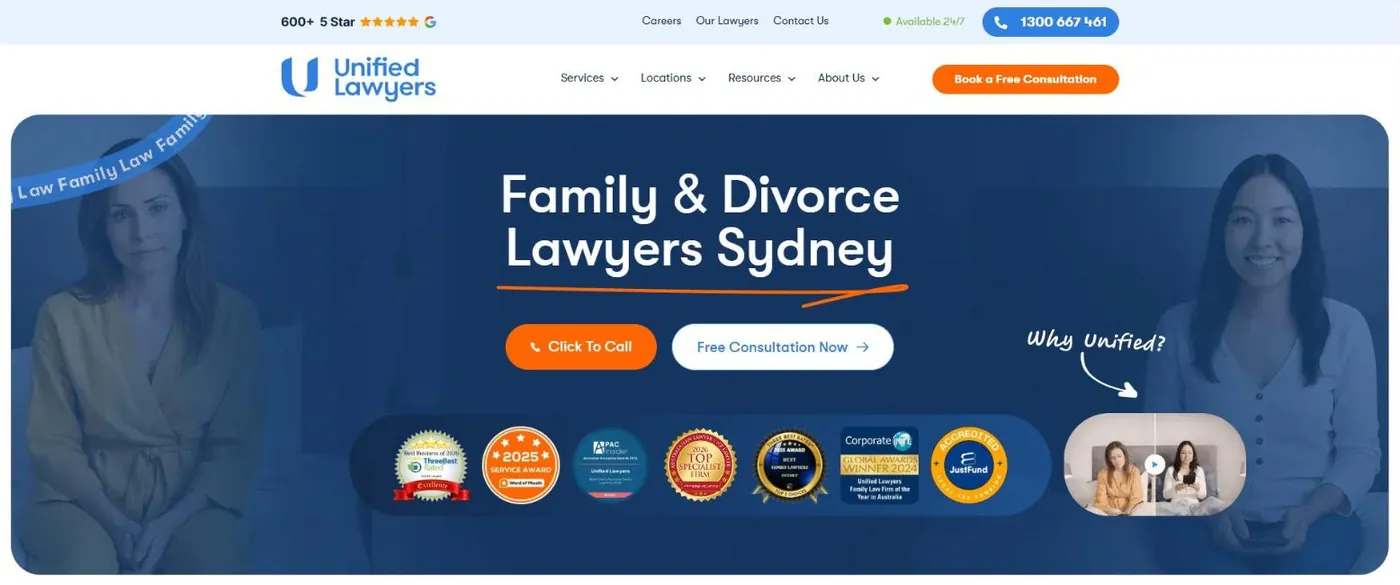
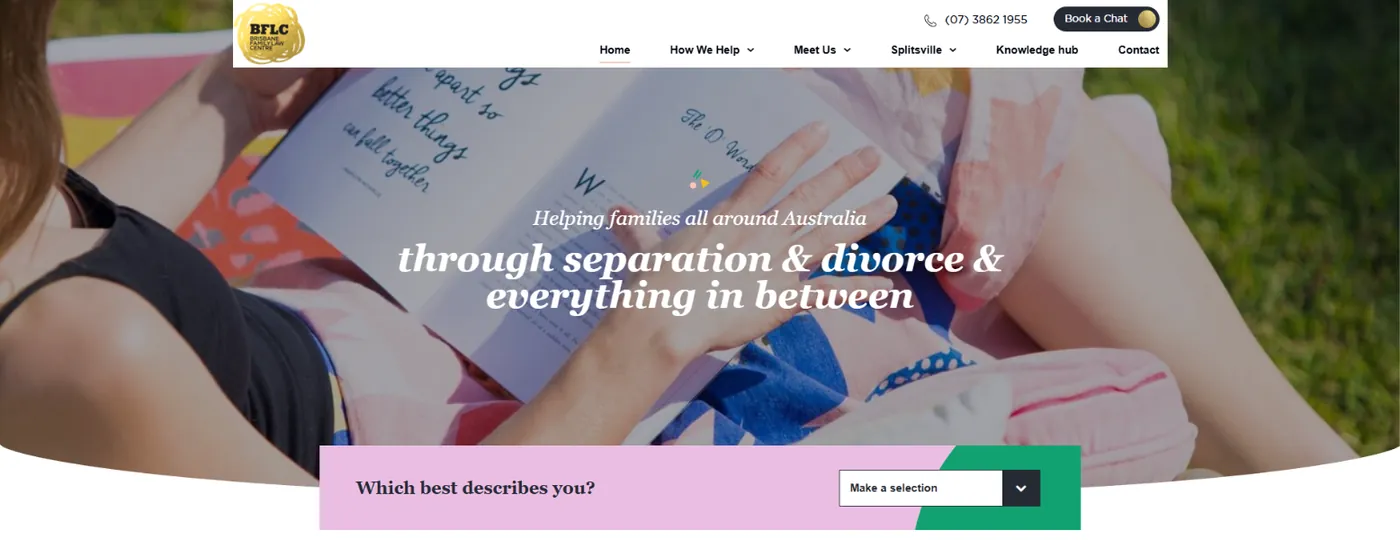
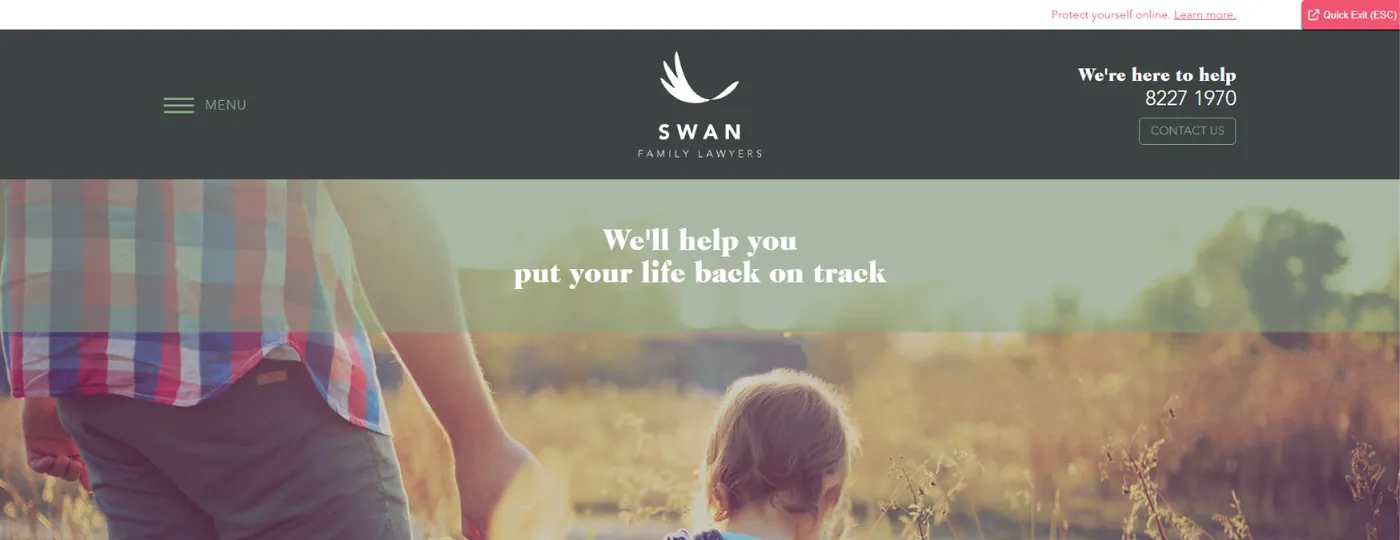
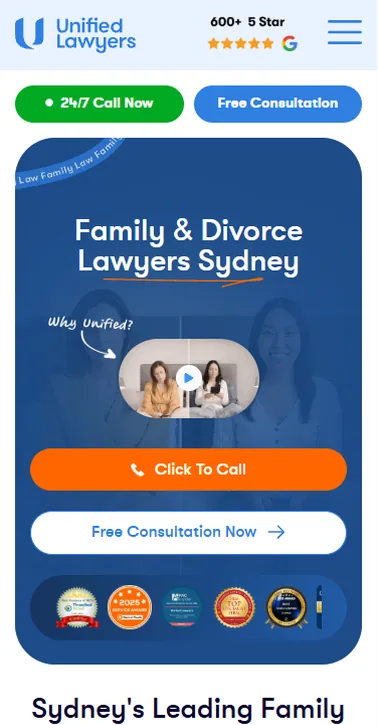
Most of the homepages that rank put the service and the city in the main heading. The rest use a brand line or the firm's name.
| Firm | Homepage headline | First call to action | Reviews shown above the fold |
|---|---|---|---|
| Unified Lawyers | Family & Divorce Lawyers Sydney | Click To Call / Free Consultation Now | "600+ 5 Star" in the top bar |
| Blackwood Family Lawyers | Expert Family Lawyers Melbourne | Get in touch with us | None |
| Forte Family Lawyers | Forte Family Lawyers Melbourne | Book an Appointment / Call | None (quick exit button) |
| Brisbane Family Law Centre | Helping families all around Australia through separation & divorce & everything in between | "Which best describes you?" selector | None |
| Collective Family Law | Resolve Your Family Law Matter | Call now / Send us a message | Google 4.8 badge |
| Meredith Family Lawyers | Divorce & Family Lawyers Sydney | Free 15-Min Phone Consultation | None |
| The Law People | Your Brisbane Family Lawyers | Get Started Online / Book Your Complimentary Call | None |
| Delaney Roberts | Specialist Family Lawyers for Professionals & Business Owners | Book Online 24/7 | None (accreditation badges) |
| Swan Family Lawyers | We'll help you put your life back on track | Contact us | None (quick exit button) |
| Johnston Withers | When experience matters. | Contact Us | None |
| JB Solicitors | Law Experts | Contact Us | None (104 reviews further down) |

Our guides to law firm website design and law firm landing pages go further into layout and conversion.
Does it change from city to city?
It changes a lot. In Sydney, Melbourne and Perth, specialist family law firms hold 80% of page one, and Brisbane is close behind at 70%. In Adelaide and Newcastle they hold less than half, because multi-practice firms such as Johnston Withers, Scammell, Lindbloms and Turnbull Hill rank there with a single family law page each.
The map results are a different contest. The number one listing in Sydney, O'Sullivan Legal, has 53 reviews, while Unified, with 561, sits third. In Melbourne, Blackwood (329 reviews) is first and Aston Legal (381) also makes the top 15. In smaller markets the leader on Maps is usually also a strong organic performer: Swan in Adelaide, Richardson Murray on the Gold Coast and Delaney Roberts in Newcastle.
| City | Specialist share of page one | #1 on Google Maps | Reviews on that listing | Median reviews, Maps top 15 | Biggest review profile |
|---|---|---|---|---|---|
| Sydney | 80% | O'Sullivan Legal | 53 | 138 | Unified Lawyers, 561 |
| Melbourne | 80% | Blackwood Family Lawyers | 329 | 108 | Aston Legal, 381 |
| Brisbane | 70% | Kate Austin Family Lawyers | 187 | 55 | Genuine Legal, 462 |
| Perth | 80% | Hickman Family Lawyers | 195 | 54 | Hickman Family Lawyers, 195 |
| Adelaide | 43% | Swan Family Lawyers | 106 | 50 | Stanley & Co, 194 |
| Gold Coast | 63% | Richardson Murray | 154 | 55 | Ramsden Lawyers, 244 |
| Newcastle | 47% | Delaney Roberts | 164 | 66 | Delaney Roberts, 164 |
Review counts are lower than in injury law and similar to litigation. The biggest single profile we captured is Unified's 561, against 1,588 for the top injury listing in Sydney. Outside Sydney and Melbourne, a firm with 100 to 200 genuine reviews and a properly set up profile is competitive for the top of the map results in every city we checked. Our guides to getting Google reviews for a law firm and Google Business Profile for lawyers cover how, and our Sydney, Melbourne, Brisbane, Perth and Adelaide pages cover each market.
Non-firms take about 10% of page one in each city and 22% of the national results. Best Lawyers appears in six of the 25 top 10s, and for the national searches "child custody lawyer" and "property settlement lawyer" the first result is Legal Aid NSW.
Where do family law firms post on social media?
Mostly on LinkedIn, Facebook and Instagram, and hardly at all on the platforms where family law audiences are growing. All 28 firms have a LinkedIn page and 22 posted in the last 90 days. 19 posted on Facebook and 14 on Instagram. Only four firms have a TikTok account with videos, and three posted in the window: JB Solicitors, with 30 videos fronted by principal John Bui, Ramsden, with seven videos and 59 followers, and Unified, with three office culture clips. 17 firms have a YouTube channel and four uploaded anything in the last year, and only JB's uploads are about family law.
uploads/wkRichardson Murray3.23.33.0·0James Noble4.74.60·0Aston Legal2.72.72.4·0Meredith2.82.71.7··JB Solicitors02.403.80.6BFLC3.03.30·0Australian Family Lawyers1.71.71.9·0Ramsden1.61.60.60.50Delaney Roberts0.90.91.3·<0.1The Law People0.90.90.9··SB Family1.21.20.2··Scammell & Co2.0·0.500Watts McCray1.201.3·0Johnston Withers0.70.70.7·0Collective1.700.2·0Turnbull Hill0.5·0.3·0.4Smith Family Law0.5·0.5··Lindbloms0.50.5<0.1·<0.1Unified000.80.20Forte··0.9··Blackwood··0.5·0Kim Wilson··0.5··Clark Panagakos<0.1<0.1<0.1·0Nolan0·0.2··Sage··<0.1··Perth Family Lawyers<0.100··Dimond0·0··Swan000··
Family law firms post about family law far more than litigation firms post about litigation. 70% of the 876 posts we coded were about family law, against 23% in litigation. The volume comes from a handful of firms posting the same explainer tile to Facebook, Instagram and LinkedIn on the same day: Richardson Murray and Aston Legal posted 90 times each in 90 days, Meredith 82 and James Noble and Brisbane Family Law Centre 60 each.
What do family law firms post, and what gets engagement?
Legal explainers are 56% of everything posted and the weakest content in the data, earning just over half a typical post's engagement. Only 12% reach double the account's usual engagement. Meredith posted 82 times in 90 days, 81 of them family law explainers, for a median of zero engagements on every platform. People posts do best. Recruitment, promotions and staff culture earn twice a typical post, and firm news and awards 1.14 times. Ramsden's post promoting a senior associate drew 118 engagements, the most of any LinkedIn post in the set. The one firm whose explainers do travel is JB Solicitors, where John Bui fronts every video himself: the firm drew about 4,600 engagements in 90 days, more than twice Ramsden, and holds eight of the ten most-engaged posts in the set, mostly reels on wills, testamentary trusts and divorce.
The best family law content is a named lawyer on camera talking about one situation. Aston Legal's "After Court Thoughts" reels, filmed with a solicitor outside court, drew six times the account's usual engagement on Instagram.
The single biggest post in the set was a humour reel. Ramsden's "When the mediation stars align" drew 1,041 engagements and about 52,300 plays on Instagram, 39 times its usual post and more than any other firm's entire 90 days of posting except JB Solicitors and Australian Family Lawyers. The same clip drew 25 engagements on TikTok and none on Facebook, which shows how much the platform and its audience matter.
Australian Family Lawyers has the biggest LinkedIn page (4,400 followers) and Forte gets the most engagement per post (a median of 45.5) from a page that posts about once a week, almost entirely about its partners speaking at conferences and winning awards. Volume without people behind it does very little: the firms posting the most explainer tiles get a median of 0 to 3 engagements per post.
Audience size is a poor guide on its own. The biggest Facebook audience in the set, 9,800 followers for an eight-person firm, responds to almost nothing and looks built by ads. The biggest Instagram account, Collective's 3,436 followers, hasn't posted since December 2025. And the most-viewed YouTube videos are ads: Unified's 2020 TV commercial has about 971,000 views and 23 likes.
YouTube is close to dormant. JB Solicitors is the only firm adding family law videos, 29 in the last year with a median of about 860 views. Most of the other good family law videos in the set are old question-and-answer clips with a named lawyer, such as Johnston Withers' 2019 session with Jason Bell on divorce and property settlement (about 8,100 views).
Which individual family lawyers are building an audience on social?
The firm accounts are only half the picture. We checked 41 Australian family lawyers posting on their own TikTok, LinkedIn, Instagram and YouTube accounts. As in injury law and litigation, the ones with real reach on TikTok all work at small firms or on their own. John Bui at JB Solicitors is the only lawyer at any of the 28 firms in this study posting short video every week.
Who is posting on TikTok?
| Lawyer | Firm | Followers | Posting rate (last 90 days) | Typical video | Best video | What they make |
|---|---|---|---|---|---|---|
| Kingsford Lawyers principal | Kingsford Lawyers, Victoria and Queensland | 10,700 | Two a week | 8,140 plays | Who gets the kids, mum or dad? (a relocation to New York): 280,700 plays, 655 comments | "Guess the verdict" case videos; 38% family law |
| Katherine Eli | Aeris Legal, NSW | 28,000 | About one a week | 7,180 plays | A mum withholds the child from dad: 31,400 plays | Real case breakdowns of anonymised judgments |
| David Gale | Gale Family Law, Melbourne | 23,900 | About 1.5 a week | 2,330 plays | "The thing that irks me most as a family lawyer": 10,900 plays | Explainers and replies to comments |
| Irene | ICAA Law, Melbourne | 3,420 | Two a week | 2,060 plays | "Most family law questions depend on the facts": 128,600 plays | Quick-answer explainers |
| Jess Bourke | Jess Bourke Legal, Dubbo | 3,040 | About one a week | 3,510 plays | Should you post online about a parenting dispute?: 46,000 plays | Short answers to questions from comments |
| John Bui | JB Solicitors, Sydney | 1,200 | Four a week | 1,570 plays | "Not everything that annoys you is divorce-worthy": 54,800 plays | Daily explainers and relationship humour |
| Melis | NSW | 3,350 | 1.4 a week | 1,100 plays | His financial agreement expired on his wedding day: 8,080 plays | One recent judgment per video |
| Lamia Daher | Sterling Legal, Sydney | 2,570 (13,200 on Instagram) | About one a week | 4,990 plays | Yes or no answers to family law questions: 8,730 plays | "Monday Myth" explainers |
| Fidan Shevket | Fox & Staniland, NSW | 1.4 million | Two a week | 218,700 plays (mostly lifestyle) | A divorce case note: 2.1 million plays (November 2025) | Food, travel and family life, with occasional case notes |
Kingsford's de facto case, two people together two years, never married, and her deposit on the house, reached about 101,700 plays in the window, and its sequel reached 165,900.
The type of video matters more than how often it's posted. Across 460 videos from lawyers posting about family law, real case breakdowns had a median of 6,221 plays, about three times explainers and humour. The win is less clean than in litigation, though. At Aeris Legal, cases split into six-part series drag the median down, and its best recent video is a single anonymised judgment told start to finish.
The questions that travel are about the house and the kids: who keeps the house after a short de facto relationship, whether one parent can withhold a child, whether you can post online about a parenting dispute, and whether mum can move the children overseas. Quick answers work too. Irene's video on why most family law questions "depend on the facts" reached 128,600 plays, against a usual 2,060 on her account.
John Bui at JB Solicitors is the most consistent family law creator we found. He posted 30 videos in the 90 days, about four a week and more than any other family lawyer in the study, mixing short to-camera answers such as "what should you never do during a divorce?" with relationship humour. His typical video gets about 1,570 plays, and his best in the window, "not everything that annoys you is divorce-worthy", reached 54,800. He also has about 5,200 followers on LinkedIn. His two real case videos earned about five times the engagement of his explainers, so the clearest next step for an account like his is more videos built around one real case.
Lifestyle reach doesn't carry over to family law content automatically. Fidan Shevket has 1.4 million TikTok followers, but in the window 26 of her 27 videos were about food, travel and family, and her family law case note drew about a sixth of her usual plays. David Gale's biggest video is about reaching $5 million net worth.
Who is posting on LinkedIn?
LinkedIn is where lawyers at the established firms post, and 13 of the 28 firms have at least one lawyer posting there. Only five of those post at least every fortnight, and several of the 13 posted once in 90 days, usually a partner appointment or a new hire. Apart from John Bui, no lawyer at any of the 28 firms posts short video personally.
| Lawyer | Firm | Followers | Posts in 90 days | Median engagement | What they post |
|---|---|---|---|---|---|
| Clarissa Rayward | Brisbane Family Law Centre | 10,300 | 28 | 15 | Productivity and practice posts for other law firm owners; 14% family law |
| Anna Roberts | Delaney Roberts, Newcastle | 6,900 | 3 | 11 | A told case story about separated parents who couldn't agree on a high school |
| Gabriella Pomare | Pomare Family Law, Sydney | 6,000 | 30+ | 18.5 | Podcast, book, media and pop-culture divorce commentary |
| Bron O'Loan | O'Loan Family Law, Sydney | 4,600 | 6 | 23.5 | Hiring, events and personal posts |
| Daniel Dalli | Aston Legal, Melbourne | 3,000 | 2 | 48.5 | Practice reflections and client stories |
| Susan Warda | Mills Oakley, Sydney | 2,900 | 6 | 93 | An international family law podcast and comparisons between countries |
| Samantha Lewis | Lewis Family Lawyers, Sydney | 2,000 | 22 | 16.5 | Awards, events and a short video Q&A series |
| Jacky Campbell | Forte Family Lawyers, Melbourne | 1,500 | 9 | 43 | Articles and conference speaking |
| Renee Smith | Ramsden Family Law, Sydney | 800 | 6 | 40.5 | Case notes on new court decisions |
| William Sloan | Kim Wilson & Co, Perth | 780 | 19 | 33 | International conference and academy posts |
At the boutiques the lawyer is usually bigger than the firm page. Clarissa Rayward has 17 times Brisbane Family Law Centre's LinkedIn following, Anna Roberts four times Delaney Roberts' and Daniel Dalli three times Aston's. Unlike litigation, where case notes were the weakest content, family law posts by lawyers beat their other posts (a median of 28 engagements against 19). Daniel Dalli's "one thing I tell almost every family law client" drew 68 engagements and 17 comments.
What do the lawyers with real reach have in common?
They are one person on camera talking about one real case or one real question, with the dispute itself as the hook: who keeps the house, can mum move the kids, what happens when an agreement expires. They post one to two times a week, every video about family law, and none of them works at a large firm. Most of the 28 firms in this study have lawyers with far more to say than the people getting these views, and apart from JB, none of them is saying it on video. Our guide to video marketing for law firms covers how to make it work.
What are family law firms running on Meta ads?
There's plenty of activity, but most of it comes from firms that don't win in search. We found 696 live family law ads from 90 advertisers in the Meta Ad Library, nearly three times the litigation market and under half of personal injury. Only eight of the 28 firms in this study run family law ads, and together they account for 94 of them. JB Solicitors runs none.
litigation: 241, personal injury: 1,602
litigation: 51, personal injury: 83
litigation: 3 of 26, personal injury: 16 of 25
The market is fragmented. The top five advertisers run 29% of the ads, against 55% in litigation, and 26 advertisers run a single ad. The testing is happening at family boutiques that barely show up in organic search. Hitch Law runs 51 ads and launched 22 of them in the last month, Wilde Law Group launched all 24 of its ads in the ten days before our crawl, and Neilson Law runs 36, mostly into an instant form. The core firms that do advertise run templated programs: Australian Family Lawyers and Watts McCray share one landing page template for "free 15-minute consultation" ads by city, and only 3 of the core firms' 94 ads started in the last month.
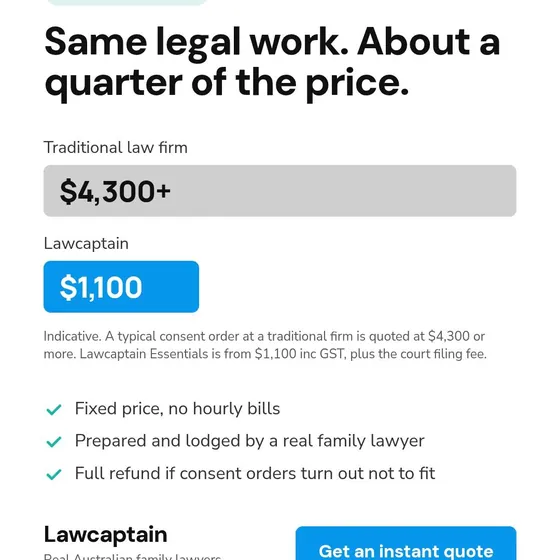
Non-lawyers are a real share of the auction. 17% of family law ads come from services that aren't law firms: an online financial agreement platform ("$2,500 for both of you"), an online consent orders service ("$1,100 vs $4,300+"), a DIY divorce course, evidence apps for family court, co-parenting coaches and a referral network. Most of them sell on price against law firms.
Divorce is the most common subject, in 42% of ads, and parenting the most widely used, by 65 advertisers. Property ads are the sharpest, built on specific fears about super, the family home, a partner's business or trust, and hidden assets. An emerging angle targets people who separated years ago and never formalised the property split ("Divorced. But not done."). Child support barely appears.
The hooks are softer than in litigation and injury law. Family law ads lean on a free consultation (24%), a question to the viewer (24%) and reassurance (19%). Deadlines appear in only 10% of ads, even though family law has hard ones: 12 months after a divorce and two years after a de facto separation to start a property claim, and court cut-offs for Christmas parenting applications. Price is used mostly by the non-lawyers attacking law firm fees.
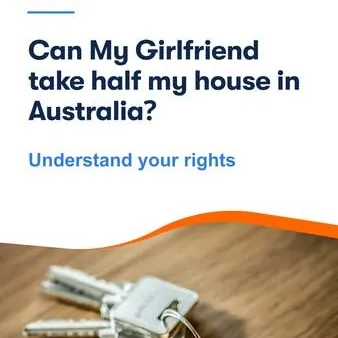
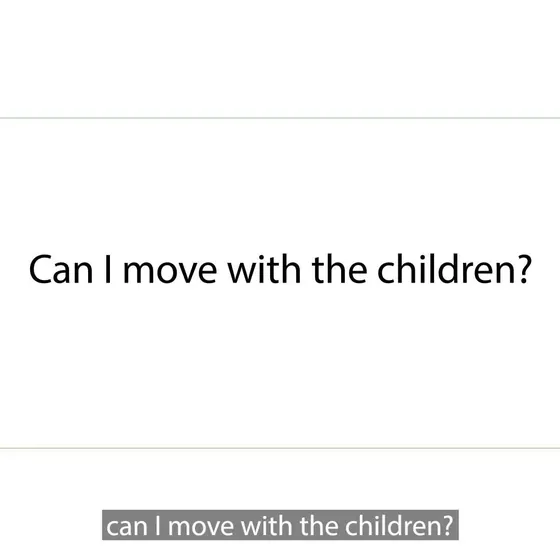
Family law ads also stay up longer. The median ad is 45 days old, against 24 in litigation, and 44 ads have been running for more than a year. Some of the long runners are brand and page-like ads that probably survive because nobody is looking at them. The others answer one question a separating person is already asking: Unified's "can my girlfriend take half my house?" article ad (652 days), Omnia's "property isn't divided 50/50" guide (449 days) and Queensland Family Law Practice's "can I move with the children?" video (438 days).
Where do the ads send people?
27% of family law ads go to a Meta instant form, between litigation (20%) and injury (37%), and a quarter go to a dedicated landing page. The forms show the biggest gap in the market. The referral network asks for total asset value and whether the case involves children or family violence, and one firm asks "Can you privately fund this matter?" and whether either party owns property. Most firm forms only ask "What would you like help with?", which qualifies nothing, so the firm pays for every legal aid enquiry that comes through. 10% of family law ads also use the "Book Travel" button, almost certainly meant as "Book Now". Our guides to Facebook ads for law firms and family law marketing cover how to set this up and screen leads properly.
Which family law ads are worth studying?
These are the longest-running family law ads, plus the current style of the most active advertisers. Images are saved copies from the Ad Library at our latest crawl, and each card links to the ad's Ad Library record, which Meta removes once an ad is switched off.


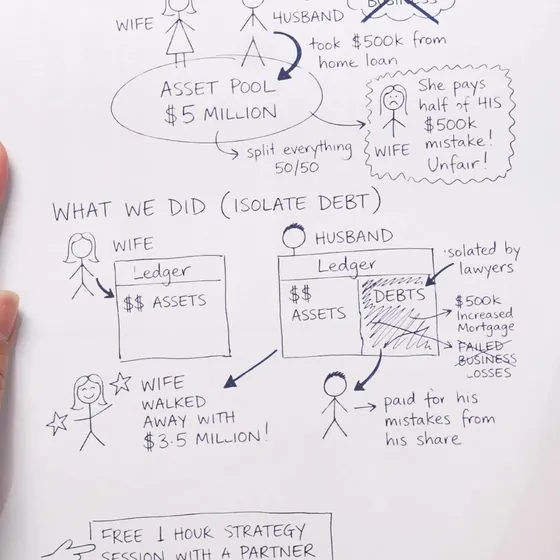
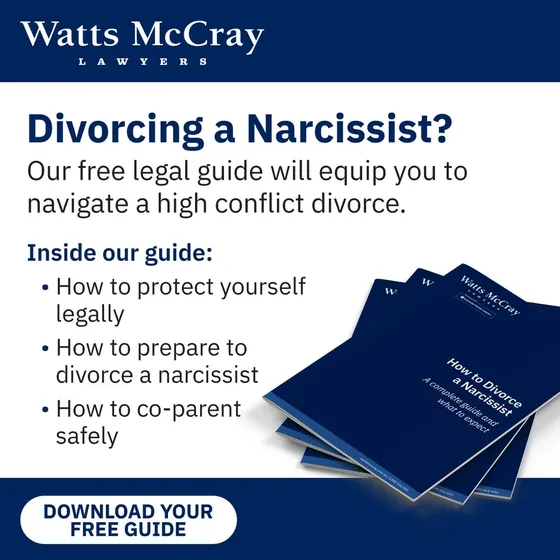





A few cautions from the same data. Claims such as "Sydney's #1 family law specialists", "most accredited family law firm" and "award winning" all need to be accurate and backed up under the conduct rules and the Australian Consumer Law, and "specialist" has to match lawyers actually accredited by the relevant law society. Case-story ads that state a specific result ("walked away with $3.5 million") are the riskiest creative in the set, because a past result can read as a likely outcome. Ads that assert or imply someone's relationship status or experience of abuse ("Are you in a high conflict separation?") are the most exposed to Meta's rules on personal attributes. Our guide to lawyer advertising rules in Australia covers the detail, and our Meta ads for law firms page explains how we run them.
What does a family law firm need to compete?
Here is the full benchmark in one table: the typical figure across the 28 firms, what the leaders have, and a sensible target for a boutique or regional firm trying to take market share.
| Area | Market typical | The leaders | Target for a challenger firm |
|---|---|---|---|
| Domain Rating | 16 | 33 to 38 | 15 to 25 is enough. Nolan (DR 7) and SB Family Lawyers (DR 8) each get about 1,400 family law visits a month |
| Visits to family law pages | About 820 a month | 2,000 to 10,700 (Australian Family Lawyers, Unified, Forte, Blackwood, BFLC, James Noble) | 1,500 or more, with almost all of it on family law pages rather than curiosity articles |
| Homepage | Ranks for the firm's name | Ranks top five for "family lawyers [city]" and brings 1,000 to 1,800 visits a month | Service and city in the H1 and title, reviews and accreditation near the top, real copy about your family law work |
| Service pages | One family law page of about 1,090 words | A page for each matter and each city served | One page each for divorce, property, parenting, child support, agreements, de facto and family violence, then one per city you genuinely serve |
| Articles | About 134 on the site, one a month | Short, single-question answers (the divorce process, de facto, prenups) and practical how-tos (the Courts Portal) | Two to four a month, each answering a question a separating person types into Google, including cost and deadlines, reviewed when the law changes |
| Article features | Named author on 59%, table on 17%, updated date on 11% | Answer in the first lines, tables, a worked asset pool, the section of the Act, a review date | All of those, plus current fees and law |
| Tools | None | Unified's child support calculator (about 620 visits a month) | A child support, property or cost estimator people will come back to |
| Google reviews (main city listing) | 50 to 140 | 300 to 560 | 150 to 300 genuine reviews, which is enough for the top of the map results outside Sydney |
| Social posting | 70% about family law, mostly explainer tiles that earn little | Lawyer-fronted reels and people news | Two or three posts a week built around your people and one real situation at a time, not daily tiles |
| Lawyers posting personally | 13 of 28 firms on LinkedIn, mostly occasional; one (JB) on short video | Small-firm lawyers with 30,000 to 280,000 plays on TikTok | One lawyer posting real case breakdowns every week, on LinkedIn and short video |
| YouTube | 4 of 17 channels uploading, only JB on family law | JB Solicitors, 29 uploads a year at about 860 views each | Lawyer-fronted answers on property, parenting and cost, cut into Shorts |
| Meta ads | 8 of 28 firms, mostly templated consult ads | Boutiques testing 20 to 50 ads with video and landing pages | One matter, one landing page, five to ten tested ads, a form that qualifies on assets and stage, refreshed monthly |
The temptation with a table like this is to start on every row at once. The firms pulling ahead in this study each did one thing properly first: Blackwood and Forte on a homepage that ranks for their city, Australian Family Lawyers on single-question explainers, Unified on a calculator, James Noble on one practical guide, Nolan and Aston on climbing for "family lawyers [city]" with very little content, JB Solicitors on putting its principal on camera every week, and Hitch and Wilde on testing Meta ads at volume.
For most family law boutiques, the order that makes sense is the homepage and the map listing first, then a service page for each matter you want more of, then cost and deadline content and a calculator, then a lawyer on camera, then paid social with forms that screen for the matters you actually want. We set out how to plan that one channel at a time in how to write a law firm marketing plan, and how much lawyers spend on marketing covers the budget side.
If you'd like to see how your firm compares with these benchmarks, our family law marketing team can run the same analysis on your site and your competitors in your city. Book a call and we'll show you where you stand and which channel to fix first.
About this data. Latest crawl: October 2026. Search, traffic and authority figures are Ahrefs estimates from that crawl. Visit numbers are modelled by Ahrefs, not taken from the firms' analytics, and actual traffic can be far higher. Without access to a firm's analytics there is no way to know exactly how its site or articles perform, so use these figures to compare firms with each other rather than as real visitor counts. Search results and map results were taken from a live Google search. "Family law pages" are classified by URL and top keyword and are an estimate; for family-focused firms the family law share is taken from their top 20 pages. Search volumes are Ahrefs estimates for Australia. Posting rates come from post lists, RSS feeds and sitemaps and are indicative. Social figures cover the 90 days to the crawl, capped at 30 posts per account. Meta ad counts are live ads at the crawl and show no spend. Firms and creators are named from public information. Some of the firms mentioned may be PixelRush clients. Where that's the case, they have been measured the same way as every other firm. Nothing here is legal advice.
Want us to implement these strategies for you?
Book a free strategy call and let's discuss how we can grow your business.
Book Your Free CallContinue reading
More on Law Firm Marketing
How Do Litigation Law Firms Win Online in Australia? (The Benchmark Guide)
We studied 27 Australian litigation and dispute resolution firms across Google, Maps, their websites, LinkedIn, Facebook, Instagram, TikTok, YouTube and every live litigation ad in the Meta Ad Library. This guide shows how much authority and content it takes to rank for litigation searches, which pages actually bring disputes work, what the leading firms put on their pages, the lawyers getting hundreds of thousands of views on their own accounts, and how it all changes from Sydney to Newcastle.
How Do Personal Injury Law Firms Win Online in Australia? (The Benchmark Guide)
We studied 25 Australian personal injury firms across Google, Maps, their websites, Facebook, Instagram, LinkedIn, TikTok, YouTube and 1,602 live Meta ads. This guide shows how much authority, content and review volume it takes to compete, what the leading firms put on their pages, what they and their lawyers post on social, the ads that have run for over a year, and how it all changes from Sydney to Newcastle.
How Do Criminal Lawyers Get More Clients? (It Comes Down to What a Matter Is Worth)
How Australian criminal lawyers get more paying clients. Why the value of the matter decides which marketing works, what Google Ads clicks really cost, why reviews and the map listing matter so much, how the leading firms do content without stuffing it, the lawyers getting millions of views on social media, and why referrals carry the serious matters.
How Should Law Firms Use Email Marketing? (The Six Emails Worth Sending)
Email rarely wins a law firm a new client on its own, but it decides what happens to the enquiries, past clients and referrers you already have. The six emails worth sending, what to send leads who don't sign, getting reviews and referrals, the Spam Act and privacy rules for Australian firms, what Queensland's injury advertising law means for email, deliverability, tools and what to measure instead of open rates.