




A person who clicks a law firm's ad has a problem, a phone in their hand and about five seconds of patience. The page either tells them in that time that they are in the right place and shows them one thing to do, or they go back to the results and click the next firm. Across the 400-plus landing pages we have optimised, the firm pages that convert at 8% to 10% and the ones that convert at 1% to 2% differ in a handful of things visible in the first screen, and the difference is worth three to five times the cost per enquiry on the same ad spend.
This article scores twelve real Australian pages against the rubric we use, across personal injury, family, criminal and property law. The pages are the ones that rank for the money searches in Brisbane, Melbourne, Sydney and Perth, which is where most Australian firms send their ads too. It follows the format of our teardown of personal injury firm websites, and sits beside the personal injury landing page guide, which covers Meta traffic and the full page structure, and the lessons from 400 Google Ads landing pages, which covers the principles. Here the question is narrower: what does a good one look like, and how does yours score.
Key Takeaways
- The page is judged in the first screen on a phone. Headline that matches the search, one primary action, a visible phone number and a reason to trust the firm. Everything else is below the fold and most visitors never see it.
- The top scorer in this set, a Sydney criminal firm's page, scored 19 of 20. It has a headline that names the practice area and city, the lawyers' faces, a 4.9 rating with a review count, and a form with "what happened" as the first question. The lowest scorers, at 10 and 11, are pages with no action at all in the first screen.
- Form or phone depends on the practice area. Criminal and injury enquiries call; family and commercial enquiries fill in a form, often at night. The page leads with whichever the practice area wants and offers the other.
- Compliance errors were on page one in every practice area. An unsubstantiated "most successful", "specialists" from firms with no accredited specialist listed, a "guarantee". Each is a claim the Legal Profession Uniform Law requires a basis for, and each is the kind of thing a competitor reports.
- Purpose-built pages in our law firm accounts convert at 6% to 10%; home pages used as landing pages at 1% to 3%. The Brisbane and Gold Coast family firm's custom pages run at 9.7%.
The rubric
Ten criteria, scored 0, 1 or 2, judged on the first screen as a visitor sees it, with no scrolling. We score desktop and phone; the phone score is the one that matters and the screenshots below are desktop for legibility.
| Criterion | 0 | 1 | 2 |
|---|---|---|---|
| Headline matches the search | Generic ("Welcome to Smith & Co") | Practice area or city, not both | Practice area and city in the headline |
| One primary action | No action visible, or four equal buttons | An action, but competing with others | One obvious next step |
| Click-to-call | No number visible | Number visible, not tappable or small | Prominent, tappable number |
| Form in the first screen | None | Form present, no qualifying question | Short form with a qualifying question |
| Rating and review count | None | Stars with no count, or a count with no source | Google rating and count, near the action |
| Concrete proof | Adjectives ("experienced", "trusted") | One specific: years, accreditation, a named lawyer | Named lawyers with faces, accreditation, specific years or volume |
| Distraction removed | Mega menu, search bar, social icons, chat popup | Standard nav | Minimal nav, nothing pulling the eye from the action |
| Specific to the practice area and location | A general practice page | Practice area specific, location generic | Both, and the copy reads as written for this matter type in this city |
| Compliance | A claim we would not run: unqualified "specialist", a success rate with no basis, a guarantee, PIPA issues | A claim that needs a basis the page does not give | Nothing we would change before running an ad to it |
| Nothing blocks the first screen | A modal, location picker or cookie wall covers the content | A banner takes part of the screen | The content is the first thing seen |
The twelve pages, scored
Screenshots taken on 3 October 2026, desktop. The firms are public and named; none is a client of ours.
Personal injury, Brisbane
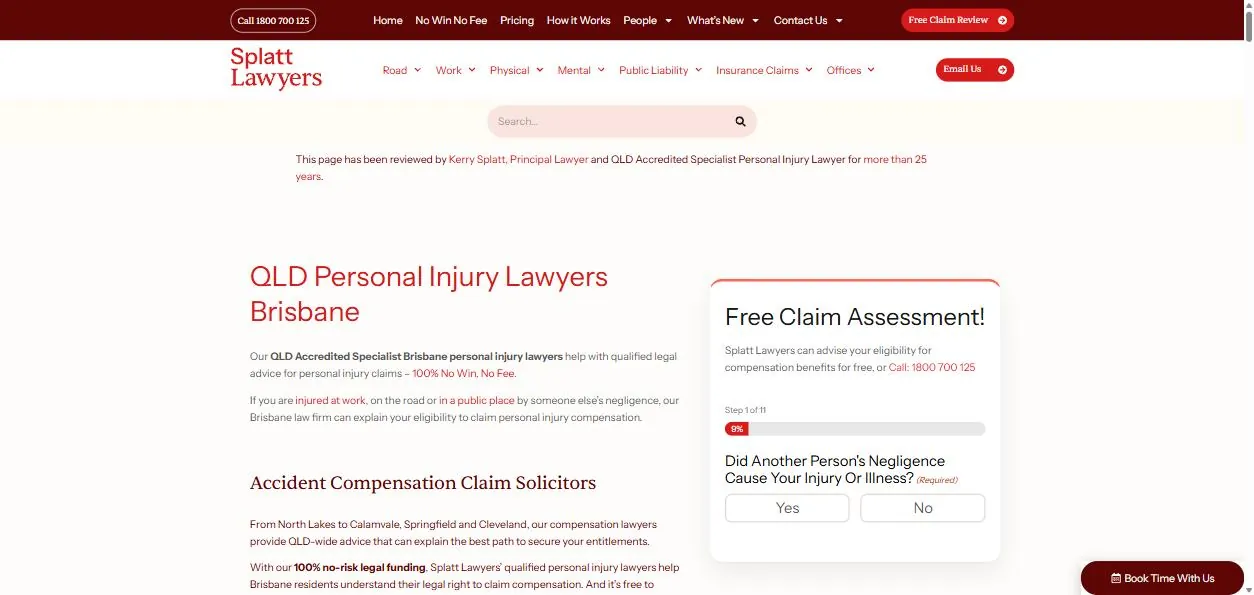
Splatt Lawyers, personal injury lawyers Brisbane. 15 of 20. The strongest injury page in the set. A headline with the practice area and city, a "reviewed by Kerry Splatt, Principal Lawyer and QLD Accredited Specialist Personal Injury Lawyer" line above it, and an eleven-step claim assessment that starts with a single yes/no question. That is the right way to begin a form for a nervous person. It loses points for two navigation bars and a search field above the content, and for no Google rating anywhere in the first screen. The compliance point is the interesting one: the page carries "100% No Win, No Fee" on a Queensland injury page, and Queensland firms read the Act's application to their own websites differently. Some, like the next firm, gate the site.
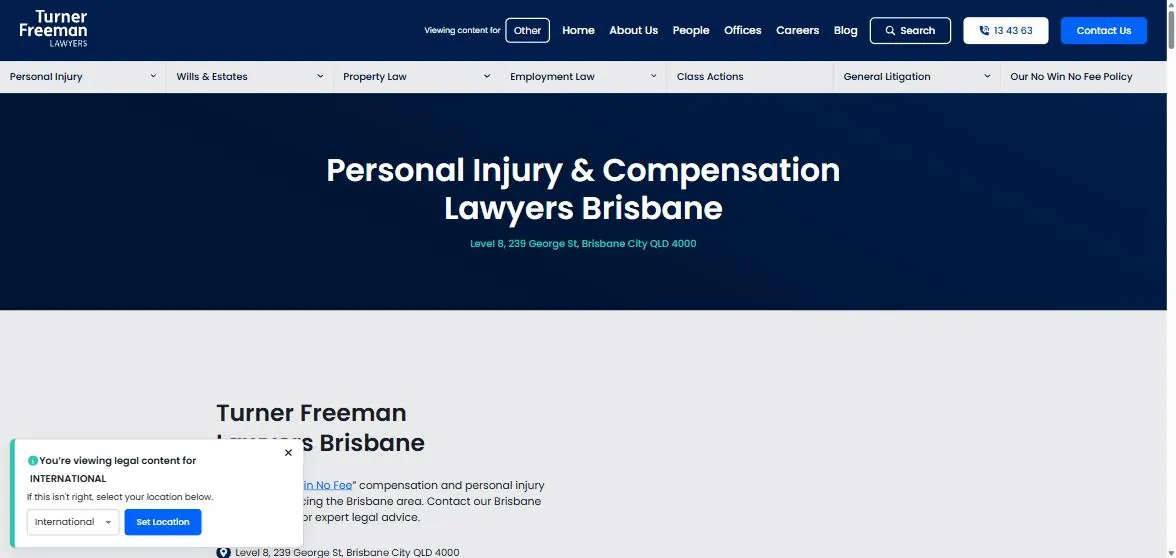
Turner Freeman, personal injury lawyers Brisbane. 10 of 20. The headline is right and the phone number is prominent. Then the first screen has nothing to do: no button, no form, an address under the headline, and a mega menu of seven practice areas across the top. A location-detection popup covers the bottom left on arrival. This is a national firm's location page doing duty as a landing page, and it would convert at a fraction of the rate of a page built for the ad.
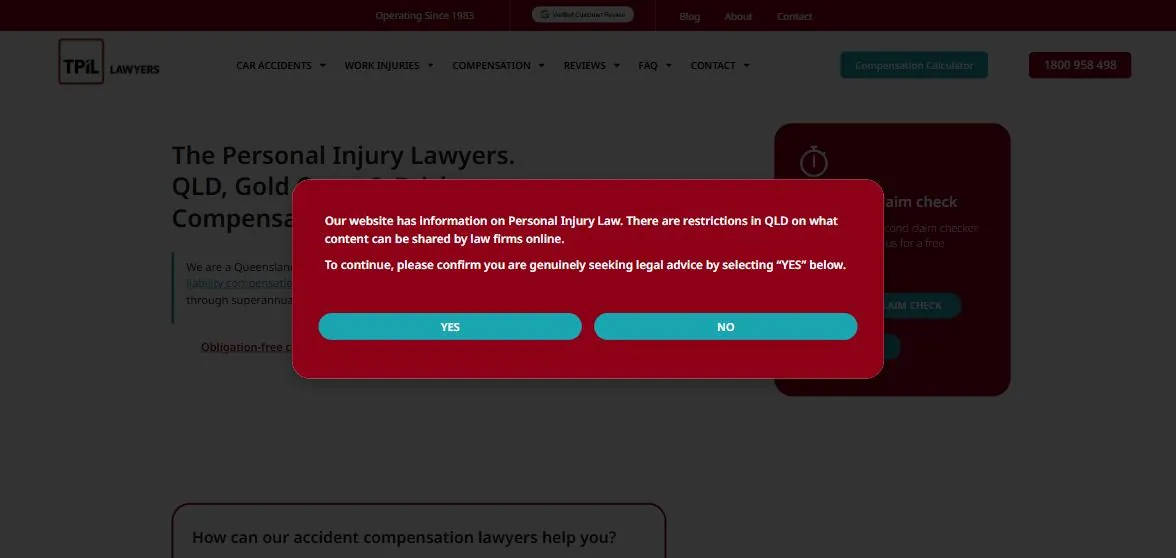
The Personal Injury Lawyers, Queensland. 15 of 20. Behind the modal is a good page: a headline with the practice area and three cities, "operating since 1983", a verified-review badge, a claim checker and a 1800 number. The modal is the page's compliance decision made visible: "There are restrictions in QLD on what content can be shared by law firms online. To continue, please confirm you are genuinely seeking legal advice." It costs the firm a share of every click and it is the most literal answer we have seen to the Queensland question. A firm that takes this view should at least make the Yes button the obvious one; here the two are identical.
Family law, Melbourne
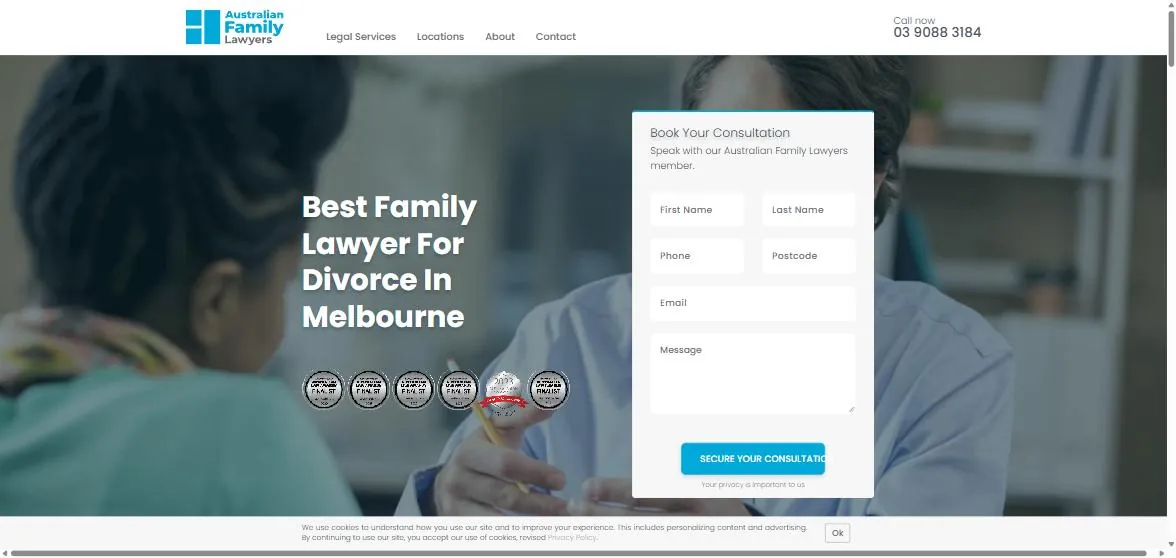
Australian Family Lawyers, "Best Family Lawyer For Divorce In Melbourne". 15 of 20. The only page in the set that is unmistakably a paid landing page: a stripped nav, a headline that matches the search, a phone number top right, award badges, and a form in the hero. It loses a point for a six-field form with no qualifying question, a point for award badges with no Google rating, a point for a cookie banner across the bottom, and a compliance point for "Best", which is a superlative the firm cannot substantiate and Google's ad policy does not love either. Swap "Best" for "Fixed-Fee", add the rating and cut the form to three fields with a matter-type question, and this is an 18.
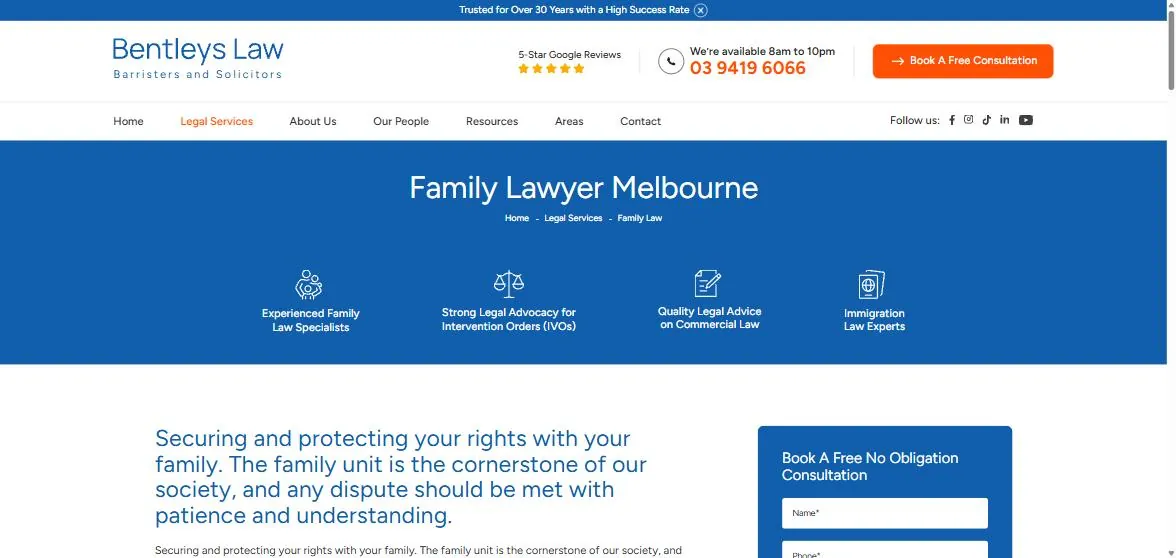
Bentleys Law, family lawyer Melbourne. 12 of 20. The practical elements are good: a phone number with "available 8am to 10pm" next to it, exactly what a family law enquirer at 9pm wants to see, a "Book a Free Consultation" button, and "5-Star Google Reviews" in the header. The page then undercuts itself. "Experienced Family Law Specialists" sits beside icons for intervention orders, commercial law and immigration, so the family law visitor is looking at a general practice, and "Specialists" is a term the Victorian regime reserves for accredited specialists, none of whom are named here. "High Success Rate" in the top banner is the kind of claim the Uniform Law wants a basis for. The form is below the fold.
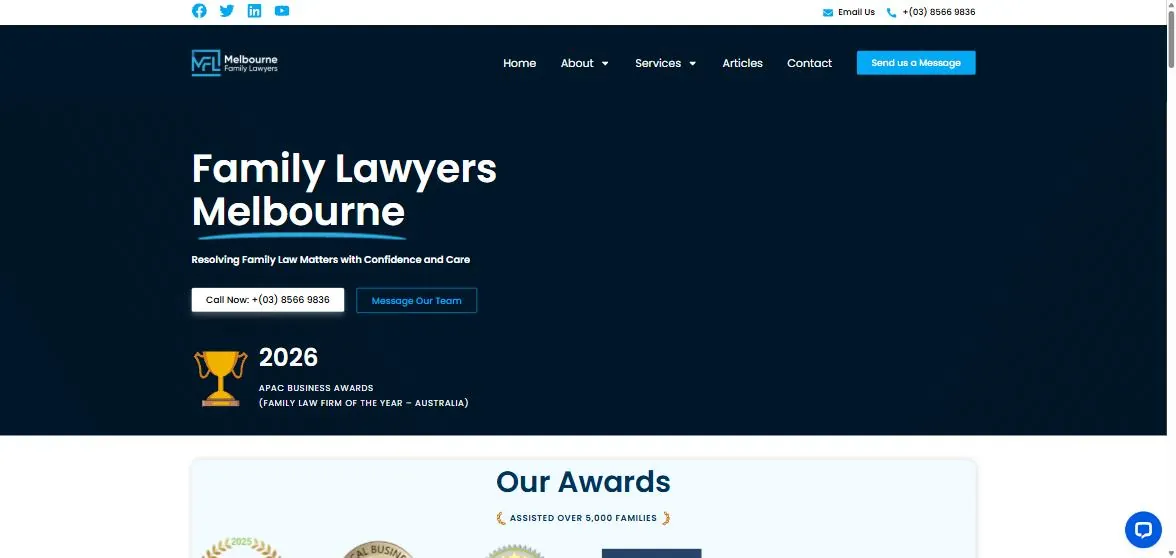
Melbourne Family Lawyers. 14 of 20. A clean page with the headline, two actions (call and message) and a 2026 award. No form, no Google rating, and a chat bubble in the corner. The award is proof of a kind; a rating with a count would do more for a frightened person at night, and the pack this firm sits in has a median of 128 reviews, so the count is there to show.
Criminal law, Sydney
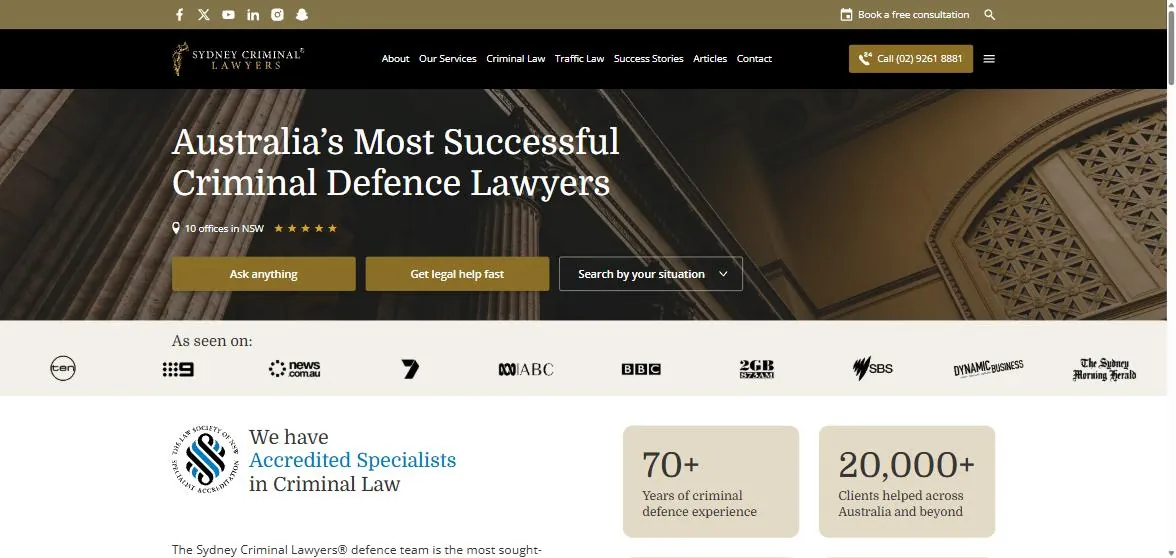
Sydney Criminal Lawyers. 12 of 20. Everything a criminal page should have is on the screen somewhere: a phone number, accredited specialists with the Law Society mark, 70-plus years, 20,000-plus clients, a media logo row. The two problems are the headline and the actions. "Australia's Most Successful Criminal Defence Lawyers" is an unsubstantiated superlative on a page from a firm that, further down, carefully documents its accreditations; the accreditations are the claim worth leading with. And the hero gives the visitor three buttons of equal weight ("Ask anything", "Get legal help fast", "Search by your situation"). None of them is the phone number a person who has just been charged wants.
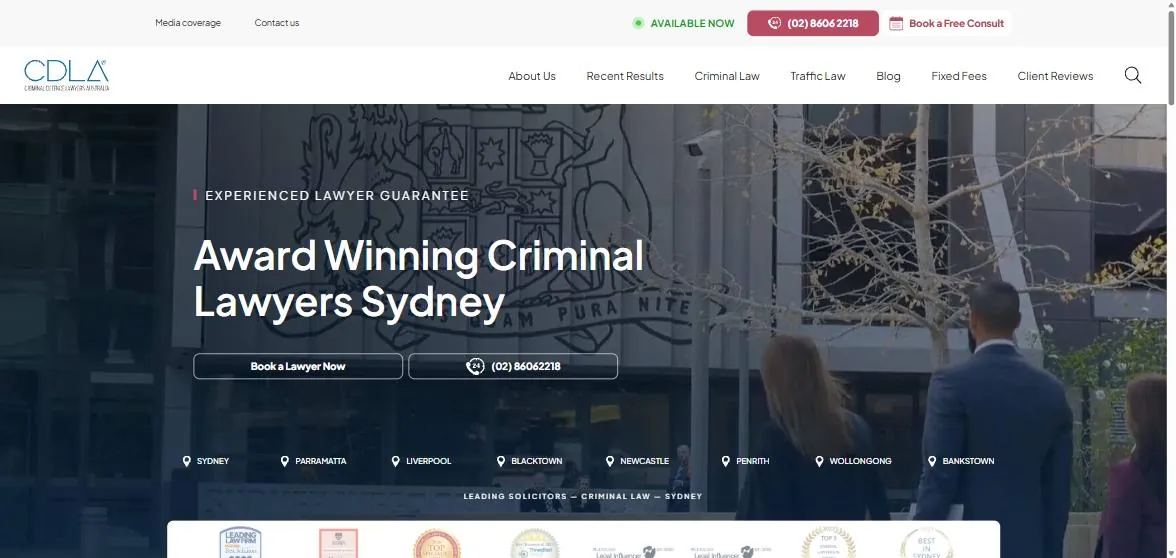
Criminal Defence Lawyers Australia, Sydney. 14 of 20. "Award Winning Criminal Lawyers Sydney" with a book button and a phone button side by side, "Available now" with a green dot, eight office locations and a row of award badges. Clean and specific. It loses on proof (awards rather than accreditation or named lawyers in the first screen), on no rating, and on "Experienced Lawyer Guarantee", which is a word a law firm's ad should not contain without the terms attached.
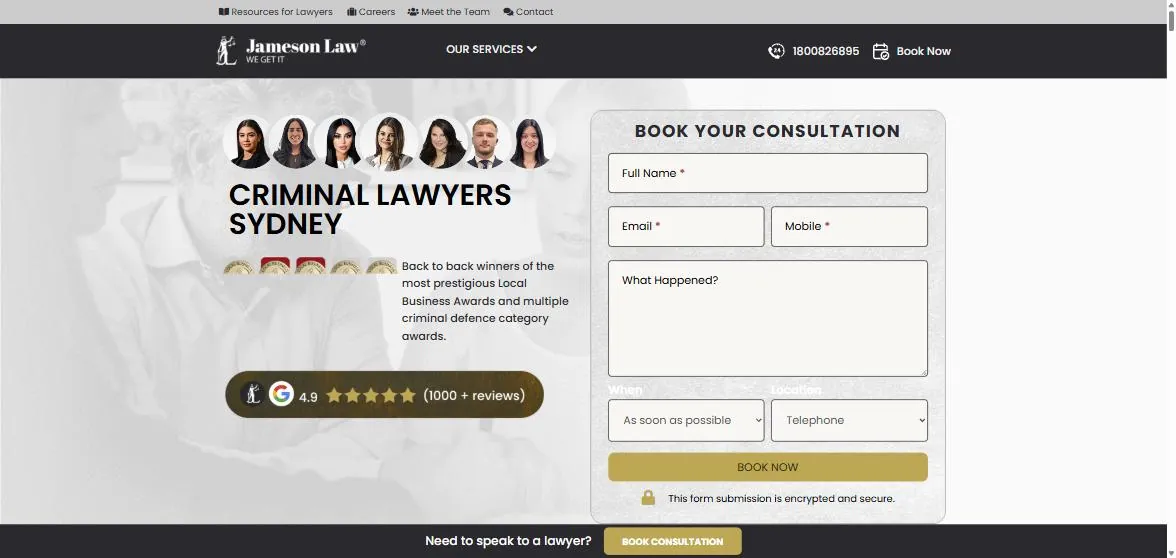
Jameson Law, criminal lawyers Sydney. 19 of 20. The top scorer. Seven lawyers' faces above a headline that names the practice area and city. A Google 4.9 rating with "1000+ reviews" beside it. A form whose fields are name, email, mobile, "What happened?", when the person wants to speak and how. A phone number and a book button in a minimal header, and a sticky "Need to speak to a lawyer?" bar at the bottom. The one point it drops is for proof: the awards are local business awards, and an accredited specialist or a named senior lawyer would carry more weight with a visitor comparing it with the two pages above. It is the page the other eleven should be measured against.
Conveyancing, Perth
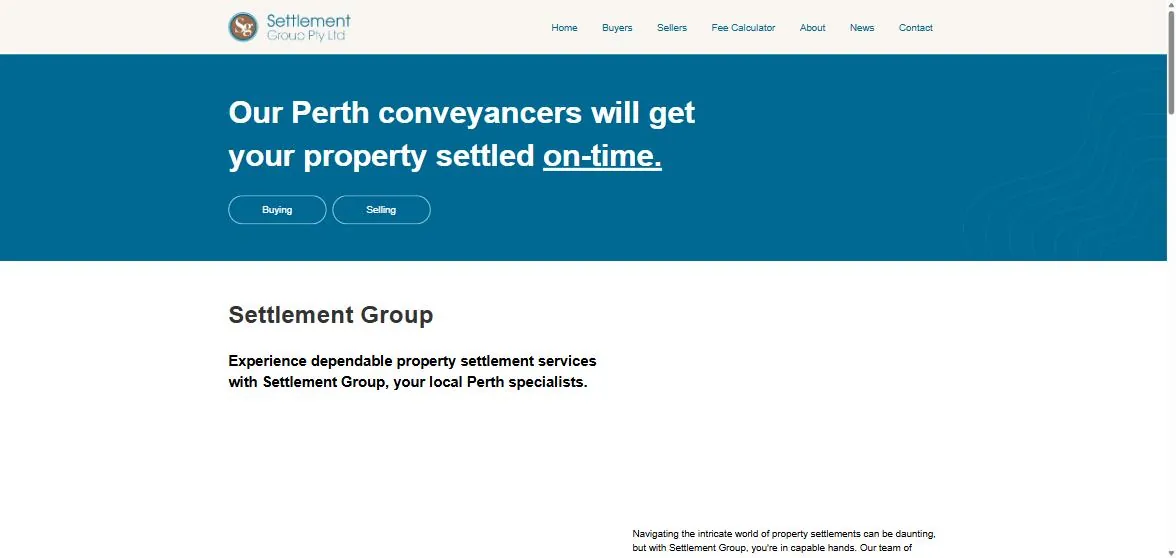
Settlement Group, Perth. 11 of 20. A good headline ("Our Perth conveyancers will get your property settled on time") and two buttons, Buying and Selling, that route the visitor sensibly. Then nothing else: no phone number anywhere in the first screen, no fee, no rating, no proof. Conveyancing is bought on price and reliability, and a Perth searcher comparing three tabs wants the fee calculator the nav mentions in the hero, not two clicks away.
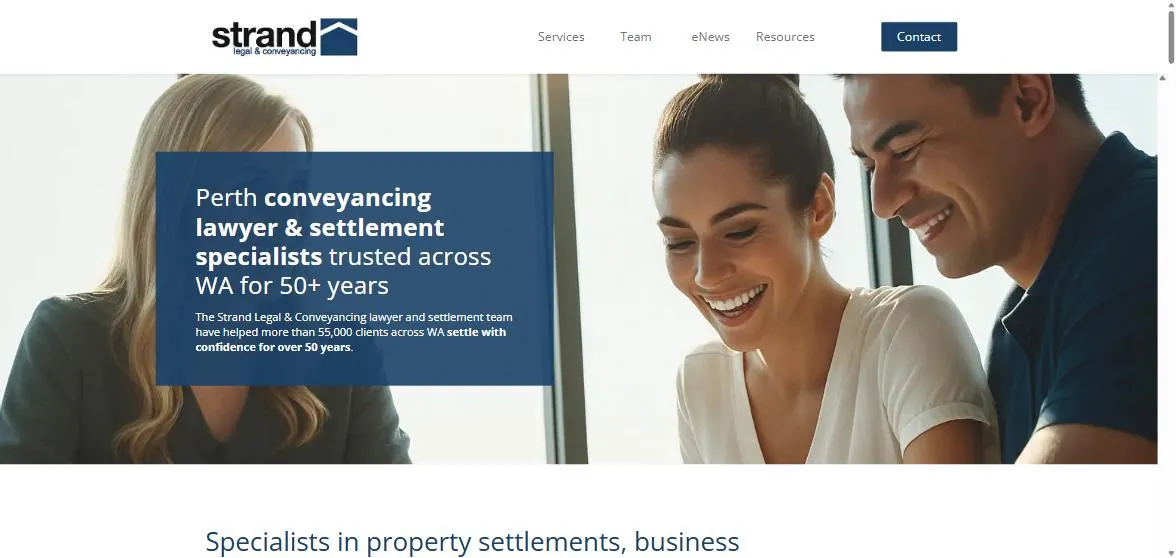
Strand Legal and Conveyancing, Perth. 11 of 20. "Trusted across WA for 50+ years" and "more than 55,000 clients" is real proof and it is in the headline. There is no action at all: no number, no form, no button beyond "Contact" in the nav. A page with this much proof and a fixed-fee quote button would be near the top of the set.
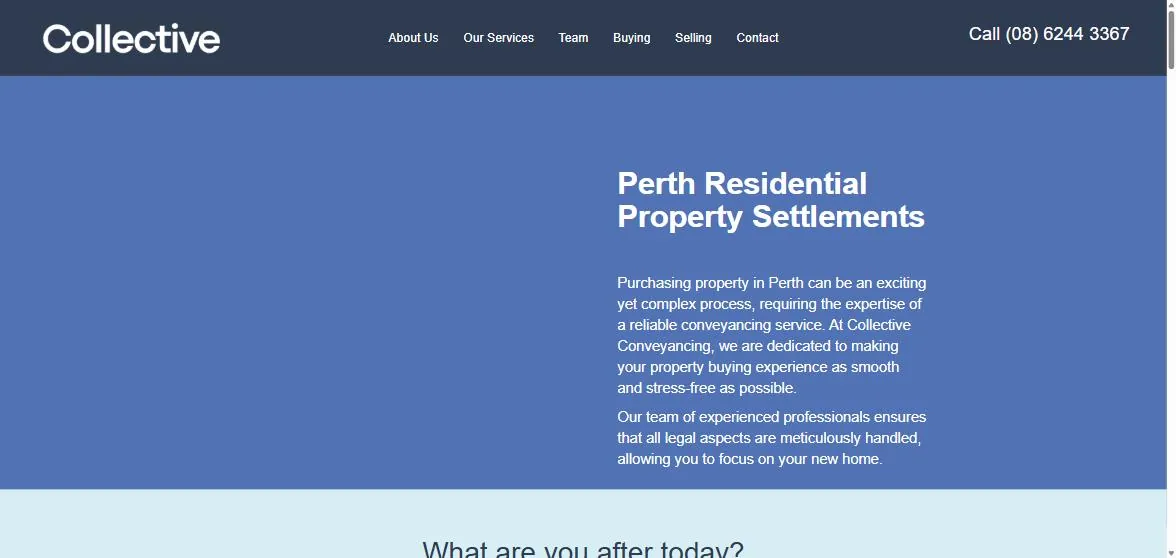
Collective, Perth residential property settlements. 12 of 20. Headline and phone number present and the page is specific to the service. Two paragraphs of copy and no action, no fee, no rating. The conveyancing pages as a group score lowest because the category's conversion lever, a visible price, is absent from all three; the firm that puts "from $X, fixed" in the hero takes the search.
What the scores say
| Page | Practice area | Score |
|---|---|---|
| Jameson Law, Sydney | Criminal | 19 |
| Splatt Lawyers, Brisbane | Personal injury | 15 |
| The Personal Injury Lawyers, Queensland | Personal injury | 15 |
| Australian Family Lawyers campaign page, Melbourne | Family | 15 |
| Melbourne Family Lawyers | Family | 14 |
| Criminal Defence Lawyers Australia, Sydney | Criminal | 14 |
| Bentleys Law, Melbourne | Family | 12 |
| Sydney Criminal Lawyers | Criminal | 12 |
| Collective, Perth | Conveyancing | 12 |
| Settlement Group, Perth | Conveyancing | 11 |
| Strand, Perth | Conveyancing | 11 |
| Turner Freeman, Brisbane | Personal injury | 10 |
Three patterns. The pages that score well are the ones built for the click rather than the ones that happen to rank. Only one page in twelve showed a Google rating with a count in the first screen, and it was the top scorer; the pack these firms sit in has medians of 78 to 356 reviews, so the proof exists and is not being shown. And the national and multi-office firms score below the boutiques, because their pages carry the whole firm's navigation and the whole firm's caution.
Conversion rates: what the accounts say
| Page type | Conversion rate range, our law firm accounts | Example |
|---|---|---|
| Home page used as the ad landing page | 1% to 3% | The pattern in most new accounts we take over |
| Practice-area service page | 2% to 5% | A page that answers the search but carries the site's navigation and length |
| Purpose-built landing page, matched to the ad group | 6% to 10% | The Brisbane and Gold Coast family firm's custom pages at 9.7%; the account in the 400 landing pages piece that went from 3% to 8% by matching the page to the search |
On the same spend, the difference between the first row and the third is three to five times the enquiries. It is the single largest lever in a law firm's paid account, ahead of bidding, ahead of keywords, and it is the one most agencies touch last because the firm's website is "not our job". Why your law firm's Google Ads leads are junk has the order to fix things in; the page is second, after tracking.
Form or phone number
The rubric scores both, and the first-screen priority depends on the practice area. From the call tracking and form events across our accounts:
| Practice area | How enquiries arrive | What goes first on the phone screen |
|---|---|---|
| Criminal | Mostly calls, often at night and in a hurry | The number, tappable, with "available now" or the hours. Form second |
| Personal injury | Calls during the day; forms at night | The number and a one-question claim check side by side, as the Brisbane injury pages do |
| Family | Forms, a majority outside business hours; calls during the day | A three-field form with a matter-type question, the number beside it, and the hours the phone is answered |
| Commercial and litigation | Forms and emails, during business hours | A form with a matter-value or matter-type question; the number is secondary |
| Property and conveyancing | Quote requests | A fee, then a quote form; the number third |
| Immigration | Forms, in the enquirer's language where possible | A form with the visa type as the first question |
Whichever leads, the form's first question should qualify. "What happened?" on the Jameson Law page does it in three words. A matter-type dropdown does it for family. A yes/no "did someone else's negligence cause your injury?" does it for personal injury, and the Splatt page starts there. A form that asks for name, email, phone and "message" qualifies nothing and gets filled in by everyone.
The compliance errors on page one
In twelve pages from firms good enough to rank first, we found claims in the first screen that we would not run an ad to:
| Claim | Where | The problem |
|---|---|---|
| "Australia's Most Successful Criminal Defence Lawyers" | Criminal, Sydney | A superlative with no basis given; the Uniform Law's prohibition on misleading conduct applies to advertising, and Google's own policy on superlatives applies to the ad that points here |
| "Family Law Specialists" | Family, Melbourne | "Specialist" is restricted to accredited specialists in Victoria and New South Wales; the page names none |
| "Best Family Lawyer For Divorce In Melbourne" | Family campaign page | Same problem as the first row |
| "Experienced Lawyer Guarantee" | Criminal, Sydney | A guarantee is a representation; the terms are not on the page |
| "High Success Rate" | Family, Melbourne | A results claim with no definition |
| "100% No Win, No Fee" | Personal injury, Queensland | Permitted elsewhere; in Queensland the Act's application to a firm's own website is contested and some firms gate the site instead |
None of these is dramatic and all are common. Each is also the kind of line a competitor screenshots and sends to the Legal Services Commissioner, and the fix is a better claim: the accreditation, the years, the named lawyer, the rating with its count. The Australian rules for law firm advertising, by state, are set out in how to market a law firm in Australia.
What a 20-point page looks like, by element
Taking the best of the twelve and the pages in our own accounts that convert at the top of the range:
A firm can score its own page against the rubric in five minutes with a phone and honesty. Most will land between 10 and 14, which is where most of the pages that rank first in Australia are. The gap from there to 18 is a day's work on the page and the difference between an account that produces enquiries at $400 and one that produces them at $130 on the same spend. The Google Ads guide for law firms covers the account that sends the traffic; how to improve your website conversion rate covers the changes we make first on the rest of the site.
Want us to implement these strategies for you?
Book a free strategy call and let's discuss how we can grow your business.
Book Your Free CallContinue reading
More on Law Firm Marketing
Do Facebook Ads Work for Law Firms? Cost per Client by Practice Area
Meta ads produce enquiries for law firms at a fifth to a tenth of the Google Ads cost, and the enquiries are colder. That is the whole trade. What they cost by practice area, which practice areas they work for and which they do not, what you are allowed to say in an ad in each Australian state, lead forms versus landing pages, the budget that lets the account learn, and how to tell within 30 days whether it is working.
Google Business Profile for Lawyers: How to Get Into the Map Pack
The map pack is the first thing most legal searchers see, and the profiles in it have more in common than firms expect. What the ranking factors weigh, the review counts and categories in eight live Australian legal packs, which category to pick by practice area, serviced offices and suspensions, what a Queensland injury firm can and cannot write, review response templates, the tracking that shows whether the profile is producing calls, and a 30-day setup checklist.
Is SEO Dead for Law Firms? The Firm That Grew 6x While AI Took the Clicks
AI Overviews now sit on every "is SEO dead" search and on most legal questions, and Ahrefs measured a 58% click loss for the top result when one appears. In the same months a Melbourne litigation firm went from 785 to 5,217 organic clicks a month. What actually died, which query types still send clicks, where AI assistants send law firm traffic, and the honest reconciliation with what we wrote in 2025.
SEO for Family Law Firms: What Separating People Actually Click
Family law search is long, private and emotional, and most of it happens weeks before anyone calls a lawyer. How to structure a family law site by matter type, the hire-intent and research-intent keywords for divorce, property settlement, parenting, child support, financial agreements and de facto matters, what a local page needs to be more than a doorway, why the practitioner profile is a ranking asset, and what to expect month by month.