




Someone in Chermside types "family lawyer brisbane" into Google at 9:40 on a Tuesday night. Four ads appear above the map. One of them is yours. They tap it, land on a page, and either call, fill in a form, or leave. If they call, someone at your firm answers or does not. If they are a private client with a property pool, they may become a $15,000 matter. If they need Legal Aid, they have just cost you $12 and ten minutes of a receptionist's time.
That whole chain is what Google Ads is for a law firm, and every step in it has a number. This guide walks the chain from search to signed matter using figures from accounts we have managed: more than $7 million of Google Ads spend since 2015 across the accounts still connected to our reporting and the ones behind our case studies, of which about $3.4 million is law firms. The cost figures are drawn from the last two years, because that is the period where we can follow every enquiry through to whether it signed; older accounts tell us what clicks cost, not what clients cost. It is written for a partner or practice manager who wants to understand the machine well enough to judge whether theirs is working, whether they run it themselves or pay someone to.
Key Takeaways
- Google Ads is an auction for intent. You pay per click, the price is set by what competing firms bid for the same search, and in legal that price ranges from $4 for immigration terms to over $80 for "no win no fee" injury phrases in Australia, and far higher in US metros.
- The click is the cheapest part. On our legal accounts a family law click averages $7.62 and an enquiry $127; a signed client costs $1,900 to $2,300 because it takes 13 to 17 enquiries to sign one. The budget has to be built backwards from that last number, not forwards from the click.
- Four campaign types, in order: brand, service, location, question. A law firm account with one "general" campaign is the most common structure we inherit and the most common reason the account loses money.
- Google optimises toward whatever you count. Count form fills and it finds form fillers. Feed back which enquiries became matters and it finds clients. This is the single largest lever in the account and most firms have never pulled it.
- The landing page and the intake decide more than the bidding. A 9.7% landing page conversion rate on the same traffic that converted at 3% on the firm's website, and a signed-matter rate that halves when calls go to voicemail, are both from accounts in this article.
What actually happens when someone searches
Google Ads is an auction run in the fraction of a second between a search and the results. Every advertiser who has bid on a keyword that matches the search enters with a bid and a quality score; Google ranks them by the product of the two, shows the top few, and charges each advertiser roughly what was needed to beat the one below them. You pay when someone clicks, not when the ad is shown.
Three consequences matter for a law firm. The price is set by your competitors, not by Google, so practice areas with high matter values have expensive clicks because the firms in them can afford to bid. Quality score is a discount: an ad and a landing page that closely match the search pay less per click for the same position. And because you pay for the click rather than the enquiry, everything that happens after the click, the page, the form, the phone, decides whether the money turned into anything.
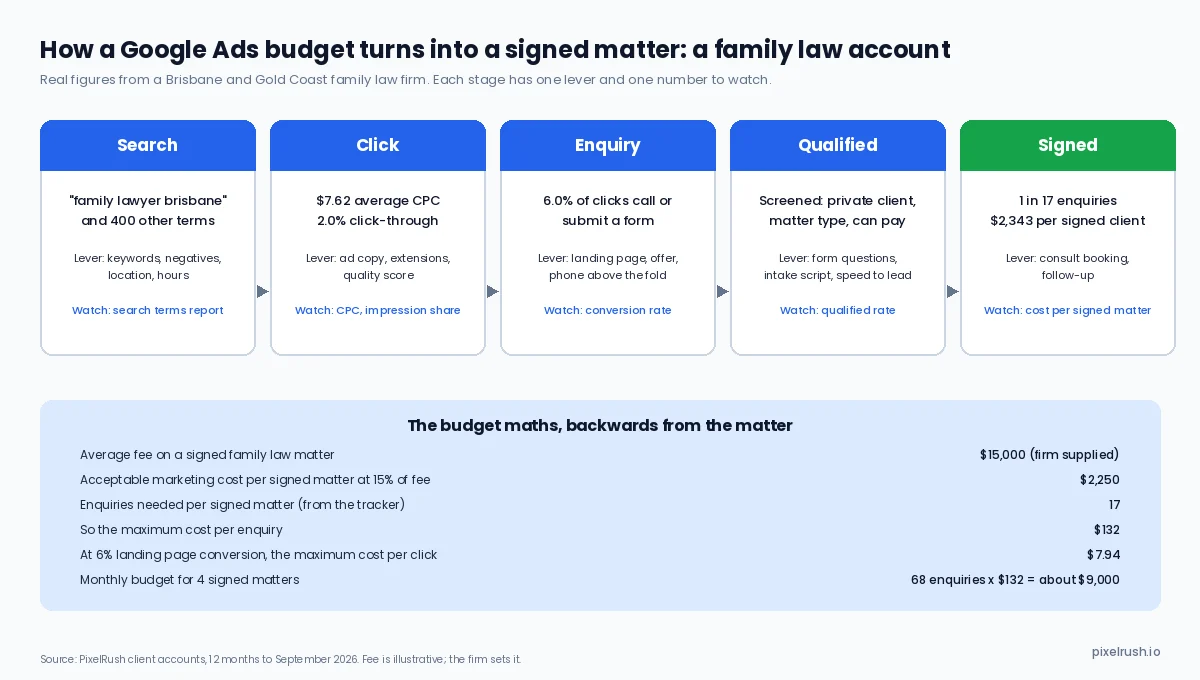
The chain from search to signed matter on a Brisbane and Gold Coast family law account, with the lever and the number to watch at each stage. The budget maths underneath is the way every law firm budget should be built.
What Google Ads costs a law firm
The figures below are from accounts we manage, non-brand search only, calls and forms counted as enquiries. Published benchmarks are mostly US figures scraped from keyword tools and they are wrong for Australia by a wide margin, which our Google Ads cost guide goes into.
| Practice area | Average cost per click | High-intent phrases | Cost per enquiry | What $5,000 a month buys |
|---|---|---|---|---|
| Immigration and visas | $3.71 | $12 to $16 for partner visa terms | $32 to $57 | 90 to 150 enquiries |
| Family law | $7.62 | $22 to $35 for suburb and city terms | $127 to $210 | 25 to 40 enquiries |
| Criminal law | $18.09 | $48 for "criminal lawyers brisbane" | $203 to $280 | 18 to 25 enquiries |
| Commercial litigation | $8.95 | $74 for "commercial litigation lawyers melbourne" | $287 in Brisbane to $560 in Melbourne | 9 to 17 enquiries |
| Personal injury | $33 | $63 to $81 for "no win no fee" phrases | Around $400 | 12 enquiries, with a very wide range by claim type |
Two things to take from the table. Cheap clicks do not mean cheap clients: commercial litigation clicks cost less than half of criminal law clicks and the enquiry costs more, because fewer of the people searching are ready to instruct. And the spread inside a practice area is wider than the spread between them. Family law ranges from $158 to $310 per enquiry across three firms bidding on the same terms; that spread is the gap between a good account and an ordinary one.
Our law firm cost per lead guide has the full dataset, including cost per signed client, and how much a family law firm should spend turns it into budget tiers for that practice area.
The budget maths, backwards from the matter
Most law firms set a Google Ads budget by picking a number they are comfortable losing. The right way is to start from the fee and work back, and it takes five lines.
| Step | Example: family law | Where the number comes from |
|---|---|---|
| Average fee on a signed matter | $15,000 | The firm's practice management system |
| Marketing cost the firm will accept per signed matter | 15% of fee = $2,250 | A decision; 10 to 20% is the range we see |
| Enquiries needed to sign one matter | 17 | The lead tracker, after 90 days; before that, use 12 to 20 for family, 15 to 50 for injury |
| So the maximum cost per enquiry | $2,250 ÷ 17 = $132 | Arithmetic |
| At the landing page's conversion rate, the maximum cost per click | $132 × 6% = $7.94 | Landing page data; 5 to 10% is achievable |
| Monthly budget for a target of four signed matters | 4 × 17 × $132 = about $9,000 | Arithmetic |
The point of doing it this way is that every assumption is checkable within three months. If the enquiries-per-matter figure turns out to be 30 rather than 17, the budget is wrong by half and you know exactly which part of the chain to fix, because it is the intake, not the ads. Our guide to whether Google Ads is worth it for law firms applies the same arithmetic to personal injury, where one signed matter can be worth $60,000 and the maths tolerates a very different cost per enquiry.
Key Point
A law firm Google Ads budget is not "what can we afford". It is the fee, times the share of it you will spend to win it, divided by the enquiries it takes to sign one. If nobody at the firm can tell you how many enquiries it takes to sign a matter, that is the first thing to fix, before any budget is set.
Campaign structure: the four campaigns every law firm account needs
The accounts we inherit usually have one campaign called something like "Search" with every keyword in it, or a campaign per practice area with the city term, the question terms and the firm's own name all mixed together. Google cannot tell those searches apart in the budget, so it spends on whichever gets clicks, which is rarely the one that gets matters.
| Campaign | What it targets | Role | Share of spend | Landing page |
|---|---|---|---|---|
| Brand | The firm's name, misspellings, the lawyers' names | Stops competitors buying your name; the cheapest conversions in the account ($35 per enquiry on a family account whose non-brand average was $178) | 5 to 10% | Homepage |
| Service | "Family lawyer brisbane", "property settlement lawyer", "drink driving lawyer", "TPD claim lawyer" | The core; high intent, matched one-to-one with a landing page per service | 50 to 60% | One page per service, per city |
| Location | "Family lawyer chermside", "conveyancing lawyer ipswich", every suburb the firm serves | High intent, low competition; the suburb is inserted into the page so the search and the page match exactly | 20 to 30% | Location pages, dynamically matched |
| Question | "How is property divided in a divorce", "can I contest a will" | Lower intent, cheaper clicks; feeds remarketing and tells you what to write; run only once the service campaigns are saturated | 5 to 15% | The article that answers it |
Each campaign keeps its own budget, so a surge of cheap question clicks cannot eat the service budget, and each reports its own cost per enquiry, so you can see that the location campaigns on a Melbourne family account came in at $169 an enquiry against $196 for the broad general campaign. Our guide to structuring PPC campaigns for law firms that convert goes further into the build.
Three settings inside the campaigns cost more law firms money than anything else. Search Partners and Display left on, which quietly takes 15 to 30% of budget to low-quality placements. Location targeting left on "presence or interest", which shows a Brisbane firm's ads to people in Manila researching Brisbane. And broad match keywords with no negative list, covered in the next section.
The junk lead problem and the negative keyword list
The most common complaint from a law firm about Google Ads is not that it is expensive. It is that the enquiries are rubbish: people wanting free advice, people in the wrong state, people with a matter the firm does not do, people who need Legal Aid.
Nearly all of that is the campaign matching to searches it should never have matched to, and it is fixed with a negative keyword list that tells Google which searches not to enter. The list we run on family accounts has over 5,000 terms built up over years and it starts every new account; the categories are below.
| Category | Examples | Why they cost money |
|---|---|---|
| Free and legal aid | free, legal aid, pro bono, community legal, duty lawyer, no cost, cheap | The largest single source of junk in family and criminal; these people click, call and cannot pay |
| Jobs and study | jobs, salary, careers, paralegal, how to become, law school, LLB | Students and job seekers search lawyer terms constantly |
| Self-help | template, form, kit, DIY, do it yourself, sample, PDF | People who want the document, not the lawyer |
| Wrong matter | Every practice area the firm does not do; for an injury firm: family, criminal, conveyancing | A personal injury firm pays injury-level CPCs for a divorce enquiry |
| Wrong place | Other states' cities, "near me" variants for places outside the service area, interstate court names | Especially damaging on injury where the law differs by state |
| Competitors and directories | Named competitor firms, Legal Aid, LawAccess, directory names | You rarely win these and the clicks are expensive |
| Already a client or employee | Portal, login, invoice, staff, careers | Existing clients searching for the client portal |
The list is never finished. A monthly search terms review finds the new variants, and in legal they multiply: "family lawyer free consultation" needs a decision (do you offer one?), "family lawyer Centrelink" is a negative, "family lawyer payment plan" might be a client. Our guide to junk leads from Google Ads covers the six causes in detail and the order to fix them in.
Conversion tracking: what Google is trying to find
Most firms get this part wrong, and it explains why two accounts with the same keywords and the same budget produce completely different clients.
Google's bidding runs on whatever you tell it is a conversion. If the account counts every form submission and every phone call over 10 seconds, Google learns to find people who submit forms and make short calls, which includes the student, the legal aid enquirer and the spam bot. If the account counts only calls over 60 seconds and forms with a qualifying answer, Google learns to find those. And if the firm records which enquiries became consultations and signed matters and feeds that back into the account, Google learns to find clients.
| What the account counts as a conversion | What Google optimises toward | What the firm gets |
|---|---|---|
| Every form and every call | Volume | Many enquiries, mostly unqualified |
| Calls over 60 seconds, forms with screening answers | Enquiries that at least passed a filter | Fewer, better enquiries |
| Qualified enquiries, marked by intake within 24 hours | People who match the firm's criteria | Enquiries the lawyers want to call back |
| Signed matters, imported with a value | Clients, weighted by what they are worth | The property settlement over the consent order |
CK Family Lawyers' account runs the last row: conversions are weighted by matter value, and the algorithm has learnt to find the enquiry worth $20,000 rather than the one worth $2,000. It produced 735 qualified leads at $97.51 on $72,000 of spend. It requires the firm to do one thing, which is to tell us within a day or two what each enquiry became. The firms that will not do that get the first row, and they get the results of the first row.
Expert Tip
Before anything else is changed in an inherited account, look at the conversion actions. In most law firm accounts we audit, the primary conversion is a page view, a button click or a 10-second call, and the account has been training Google to find the wrong people for years. Fixing that one setting changes the account more than any bidding or keyword work.
The landing page: where the budget is won or lost
Sending paid traffic to a law firm's homepage halves the conversion rate, because the homepage is about the firm and the visitor searched for a service. Two accounts make the point. CK Family Lawyers' custom landing pages converted 9.71% of visitors on traffic that the firm's website had been converting at a fraction of that. Melbourne Family Lawyers' leads rose 575% and cost per lead fell 52% in the first month after landing pages replaced the text-heavy site pages, on the same budget.
The page that converts a legal search, in order from the top:
| Element | Why |
|---|---|
| Headline that names the service and the city the visitor searched | The visitor checks they are in the right place in under a second |
| Phone number and a three-field form above the fold on mobile | Most legal search traffic is mobile and outside business hours |
| The offer: free or fixed-fee first call, and what happens after | Removes the fear of an open-ended bill and of commitment |
| Three to five reviews above the fold | Moving testimonials below the fold measurably cut conversion in our tests |
| The lawyers' names and faces | The visitor is about to tell a stranger their worst problem |
| Direct answers to the three questions this service always raises | Cost, time, "will I have to go to court" |
| Nothing else | No menu, no blog links, no newsletter; one job |
Our guide to improving website conversion rate covers the tests behind that order, and the lessons from 400 landing pages shows the before and afters.
Intake: the step the ads cannot fix
A legal enquirer calls two or three firms. The signed-matter rate on an account halves when calls go to voicemail, and a form enquiry that is not called within an hour is usually already talking to someone else. On accounts where we can see both, the difference between an intake team that answers in three rings and books on the call, and one that calls back the next morning, is larger than the difference between a good campaign and a bad one.
The practical standard: answer within three rings or call back within five minutes, run a 60-second screening script before any legal discussion, book the consultation on the first call, and cover after-hours with at least an SMS promise of a call-back time. Our first six months of law firm advertising covers what intake needs before a campaign launches.
Compliance: what you can and cannot say in an ad
Google approving an ad does not make it compliant, and the regulator holds the lawyer responsible regardless of who wrote it.
| Australia | United States | United Kingdom | |
|---|---|---|---|
| Who regulates | State legal services commissioners under the Legal Profession Uniform Law and state Acts | State bar associations under their versions of the ABA Model Rules (7.1 to 7.5) | Solicitors Regulation Authority; Advertising Standards Authority for general ad rules |
| The general rule | Not false, misleading or deceptive; not likely to bring the profession into disrepute | Not false or misleading; no unjustified expectations; "specialist" claims restricted in many states | Not misleading; SRA Transparency Rules require published prices for some services |
| Personal injury specifics | Queensland and NSW restrict personal injury advertising heavily; the rules on what can appear in an ad are the strictest in the country | Testimonials and results claims regulated state by state; some require disclaimers | Referral fee ban in personal injury since 2013; claims management rules |
| "No win no fee" | Permitted with conditions; must not be misleading about what the client pays | Permitted; "contingency" language common | Permitted as "conditional fee agreement"; must be accurate about deductions |
| Google's own policy | Local legal advertising rules apply; certain claims disapproved | Legal services ads must comply with local law; certification required for some categories | Same |
Australian personal injury firms should read whether personal injury lawyers can advertise in Queensland before writing an ad, because the Queensland rules restrict content that is routine in every other state. For all three markets, the practical process is the same: a named lawyer reviews ad copy and landing page copy before it goes live, and the review is documented.
What the first year looks like
Google Ads produces enquiries in the first week, which is its main advantage over SEO, and it does not produce its best results until the account has enough conversion data to bid well, which takes about three months.
| Month | What is happening | What the firm sees | What to do |
|---|---|---|---|
| 1 | Tracking built, campaigns launched, negatives from the starter list, manual or maximise-clicks bidding while data accumulates | Enquiries from week one; cost per enquiry high; search terms report full of surprises | Daily search terms review; mark every enquiry qualified or not |
| 2 | Negatives tightened; first landing page changes; Google has 30 to 50 conversions per campaign | Cost per enquiry falling; quality improving | Weekly review; move to conversion-based bidding where there is data |
| 3 | Conversion-based bidding stable; first matters signed and fed back | The first cost per signed matter figure; the budget maths can be checked against reality | Fix whichever stage the maths exposes: enquiries per matter, conversion rate or CPC |
| 4 to 6 | Account at its floor cost per enquiry; location campaigns expanded; value-based conversions if the firm supplies them | Predictable enquiry volume; a known cost per matter | Scale the campaigns that produce matters; cut the ones that produce enquiries only |
| 6 to 12 | Second practice area or second city; brand campaign protecting the name that the ads have made more searched | Google Ads as the most measurable line in the marketing budget | Decide how much of the budget to shift toward SEO as organic enquiries arrive |
The firms that stop at month two because "the leads were bad" nearly always had the tracking problem in the conversion section above, and they conclude that Google Ads does not work for legal. It does; it was finding what it was told to find. Our first six months of law firm advertising covers this period in detail, and Meta ads versus Google Ads for law firms covers when the other channel is the better first dollar.
What a Google Ads report should show
If someone else runs the account, the report tells you whether they understand the chain above.
| A report that shows the work | A report that hides it |
|---|---|
| Cost per qualified enquiry, by campaign | Clicks, impressions and click-through rate |
| Cost per signed matter, where the firm has supplied the data | "Conversions" with no definition |
| The negatives added this month and the search terms that prompted them | A search terms report attached without comment |
| Landing page conversion rate by page | Average position |
| Impression share lost to budget on the service campaigns | "Reach" |
| The change log: what was changed in the account and why | A narrative paragraph that could apply to any month |
The ten questions to ask before hiring a PPC agency and how to tell if marketing is actually working cover the agency side. The seven costly Google Ads mistakes covers the settings leaks in detail, including an AI-assisted audit you can run on your own account.
The short version
Google Ads works for law firms when the budget is built backwards from the fee, the campaigns are split so each search type has its own money and its own page, the account counts qualified enquiries and signed matters rather than form fills, the page is built for the search rather than the firm, and someone answers the phone. Each of those is a number you can check in the first 90 days. When one of them is missing, the account loses money in a way that looks like "Google Ads does not work for lawyers", and it has nothing to do with Google.
If you want us to audit your account against this chain, book a call and bring read access to the account. We run Google Ads for lawyers across personal injury, family, criminal, commercial and immigration in Brisbane, Sydney, Melbourne, Perth and Adelaide.
Want us to implement these strategies for you?
Book a free strategy call and let's discuss how we can grow your business.
Book Your Free CallContinue reading
More on Law Firm Marketing
How Do You Market a Family Law Firm? What Worked Across $1.5 Million of Family Law Campaigns
Family law has its own marketing economics: urgent but not instant, high legal aid noise, matter values from $3,000 to $300,000 and a client who is researching at midnight. What we have learned running Google Ads, Meta and SEO for family law firms from Townsville to New Zealand, with the cost per lead from each account.
How Long Does SEO Take to Work for a Law Firm? A Week-by-Week Answer From a Real Account
The honest timeline for law firm SEO, from the weekly Search Console data of a litigation firm that went from 24 clicks a week to over 1,500 in six months, what you should see at each month, what makes it faster or slower, and when to call it.
How Do You Get a Law Firm Into ChatGPT, Gemini and Google AI Overviews?
What each AI answer engine actually reads, the signals that get a law firm cited, the robots.txt mistake that silently removes you from ChatGPT, and how to measure it now that Search Console reports AI impressions. With a 90-day plan for AU, US and UK firms.
SEO for Law Firms: 12 Strategies That Took a Litigation Firm From 785 to 5,200 Clicks a Month
How we structure, write and link a law firm website so it ranks, from the system that grew a litigation firm's search clicks 6.6x in five months with no link building, plus the PR and partnership work that builds links for firms that need them.