




You have probably been sold SEO at some point. A monthly retainer, a graph that was going to climb forever, a promise that if you just kept publishing, the traffic would come.
For a long time, that promise held. Then it stopped.
We know, because SEO used to be one of the best things we did. We walked away from it anyway, and built something that works better. This is the whole story, and the whole system, so you can decide what to do about your own content.
Key Takeaways
- SEO isn't dead, but the way most agencies sell it is. The steady climb that used to take a business from 1,000 to 40,000 visitors now stalls far sooner, and a stalled campaign breaks trust fast.
- Publishing more content is now a losing move. AI made content cheap and everywhere. Adding another average article hides you in the crowd instead of lifting you above it.
- Depth wins. Your goal is to publish the single best piece that exists on a topic, the one only someone who does the work could write.
- Put a real expert in front of the AI. We weight genuine first-hand expertise as the main source, around 60%, and use AI for structure and speed, never for the substance.
- Internal linking, pruning old content, and strong service pages matter as much as the writing. Most sites ignore all three.
- Authority is the moat. Real named authors and genuine outside recognition are the one thing content mills can't copy.
- The same system gets you found in AI search. What makes you the best answer for a person is what makes ChatGPT or Gemini cite you. We already see leads arriving that way.
Is SEO dead in 2026?
SEO is not dead. The version most people still pay for is.
Ask yourself a simple question. When did your organic traffic last grow the way it did in the early days? If the honest answer is "a while ago," you are already living the shift this article is about.
We had years where SEO was a cheat code. We would take an ordinary business doing 1,000 to 2,000 visits a month and, over a year, get it to 30,000 or 40,000. Real traffic. Real leads. A genuinely changed business.
Then the same work started producing less. Rankings that used to hold began to slide. The graph flattened earlier and lower every year.
So organic discovery still matters enormously. Being found by the right person at the moment they need you is worth more than ever. The old method of "publish keyword pages and climb steadily forever" is what stopped working.
Key Point
If your SEO results have quietly plateaued and nobody can explain why, that is not bad luck. It is the predictable result of running a 2015 playbook in a 2026 search environment.
Why has SEO stopped working?
SEO stopped working for four reasons, and each one tells you what the new strategy has to be.
Google took the clicks for itself. The ten blue links are gone. The results page is now full of Google's own features, map packs, snippets, and AI overviews that answer the question before anyone scrolls. You can rank on page one and still get no traffic, because an AI answer sits above you.
The supply of content exploded. AI made it trivial to produce a tidy, competent article in minutes. Every competitor in your market is publishing more, faster. When everyone floods the same topics with near-identical writing, "competent and optimised" becomes the floor, and the floor does not rank.
Google got better at spotting thin content. Update after update has targeted mass-produced, low-value pages. The exact tactic the AI tools push, publish a lot and publish quickly, is the tactic most likely to get you devalued.
And people started searching differently. More of your prospects now ask an AI assistant instead of running a Google search. If you only optimise for the classic results page, you are fighting for a shrinking share of how people actually find you.
| The old SEO playbook | The depth-first system |
|---|---|
| Publish a high volume of keyword pages | Publish the single best piece on each topic |
| Chase rankings and hope for clicks | Deserve to be the answer, in Google and AI |
| Content written from the average of the web | Content built on real first-hand expertise |
| More articles, faster | Fewer articles, deeper |
| Anonymous brand or "admin" bylines | Real, named, credentialled authors |
| Links and pruning left as afterthoughts | Systematic linking and a pruned, focused site |
Can you see the pattern? Every one of those forces punishes volume and rewards depth.
Expert Tip
Before you brief another batch of articles, check what shows above your best-ranking page in Google right now. If an AI overview is answering the query, your job is not a higher ranking. Your job is to be the source that answer is built from.
Does AI content actually work?
Most AI content does not work, and it is worth being precise about why, because the reason points straight at what does.
We learned this from the inside. We took on an outsourced-CMO role with a professional-services firm, so I became its head of marketing rather than a vendor bolted on the side. The firm was already looking at AI content tools and asked me to review them.
I was not impressed. Every showcase was the same: generic content with almost no depth. Competent, tidy, and completely forgettable.
The strategy underneath all of it was identical. Make content cheap, publish a lot of it, and hope Google and AI pick it up. That instinct is backwards.
AI did not make content better. It made content cheaper and more common. The web is now full of adequate, near-identical articles built the same way from the same prompts. Add one more, and you disappear into the pile. You do not stand out from it.
There is a deeper problem too. Ask a model to "write an article about X" and it gives you a blend of everything already written about X. By design, that is the average of what exists. It cannot be the best thing on the topic, because it is made from the middle of the topic.
So the scarce thing has flipped. Competent content is everywhere. Genuine depth and real expertise are rare. Rare is what wins.
Key Point
If your content plan is "publish more, faster," AI will help you fail faster. The only use of AI that holds up is as a tool for depth and consistency, not a machine for volume.
What is a depth-first AI content strategy?
A depth-first AI content strategy has one rule. For every topic that matters, publish the single most valuable piece that exists anywhere.
Not a good article. The best one. The piece a professional would bookmark. The one that answers the question and the three questions that come after it. The one only someone who actually does the work could have written.
One piece like that beats fifty thin ones on every measure that counts now. It earns links. It holds its ranking. It gets shared. It converts. And it is the source an AI reaches for when it builds an answer.
This changes the whole job. You are no longer trying to trick a ranking. You are trying to deserve to be the answer. That is a much higher bar, which is exactly why it lasts. Most competitors will not clear it, and no AI tool can fake it.
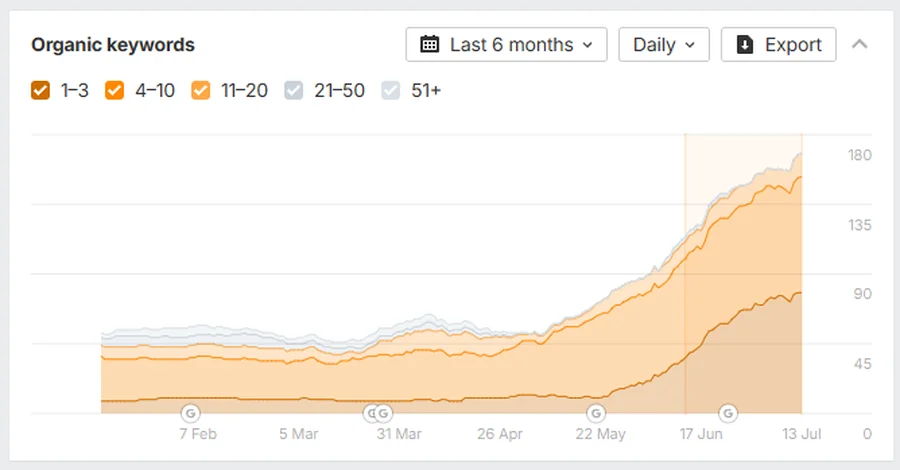
Organic keyword rankings climbing steadily as depth-first pieces mature, with top-three and top-ten positions accelerating from around May.
This is where it gets practical. You don't have to choose between expert quality and AI scale. You can have both, as long as the expert sits in front of the AI, not the other way around.
Ask yourself: on your most important topic, is there a single page on your site you would confidently call the best thing on the internet about it? If not, that is the gap.
Expert Tip
Pick your three most commercially important topics. For each, find the current best article on the web and read it properly. Your only goal is to publish something a fair reader would call clearly better. That is the whole brief.
How do you build an AI content pipeline that isn't generic?
An AI content pipeline that produces depth runs in two stages, and the order matters more than the tools.
Stage one is research, and it builds a map, not the material. Before you write a word, you research the topic to find the real questions people ask, the intent behind the search, what the current top pages cover, and where they fall short. That gives you the shape of a complete piece and the gaps you can own. It is scaffolding and search intelligence. It is not the substance.
Stage two is where most pipelines fail and ours is different. The article is not written from the research. It is written from a weighted blend, and real first-hand expertise is the main source. We weight it around 60%. Research supplies the other 40%, the facts, the statistics, the references, and the search scaffolding from stage one.
That expert input is not vague tone guidance. It is the real thing. Transcripts of a practitioner talking through how they actually think. Partner notes. The war stories, the warnings, the things clients always ask, the opinions the textbooks never print.
And it runs to strict rules. Every distinctive point the expert makes has to survive into the final piece. Their specific phrases and framings stay word for word, so the parts that sound like a real person do not get sanded off. When the research and the expert disagree, the expert wins. The voice sounds like them, not like a writer.
Do that, and the output reads like a senior practitioner on their best day, produced at a pace no single writer could match. Human expertise supplies the depth. AI supplies the speed and the structure. Swap that order and you are back to forgettable.
Key Point
The prompt that produces great content is not "write about X." It is everything a specialist knows about X that nobody has bothered to write down, and then the AI. The expertise is the ingredient. The AI is the oven.
How do you clean up old and stale content?
Before you add great content, deal with the bad content you already have. Almost every established site is carrying a graveyard: years of thin, dated, off-topic posts nobody reads.
That dead weight is not harmless. It blurs what your site is about, spreads your authority across pages that do not deserve it, and gives Google and AI a lower opinion of your site as a whole. When a third of your pages are weak, they drag down the average, and the average is part of how you are judged.
So audit everything, then do one of three things with each page.
Consolidate. Merge several thin posts on the same theme into one strong piece, and redirect the old URLs into it. Ten weak articles become one that can actually rank.
Refresh. Update the genuinely salvageable with current data and deeper treatment, then republish.
Remove. Delete and redirect the truly dead. Not everything deserves saving.
The target is simple. Nothing on your site is stale. Every page earns its place or goes.
Expert Tip
Pruning often lifts your traffic faster than publishing does. Cut the dead weight first, and the pages you care about inherit the focus. Clean the site before you scale production, not after.
How do you make your service pages convert?
Articles bring people in. Your service pages turn them into clients. Yet on most sites the service pages are the most neglected asset in the business, a few generic paragraphs written once and never touched again.
Rebuild them to be the best in your market for their job. The clearest, most reassuring, most complete version of that page a prospect could find anywhere. If your competitor's service page reads like a brochure and yours answers every question and objection a worried buyer has, you win the comparison at the exact moment they are choosing who to call.
Your best service pages matter to the whole system for a second reason. They are where your internal links should point. Which brings us to the discipline nearly everyone knows they should do and nearly nobody does well.
Key Point
Ask a friend who has never used your service to read your main service page and tell you, in one sentence, what you do and why they'd trust you. If they hesitate, that page is costing you clients every day it stays as it is.
How do you do internal linking properly?
Internal linking is where content strategies quietly fall apart. Everyone knows it matters. Almost nobody does it consistently, because doing it by hand across a growing library is tedious and gets skipped the moment things get busy.
Done well, internal linking does three jobs at once. It tells search engines and AI how your content connects, so you build authority on a topic. It sends readers and ranking strength toward your service pages. And it keeps people moving through your site instead of leaving.
The trick is to make it a system, not a chore. A few rules make that work at scale.
Spread the links out. Around 10 to 15 per article, placed across the whole piece, not stacked at the top. Aim to have links in most sections, not one.
Use two different anchor styles depending on where the link goes. This is the bit most people miss. For your service pages, use short, high-intent anchors of one to three words, the exact phrase a prospect would type into Google when they are ready to hire. For links to other articles, use longer descriptive phrases of three to six words that tell the reader what the article is about. A single generic word should never link to a blog post. That signal belongs to a money page.
Bind each key phrase to one destination and keep it there. The same anchor phrase should never point to two different pages, on a page or across the site. It splits your relevance and confuses search engines.
Never put a link inside a heading, and make sure every anchor genuinely describes where it leads, not just shares a word with it.
One more thing, and it saves you real pain later. Do not hand-embed a "related reading" list at the bottom of every post. Pull related articles automatically from the relevant category instead. If you hardcode them, then rename or retire an article, you have created broken links across your whole site. Let the relationships update themselves.
Expert Tip
If your internal linking depends on someone remembering to do it, it will rot. Build it so every new article gets linked on publication and the older articles link back to it, without anyone having to think about it.
How do you build authority and E-E-A-T?
Depth gets you into the race. Authority is what makes Google and AI trust you enough to put you forward. Two things matter most, and both are about being a credible name, not just a page.
Give your content real authors. Not a faceless brand. Not an "admin" account. Real, named practitioners with real reputations, ideally people who are searched for and recognised in their field. Google increasingly wants to know who stands behind a claim, and AI weights sources by provable expertise. The same article is worth far more under a respected expert's name than under a logo. Set the author up as a real, linked, credentialled person, and let that byline attach to everything they are behind.
Build outside signals of standing. Beyond your own site, the rest of the web's opinion of you decides a lot. Genuine awards and independent recognition. Real media mentions. Citations from other credible sources. These confirm what your content claims, and they are exactly the signals search engines and AI use to decide whether you are worth surfacing. You cannot fully manufacture them, which is why they carry weight.
Be honest with yourself here. If a prospect googled the name on your best article, would they find a credible person with a track record? Or a blank?
Key Point
In a web full of anonymous, AI-written sameness, provable authority is the one advantage the content mills cannot copy. Depth gets you cited. A real, credentialled author gets you trusted.
How do you publish content consistently at scale?
None of this compounds if every article is a manual, one-off effort. You get drift, inconsistency, and a system that only works while the person who cares is watching.
So publish through reusable components and shortcodes rather than formatting each post by hand. The building blocks of a strong article, the key takeaways box, the callouts, the comparison tables, the FAQ blocks, the headings, the internal links, all become standard pieces applied the same way every time. A post goes live with the right structure, design, and links built in, and nobody has to reformat anything.
You get three things from that.
Consistency, because every article looks and behaves like it belongs to one quality publication, which is a trust signal in itself. Speed, because formatting and linking are automatic and can flow straight into your CMS. And a floor, because the worst article you publish still has professional structure, since the system will not let it be otherwise.
Expert Tip
If your content quality depends on who formatted the post that day, it will slip. Engineer the structure into reusable blocks so consistency is automatic, and your people spend their energy on the only thing that should vary, the substance.
How do you get cited in AI search?
This is where the strategy pays off twice. Everything above is also how you get found through AI, what people now call answer-engine or generative-engine optimisation.
When someone asks ChatGPT, Gemini, or Perplexity "who is the best firm for X" or a specific question in your field, the assistant builds its answer from the sources it judges most complete, best structured, and most credible. A depth-first, well-linked, expert-authored, well-regarded site is exactly what it wants.
Four things make an AI cite you. Genuine completeness, so you are the most useful single source. Clear structure, with question headings, direct answers, and defined terms a model can parse and quote. Provable expertise and real authorship. And outside corroboration that confirms you are a real authority.
Notice that is the same list that makes you the best answer for a human. You are not choosing between ranking in Google and showing up in AI. One system does both.
And you can see it working. The clearest sign is not a number on a dashboard. It is a prospect on a first call saying, without being asked, that an AI assistant pointed them to you. That is the new word of mouth.
Key Point
Stop treating AI search as a separate project. The content that earns a Google ranking and the content an AI quotes are the same content. Build it once, properly, and you show up in both.
What results can you expect?
I will keep this vague about the firm, but the shape is real and recent. Across roughly three months of running this system as an embedded function:
| Metric | Before | After ~3 months |
|---|---|---|
| Monthly search impressions | Under 40,000 | Around 180,000 |
| Monthly clicks | About 600 | Over 2,200 |
| Daily clicks | Low tens | Well over a hundred |
| Average position | Lower | Improved, across far more queries |
Leads went up alongside the visibility, and a growing share of new enquiries now say an AI assistant is how they found the firm.
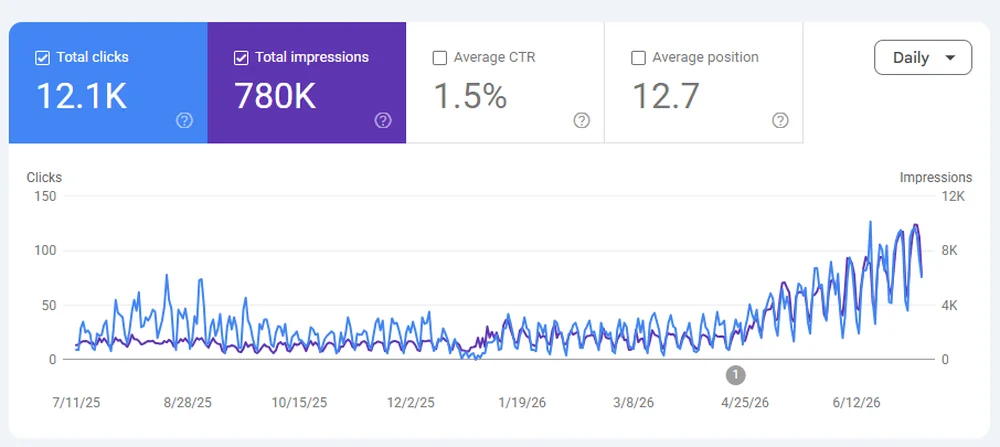
Total clicks and impressions over the same period. The steep climb from around April is when the depth-first content began to compound.
Two honest caveats, because I do not trade in hype. This is early, three months into a system built to compound over years, so the direction matters more than any single figure. And this is one firm in one market, so your starting point will differ.
Expert Tip
When you measure this, do not only watch rankings and traffic. Ask every new lead how they found you, and log the ones who say an AI tool. That number is small today and tells you where the next few years are going.
What should you consider before building this yourself?
You asked the right question, so I'll be straight about what decides whether this works. Most of it isn't the software.
You need real expertise to feed it. This whole system sits downstream of genuine first-hand knowledge. No expert to capture, and you are back to generic AI content, whatever tools you buy. Solve that first.
Keep research and writing as two jobs. Research maps the questions and gaps. Writing turns expert input into depth. Collapse them into one "write me an article" prompt and you lose both.
Build in approval. Great content produced fast still needs the right people to check and sign it off before it goes live, especially in a regulated field. Make that a step in the process, not an afterthought.
Fix the foundation before you scale. Prune the stale content and rebuild the service pages first. Pouring new content onto a weak site wastes most of the effort.
Make internal linking systematic from day one. Decide the anchor strategy, keep one phrase to one URL, spread the links, and pull related reading dynamically so you are not fixing broken links for years.
Start authority early. Real authors and outside recognition compound slowly, so you cannot bolt them on at the end.
And accept the timeline. This gets stronger every month for years. It does not spike next week. If you need a result by Friday, this is the wrong lever. If you want durable growth across Google and AI, it is the only one that still works.
Key Point
The tools are the easy part. Plenty of people can wire up a research model and a writing model. What decides the outcome is the expertise you put in front of them, the discipline to prune and strengthen your money pages, systematic linking, real authority, and the patience to let it compound.
Where to start
You do not need to rebuild everything at once. Start with one topic that matters commercially, capture what your best expert actually knows about it, and publish the single best piece on the internet about it. Link it properly. Put a real name on it.
Then do it again.
That is the whole strategy. Not more content. Better content, deployed consistently, linked properly, and backed by a real expert. In a web full of the same generated writing, being genuinely the best is the last advantage that holds.
If you want this built for your firm, we run it as an embedded marketing function, not a bolt-on service. Book a strategy call and we will map what it looks like for your market.
General information only, based on our own experience and anonymised results. Outcomes vary by market, starting point, and execution.
Want us to implement these strategies for you?
Book a free strategy call and let's discuss how we can grow your business.
Book Your Free CallContinue reading
More on SEO
Google Business Profile for Lawyers: How to Get Into the Map Pack
The map pack is the first thing most legal searchers see, and the profiles in it have more in common than firms expect. What the ranking factors weigh, the review counts and categories in eight live Australian legal packs, which category to pick by practice area, serviced offices and suspensions, what a Queensland injury firm can and cannot write, review response templates, the tracking that shows whether the profile is producing calls, and a 30-day setup checklist.
Is SEO Dead for Law Firms? The Firm That Grew 6x While AI Took the Clicks
AI Overviews now sit on every "is SEO dead" search and on most legal questions, and Ahrefs measured a 58% click loss for the top result when one appears. In the same months a Melbourne litigation firm went from 785 to 5,217 organic clicks a month. What actually died, which query types still send clicks, where AI assistants send law firm traffic, and the honest reconciliation with what we wrote in 2025.
SEO for Family Law Firms: What Separating People Actually Click
Family law search is long, private and emotional, and most of it happens weeks before anyone calls a lawyer. How to structure a family law site by matter type, the hire-intent and research-intent keywords for divorce, property settlement, parenting, child support, financial agreements and de facto matters, what a local page needs to be more than a doorway, why the practitioner profile is a ranking asset, and what to expect month by month.
How Does SEO Work for Personal Injury Law Firms? What It Takes to Rank Against the National Brands
Personal injury is the most contested legal search in every market, and the page-one firms got there with hundreds of pages, named lawyers and years of compounding. How a mid-sized injury firm competes anyway: the claim-type hub structure, the questions injured people actually search, the state-based location model, the advertising rules that shape every page, and the timeline to expect.