
You're spending thousands on Google Ads and getting decent results. But here's what most personal injury firms don't realise: there's a much larger pool of qualified prospects who aren't actively searching for you yet. They've been injured, they know something's wrong, but they haven't typed "car accident lawyer" into Google.
That's where Facebook ads and Meta advertising come in. And if you think you can just copy your Google Ads strategy over to Facebook, you're about to waste a lot of money.
Key Takeaways
- Facebook ads and Meta ads target cold, problem-aware traffic versus Google's hot, solution-aware searchers.
- Creative quality matters more on social platforms. You're battling for attention, not intent.
- Qualification happens through your creative first, then through strategic form design.
- Video dramatically outperforms images for building trust and pre-selling cold prospects, but images have their place for speed and testing.
- Most agencies track the wrong metrics. Cost per lead means nothing without tracking CAC to LTV.
- Minimum budget of $2,000-$3,000 monthly in Australia, but higher budgets optimise faster and deliver better data.
- Heavily qualified MVA leads can cost $100-$300 each, while TPD and WorkCover are cheaper.
- Australian market is far less competitive than the US. You can acquire clients for $250-$500 versus US costs of $2,000-$5,000+.
- One MVA case from 100 leads makes Facebook advertising profitable, but proper strategy can 10x those results.
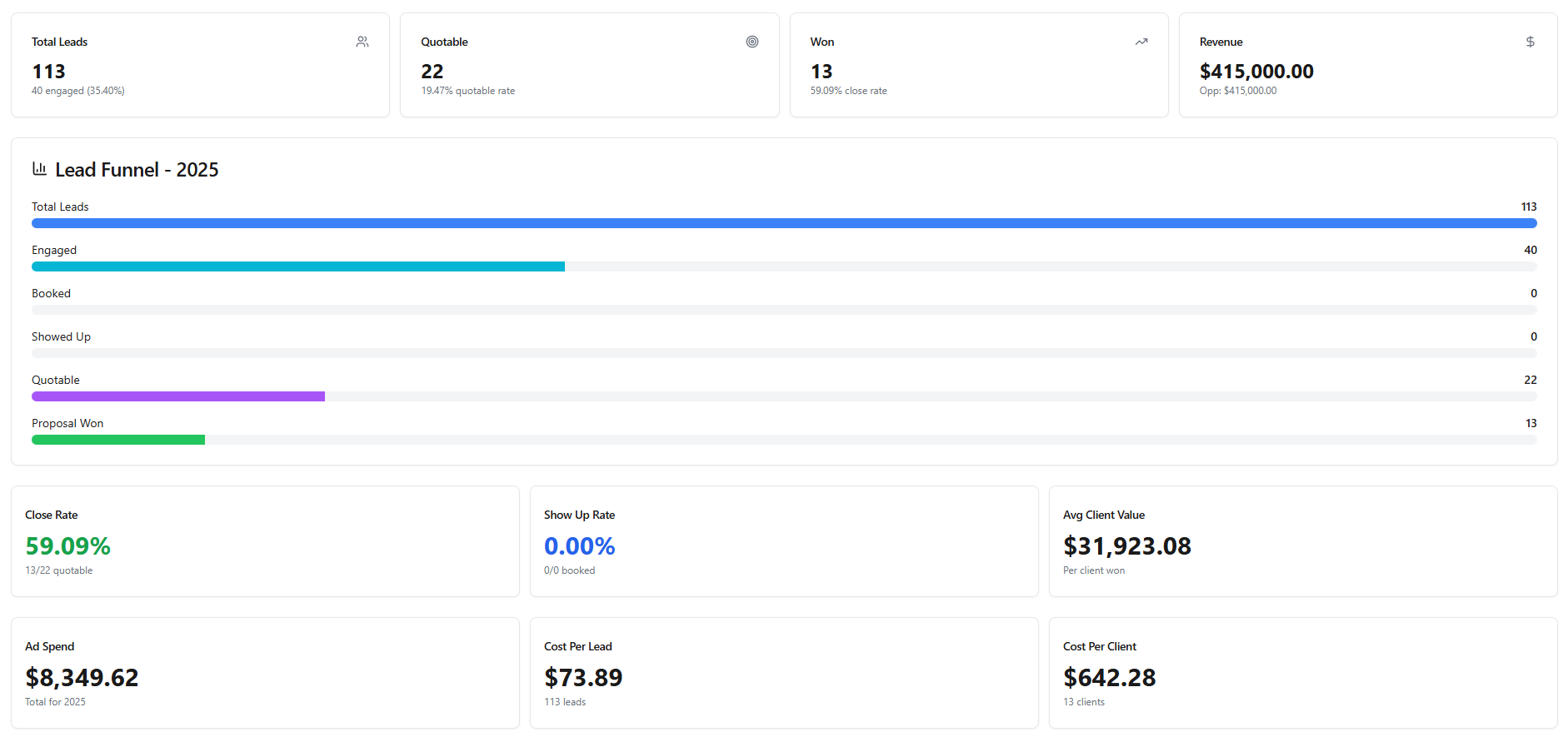
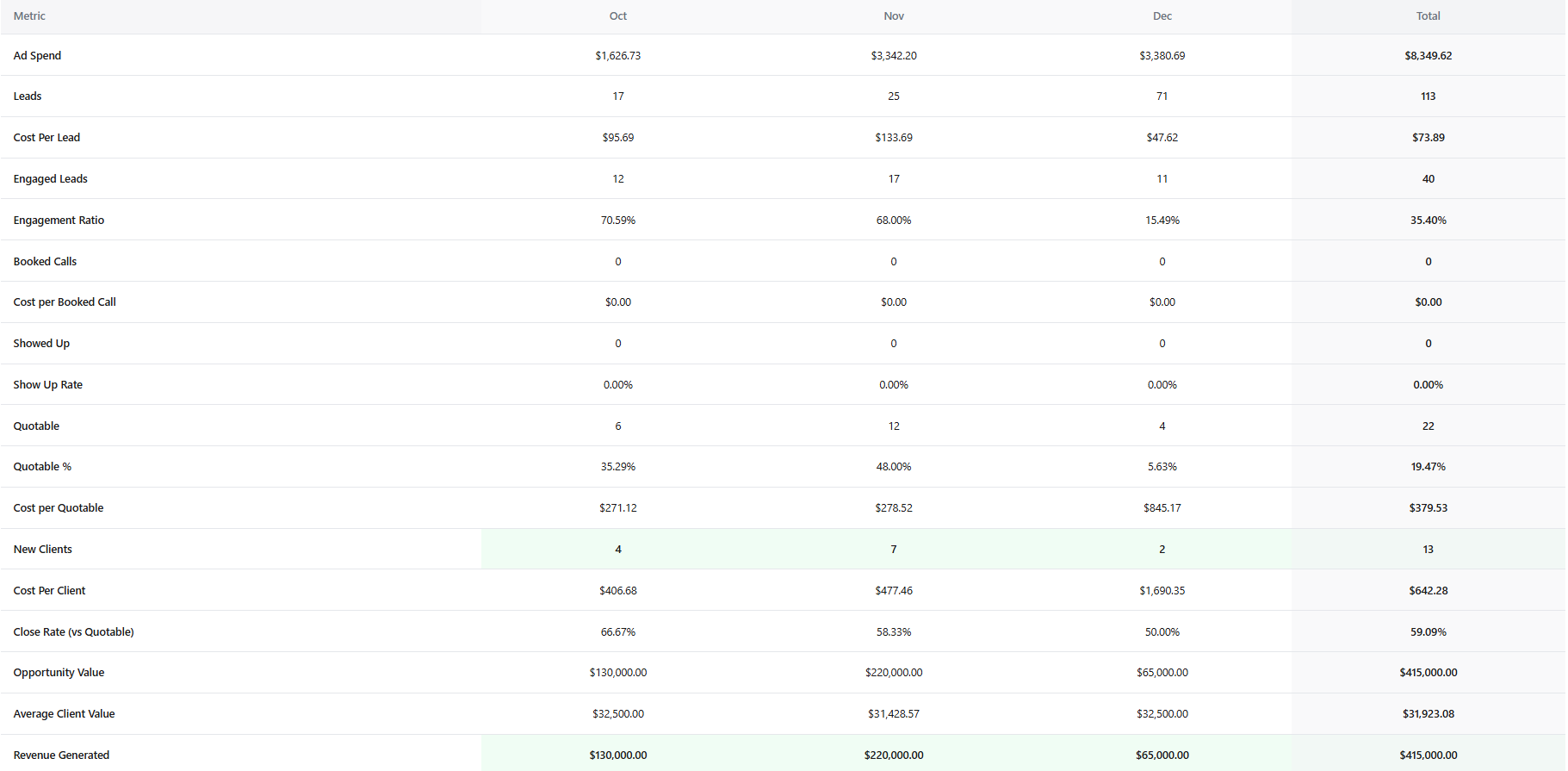
- Instant forms work when designed correctly. We've generated $415,000 from $8,349 in ad spend using them.
- Soft disqualification trains the algorithm better than hard rejection.
- No-win-no-fee model means 12-24 month pipeline building before seeing settlement revenue.
Understanding the Fundamental Difference: Cold Traffic Changes Everything
Here's the mistake I see every week. A law firm crushing it on Google Ads decides to "expand" to Facebook and Meta. They run the same messaging, target "people interested in personal injury lawyers," and wonder why the leads are terrible.
Google Ads is solution-aware traffic. Someone types "compensation lawyer Sydney" and they know exactly what they want. They're ready to hire, they're comparing options, and they're a warm lead from the first click.
Facebook advertising is different. These are people scrolling through their feed looking at holiday photos and cat videos. They've been in an accident, sure. They know they're hurt. But they haven't decided to take action yet.
Think about it like this. Two knights walk into a tavern. The first heard about the place through referrals. He's tied up his horse, changed out of his armour, and he's ready for a beer and chicken leg. The second knight just showed up cold. He's still got his full armour on, helmet included, and he's trying to drink beer through the grill.
You can serve them the same meal, but one trusts the environment and the other doesn't. That's cold traffic. Your job with Facebook ads and Meta advertising is to help them take off some of that armour before your intake team calls them.
Key Insight
Cold traffic isn't worse traffic, it's earlier traffic. The prospect pool for personal injury marketing on Facebook is massive compared to Google search. Your job is to build trust before intent, not wait for intent to appear.
Why the Australian Market Is Different
Before we go further, you need to understand something critical. Personal injury advertising in the United States is brutally competitive. Firms are spending $2,000 to $5,000+ per signed case because they're competing in saturated markets like Los Angeles and New York where a single click can cost $400-$600.
In Australia, the dynamics are completely different. We've detailed this in our guide to personal injury client acquisition costs in Australia, but here's the summary. Australian PI firms using Facebook ads and Meta advertising are acquiring clients for $250-$500 when they execute properly. That's 5-10x cheaper than the US.
Why? Lower competition, less saturated markets, and case values that don't justify the same acquisition costs. A catastrophic injury case in the US might settle for $10 million with contingency fees in the millions. Australian compensation is more standardised and predictable.
This is your advantage. You're operating in a market where Facebook advertising actually works at scale without burning massive budgets.
Pro Tip
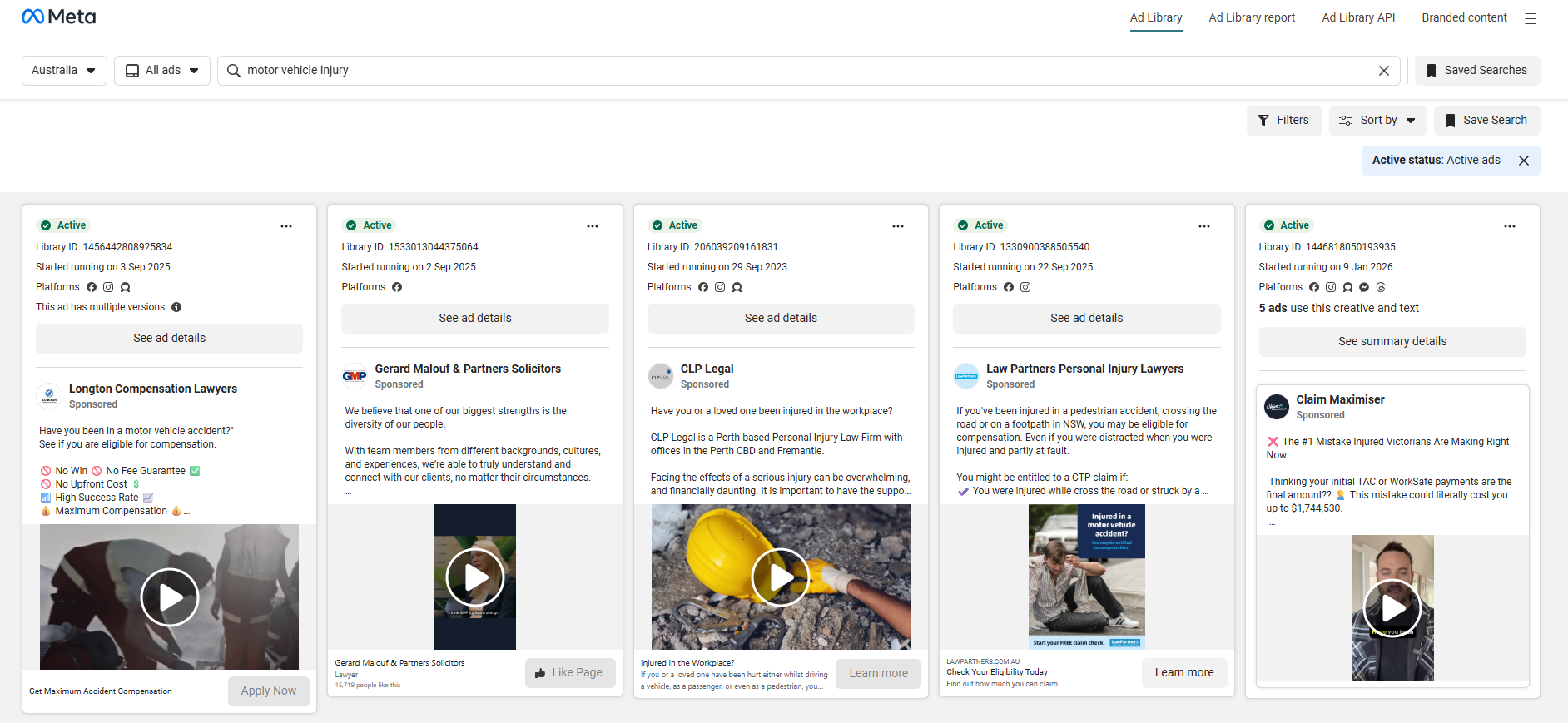
Use the Meta Ad Library to research what your competitors are running. Search for "motor vehicle injury" or "personal injury" filtered to Australia. You'll see exactly what creative is live, how long ads have been running, and which firms are investing heavily. This is free competitive intelligence most law firm marketing teams ignore completely.
Why Most PI Firms Get Facebook Ads Wrong
The biggest issue I see is firms treating Facebook and Meta like a lead generation machine without thinking about lead quality. Their agency proudly reports "100 leads at $15 each" and doesn't mention that 80 of them were rubbish.
Here's what happens next. The intake team wastes hours calling prospects who were never injured, don't have a case, or clicked by accident. The firm tells the agency the leads are terrible. The agency blames Facebook and says "it doesn't work for legal."
Wrong. Facebook advertising works incredibly well for personal injury law firm marketing. You really only need one motor vehicle accident case out of 100 leads to be profitable. But if you want to excel and generate a high percentage of qualified leads, you need to do things differently.
The reality is this: most law firms are running brochure ads on a platform designed for entertainment. They're using stock photos, generic messaging, and hoping for the best. That doesn't work when you're competing with videos of puppies and engagement announcements.
If this sounds familiar, you might want to read why 90% of law firm Facebook ads fail for a deeper look at the system that actually works.
Quick Win
Stop using stock photos in your ads immediately. Even a simple iPhone video of a lawyer explaining who they help will outperform the most polished stock image. Authenticity beats production value on social media every time.
The Battle for Attention: Why Creative Matters More Than You Think
Social media is fundamentally about attention. You're not bidding on keywords where someone already wants what you sell. You're interrupting people's scrolling with something that needs to make them stop.
I've seen basic ads work. Really basic. But they work because the prospect pool for personal injury is massive and even terrible ads stumble into a few good cases. If you want to stand out and build a sustainable system, you need better creative.
Gone are the days of spending hours on interests, demographics, and precise targeting in Facebook Ads Manager. Facebook's algorithm and Meta's algorithm are smart enough now that you open up to broader audiences and let your creative do the targeting.
What does that mean practically? Your ad copy should speak directly to your ideal prospect. "Have you been in a car accident with multiple participants, you're out of work, and you weren't at fault?" That sentence targets for you. The right people lean in, the wrong people scroll past.
This is why most lawyers fail at Facebook advertising. They create generic "we're the best personal injury firm" messaging that appeals to everyone and no one. Specificity is what makes cold traffic work.
Key Insight
Your creative IS your targeting. On Meta, broad audiences with specific creative outperform narrow audiences with generic creative. Write your ad copy to speak to one specific person with one specific problem, and let the algorithm find more people like them.
Qualification: The Make-or-Break Factor
Qualification is massive in personal injury advertising. You can't afford to have your intake team chasing garbage leads. But there are multiple ways to qualify, and most firms only know one.
Creative-Level Qualification
Your first filter is what you say in the ad itself. This is where you start removing people who aren't a fit before they even click.
If your video says "for this to work, you must have had a car accident where you weren't at fault, you haven't spoken to another lawyer, and the accident happened within the last three years," anyone who doesn't fit will start to lean out.
This is subtle but powerful. You're not blocking anyone, but you're setting expectations. The wrong prospects self-select out.
Form-Level Qualification: Instant Forms vs External Forms
People have told me for years that instant forms are horrible quality. I disagree completely.
Yes, there's less friction with instant forms. They pop up immediately on Facebook without sending prospects to an external site. That can lead to more spam. But we've seen examples where instant forms generated $415,000 from only $8,349 in ad spend in the first 90 days.
The secret is using the logic features properly. Before a prospect can submit their details, you ask questions that qualify whether they're a good fit. The algorithm is like training a puppy. If you let everyone through, Meta learns to find more unqualified people. If you qualify hard, you teach the algorithm what "good" looks like.
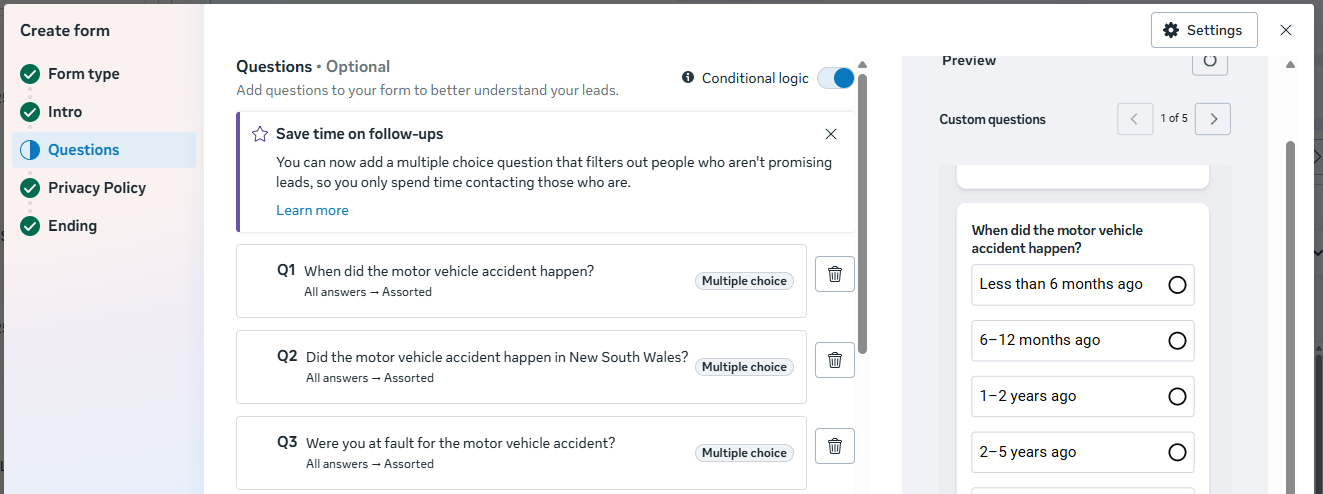
Now, some PI firms want to look at prospects from all angles. They don't want to over-qualify and miss potential claims. Maybe someone doesn't fit for CTP but they're perfect for TPD. That's fair. But you still need to train the algorithm on what a good prospect looks like.
Instant forms let you add anywhere from one to eight qualification questions, plus SMS verification, plus high intent confirmations that add more friction. Use them.
Pro Tip
Add SMS verification to your instant forms. This single step eliminates a huge percentage of accidental submissions and spam clicks. It adds friction in the right way and dramatically improves lead quality without increasing your cost per lead significantly.
External Forms: The More Sophisticated Approach
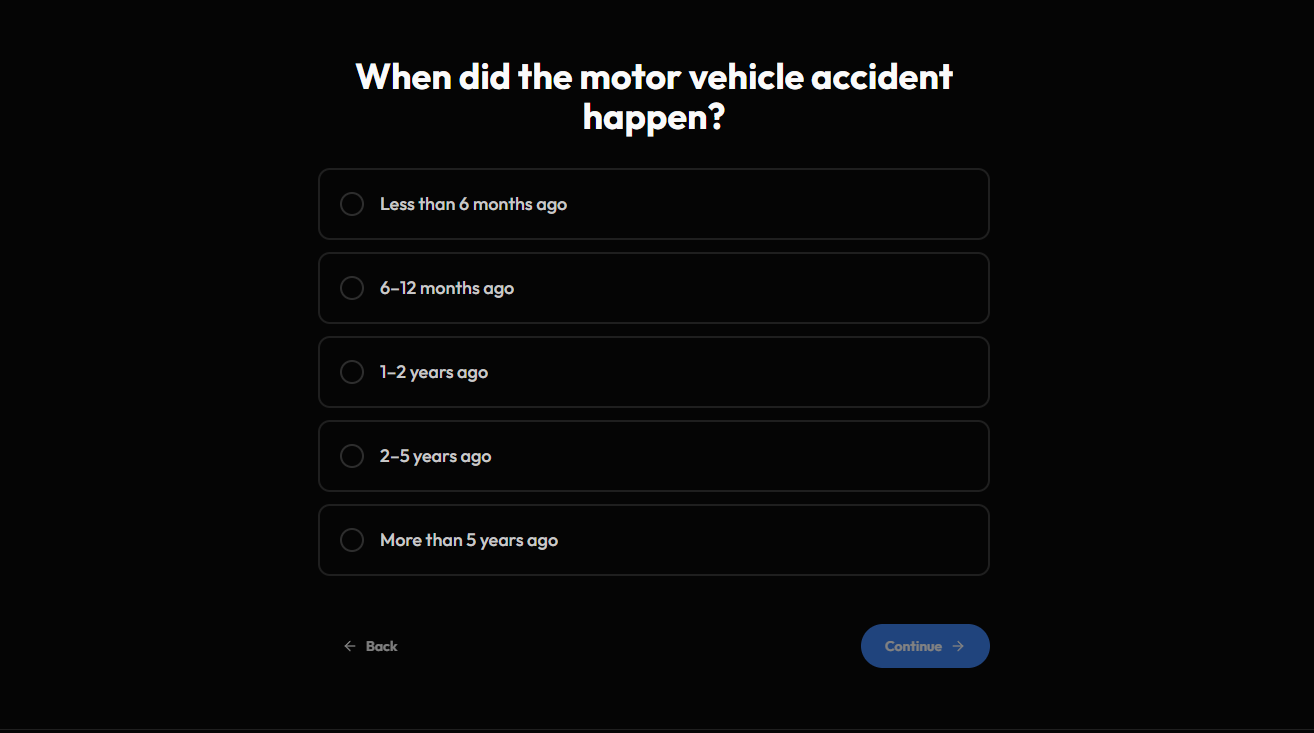
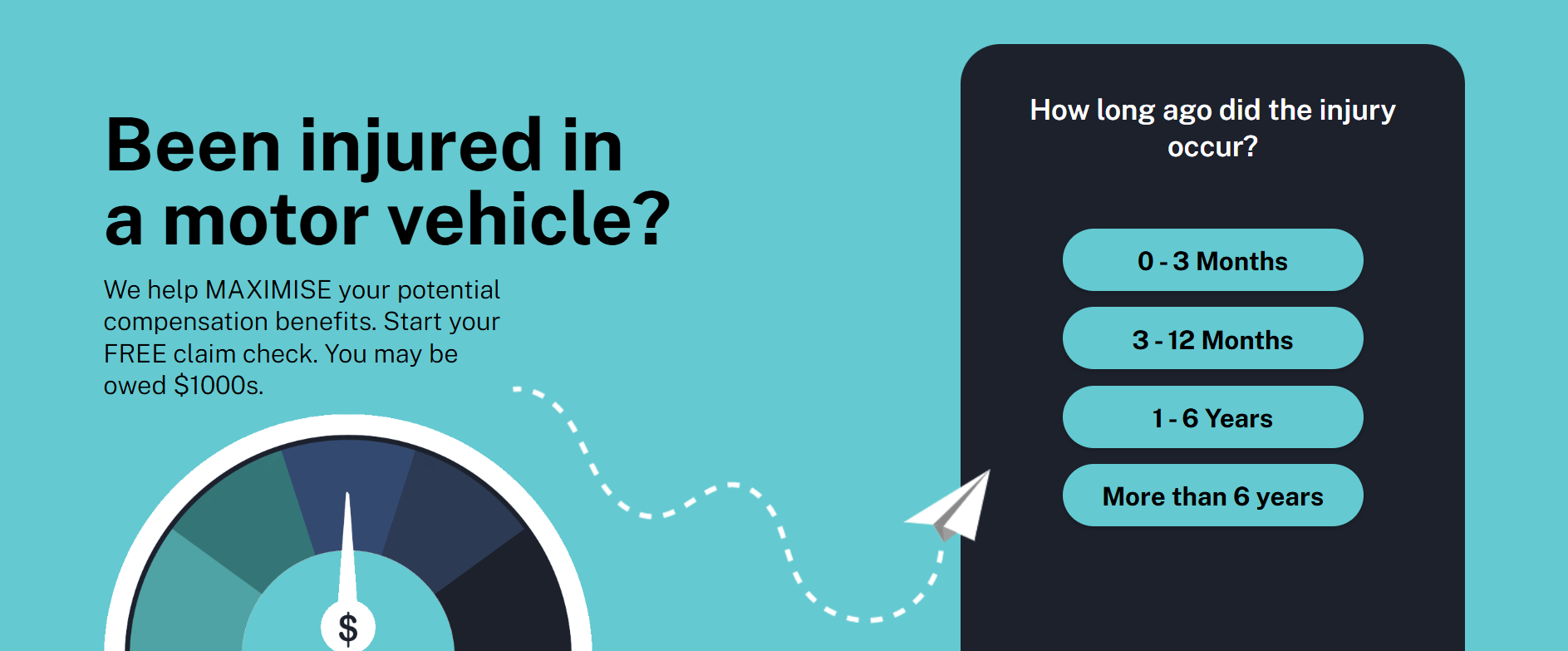
External forms use tools like Go High Level, TypeForm, or LeadsHook. You send prospects to an external landing page with a form that mirrors the instant form technique but with more control.
Many people say this is superior because there's more friction in the click. Meta optimises for prospects willing to take that action, which generally means higher quality than low-friction form fills.
This technique is more sophisticated and needs technical skill to execute well. You need someone who understands forms, can build landing pages, understands events, and knows how to set up conversion API properly. For more on landing page strategy, read our guide on how personal injury firms should optimise landing pages for PPC traffic.
But the benefits are significant. You get more control over the user experience, you can build multi-step funnels, and you can implement soft disqualification strategies that I'll explain next.
Hard Qualification vs Soft Disqualification
Hard qualification is black and white. A prospect either qualifies or they don't, and you only receive details from those who pass all criteria.
This might not fit all PI firms. Maybe you want to look at each prospect for multiple claim types. They might not be a fit for one service but perfect for another.
Here's where soft disqualification gets interesting. You use an external form with rules. When prospects hard qualify, you send them to a confirmation page and fire your conversion pixel. This is a good prospect, known good, and you feed that information back to Meta to find more like them.
When prospects soft disqualify, you tell them your team will still call, but you either fire a completely different pixel or no pixel at all. You're not training your algorithm to find more of these types, but the prospect hasn't been told they're rejected and you can still capture their details.
This is advanced, but it's how you train Meta properly while not losing potential cases.
Interactive demo
How does your intake form train Meta's algorithm?
Pick how you'd handle each scenario, we'll show you what it means for your pixel.
Scenario 1 of 3
A lead comes in from your ad. They were injured 4 years ago, outside the limitation period.
3 scenarios · Takes 30 seconds
Key Insight
Soft disqualification is the secret weapon most agencies don't know about. Instead of rejecting leads that don't perfectly fit one claim type, you capture their details without feeding the conversion signal back to Meta. This preserves your algorithm quality while keeping potential multi-claim prospects in your pipeline.
How You Receive Leads: Emails vs CRM vs Booked Calls
Lawyers don't just want more leads. They want the right leads and they want to spend the least amount of time chasing them.
If you're a smaller firm, your time is incredibly valuable. You don't want to spend two hours a day calling leads who clicked by accident. If you're a larger firm with a dedicated intake team, you have more capacity to filter.
Email or CRM Push. The simplest option. Prospect opts in, details go straight to your team via email or CRM. Your intake team follows up manually. This works fine if your qualification is tight and your team is disciplined about speed to lead. But it puts all the pressure on your team to chase.
Booked Calls. This is the more advanced technique. Through your external qualification form, the next step in the funnel is booking directly into your calendar. The prospect qualifies, then immediately books a time. This is possible through instant forms too. On the qualified confirmation page, you can send them to an external URL with your calendar.
The benefit is massive. Instead of your team chasing cold leads, you're talking to people who've already committed time. They're warmer, more serious, and your close rate goes up.
Fast Fix
If you're using instant forms, add a "Book a Call" link on your confirmation page. Most firms just show a "thank you" message. Instead, send qualified prospects to your calendar immediately while they're still engaged. This simple change can increase your booked call rate by 30-50%.
Images vs Video: Understanding the Trade-Offs
Both images and videos work for Facebook ads and Meta advertising. The question isn't which is "better" but which fits your goals, resources, and testing approach. Let's look at the honest pros and cons of each.
Image Ads: The Pros
- Speed of Production: Images are fast to create. You can test 10 different image concepts in the time it takes to produce one video. This speed matters when you're validating messaging or testing new angles.
- Lower Barrier to Entry: No camera equipment needed. No comfort on video required. No editing software to learn. You can start testing image ads today with text-driven creative.
- Easy to Test at Scale: When you're running split tests, images let you isolate variables. Same copy, different image. Same image, different headline. You can move quickly.
Image Ads: The Cons
- Less Emotional Impact: Images don't build the same emotional connection as video. You're not showing your face, your voice, or your personality. That makes it harder to build trust with cold prospects.
- Faster Ad Fatigue: Image ads tend to fatigue quicker on Facebook. People scroll past them faster, and after seeing the same image a few times, they tune it out completely.
- Easy to Look Like Everyone Else: Most PI firms use the same stock photos. Neck braces, car accidents, courtroom imagery. Your image ad blends into a sea of identical creative from competitors.
- Less Memorable: By the time you call the lead, they might not even remember opting in. There's no face to remember, no voice to recognise. You're just another inquiry form they filled out.
Video Ads: The Pros
- Emotional Connection: Video lets prospects see you, hear you, and get a sense of who you are. That builds trust faster than any image ever will. Cold prospects warm up when they connect with a real person.
- Pre-Selling Power: A well-crafted video can do the work of your first sales call. You can explain your process, show how you've helped others, and address common objections before your intake team picks up the phone. Learn more about pre-selling cold prospects.
- Differentiation: Most of your competitors aren't running video ads. When prospects see your face explaining how you help people in their exact situation, you stand out immediately.
- Higher Recall: When your team calls the lead, they remember you. They've seen your face, heard your voice and consumed your content. The conversation starts warmer.
Video Ads: The Cons
- Higher Production Barrier: You need to get comfortable on camera. That's not easy for everyone, and it's the number one reason lawyers avoid video entirely.
- More Time to Produce: Creating video takes longer than creating images. Script, shoot, edit. Even simple videos require more effort than uploading an image with text overlay.
- Testing Takes Longer: You can't test 10 video concepts as quickly as 10 image concepts. Video testing requires more patience and bigger budgets to validate what works.
The Practical Approach
Here's what we recommend. Start with text-driven image ads to validate your messaging fast. Test different hooks, different angles, different qualification criteria. Find what resonates.
Once you know what messaging works, create video around those proven concepts. You'll have data telling you exactly what to say in the video, which angles to emphasise, and which prospects to target.
Use images for speed and testing. Use video for scale and trust-building.
And if you're adamantly against being on camera, work with UGC creators (user generated content creators). These are people who specialise in creating authentic-feeling videos to promote products and services. Every face performs differently, so it's worth testing.
What Not to Do With Video
Don't spend $20,000 on a polished video production. I've seen law firms do this, and it's almost always a mistake.
Just because you paid a lot doesn't mean it'll perform better. In fact, overproduced videos often perform worse because they look like ads. Facebook users are trained to scroll past anything that feels like traditional advertising.
Point-and-shoot iPhone videos work fine. Work with a personal injury marketing agency like PixelRush to add captions, transitions, and attention-grabbing elements. That's all you need.
Quick Win
Record a 60-second iPhone video answering your most common client question. No script, no fancy editing. Just you talking directly to camera about one specific claim type. Test it against your best performing image ad. Nine times out of ten, the video wins.
Sales Funnels: Pre-Selling Before the Call
In general, the more content a prospect consumes before their first conversation with you, the warmer they'll be.
We've talked about external landing pages with qualification forms, but the downfall is there's no additional content for prospects to consume beyond answering questions.
Video Sales Letters
A video sales letter is a long video you use to pre-sell prospects. Think about your first call with a prospect. What do you normally ask them? How do you introduce your offer? How do you build trust?
That's the purpose of a video sales letter. It's anywhere from 3-4 minutes to as long as 20 minutes if you have a lot to say. You're using this as your 24/7 salesperson.
The purpose isn't just to pre-sell. It's to help that prospect determine if they're a good fit for you. When they turn up to the call, it's less about whether they qualify and more about whether they're a good fit to work with your law firm.
This dramatically increases your close rate because you're only talking to people who've already bought into your approach. If you want to understand the psychology behind this, check out our article on why selling to cold prospects is harder than ever.
Key Insight
A video sales letter turns your intake calls into formalities. When prospects have already consumed 5-10 minutes of content explaining your process, your success stories, and what makes someone a good fit, the call becomes about logistics rather than selling.
Tracking: Where Most Law Firms Get It Catastrophically Wrong
This is where most law firms and their agencies completely miss the mark. They work with agencies that care purely about leads and cost per lead.
An agency will proudly tell you they got you 100 leads at $15 each. They don't care about quality. They don't care if you closed any deals. They just want to report good-looking numbers.
The benefit with Meta ads is you can make a closed system. Tracking leads and attributing them becomes much easier. Because of that, you need to raise the game when it comes to how you track.
If you're not sure whether your current marketing is actually working, read our guide on how to tell if marketing is actually working for your personal injury firm.
The Metrics That Actually Matter
Here's what you should be tracking:
Lead-Level Metrics
- Cost per lead
- Engagement rate
- Cost per engaged lead
- Cost per qualified prospect
Business-Level Metrics
- Cost per proposal sent
- Cost per client
- Estimated opportunity value
- Estimated fees/revenue
- Return on ad spend
- CAC to LTV ratio
- CAC to gross profit LTV ratio
It's only when you understand your customer acquisition cost to lifetime value ratio that you can determine whether you're in a position to scale.
If your ratio is 2x, you're losing money. If it's 4x, it's likely underwhelming and you're struggling to decide if you can continue. If it's 10x, 20x, or 30x like many of our clients, you're in a position to buy your growth.
The Problem with Gut Feel
You might be thinking "money in, money out, I know if it's working." But I've worked with many law firms spending tens to hundreds of thousands on marketing going purely on gut feel.
It's only once you peel back the layers that they realise how heavily it's underperforming. They were confusing paid leads with local referrals, organic search, or some other source entirely. They had no idea how much money was being wasted.
Paid ads is not for gut feel. You need attribution, you need tracking, and you need to know which campaigns are actually generating revenue. We covered this in detail in our article about why most businesses waste 70% of their paid leads.
Pro Tip
Build a simple spreadsheet that tracks every lead from first click to signed case. Include source, date, claim type, qualification status, and outcome. After 90 days, you'll have clear data on your actual cost per client, not just cost per lead. This single action will transform how you make marketing decisions.
The Facebook Ads and Meta Ads System That Actually Works
Here's how to put this all together:
- Start with Creative: Create video ads that speak directly to your ideal case type. Be specific about who you help and what makes someone a good fit. Use your creative to do the targeting work.
- Layer in Qualification: Use instant forms or external forms with strategic qualification questions. Train the Facebook algorithm on what good looks like. Consider soft disqualification if you want to preserve potential multi-claim prospects.
- Pre-Sell with Funnels: Send qualified prospects through a video sales letter or multi-step funnel. The more content they consume, the warmer they'll be when your team calls.
- Track Properly: Set up conversion tracking that goes beyond cost per lead. Track all the way through to revenue and understand your true CAC to LTV ratio.
- Optimise for Revenue, Not Leads: Work with an agency that cares about cases closed, not just form fills. The only number that matters is how much you spent versus how much you made.
Key Insight
The system compounds over time. Month one, you're testing creative and learning what works. Month three, your algorithm is trained and lead quality improves. Month six, you have pipeline data. Month twelve, cases start settling and you can calculate true ROI. The firms that win are the ones that commit to the process.
What Budget Do You Actually Need?
This is the question every PI firm asks first. And the answer is different than Google Ads.
With Google Ads, you're paying $200-$300 per click in competitive markets. I wouldn't recommend anything less than $8,000 per month minimum for PI ads on Google. Many firms are spending $50,000 to $100,000+ monthly because the clicks are expensive and the competition is brutal. We break this down in our guide to why personal injury Google Ads are getting more expensive.
The Australia vs United States Reality
Before we talk budgets, you need to understand why Australian firms have a massive advantage over their US counterparts.
In the United States, personal injury is one of the most competitive advertising categories that exists. Firms in major metros like Los Angeles, New York, and Miami are spending $2,000 to $5,000+ per signed case.
Why so expensive? US firms are fighting for jury verdicts that can run into the millions. A single catastrophic injury case might settle for $10 million with contingency fees of $3-4 million. Those economics support spending $10,000 to acquire a client when that client might be worth millions in fees.
Australia is fundamentally different. As we've detailed in our guide to personal injury client acquisition costs in Australia, Australian PI firms using Facebook ads properly are acquiring clients for $250-$500. That's 5-10x cheaper than the US.
Compensation in Australia is more standardised. Case values are generally lower but more predictable. You don't have the same mega-verdicts. And critically, competition density is lower even in Sydney and Melbourne. You're not fighting against 50 firms each spending half a million monthly on advertising.
Starting Budgets in Australia
We've been able to win for as little as $2,000-$3,000 per month in Australia using Facebook ads and Meta advertising. But keep in mind, this depends heavily on how hard you want to qualify and the types of leads you're going after.
Heavily qualified motor vehicle accident leads can cost $100-$300 per lead depending on the number of qualification questions, which state you're targeting, and how bold your creative is. The more you qualify upfront, the higher your cost per lead, but the better your conversion rate.
TPD leads and workers compensation are generally much cheaper to target. Again, it depends on how hard you want to qualify them upfront to save your team time weeding through poor quality opportunities.
Small Budgets vs Large Budgets
Personal injury is a highly competitive space. Small budgets are harder to optimise for and give you less data to work with. It's much easier to work with PI firms that have higher budgets because we can test faster and find what works quicker. For context, we've written about why small Google Ads budgets are actually harder to manage, and the same principle applies to Meta.
But here's the thing. Even if you start small, if you work with a personal injury marketing agency like PixelRush and you provide good feedback on lead quality, you're going to understand your CAC to LTV ROI. And when you know that number with confidence, you're going to scale.
That's how you become a PI firm that can comfortably spend $50,000 or $100,000 per month on Facebook advertising. You're not guessing. You know that for every dollar you put in, you're getting five, ten, or twenty dollars back.
Fast Fix
Start with $2,000-$3,000 per month and commit to 90 days. Don't judge Facebook ads after two weeks. The algorithm needs time to learn, your creative needs testing, and your team needs time to build follow-up processes. If after 90 days the numbers don't work, pivot. But give it a fair shot with proper tracking in place first.
The No-Win-No-Fee Reality
The only challenge with personal injury is the no-win-no-fee model. It might take 12 to 24 months of spending before you start to see cases settle and revenue come back.
This is why tracking matters so much. You need to know your lead-to-case conversion rate, your average case value, and your typical settlement timeline. Otherwise, you're spending blind and hoping it works out 18 months from now.
The firms that succeed with Facebook ads are the ones willing to invest in building a pipeline. They understand they're planting seeds today that will pay off down the line. They track everything, they optimise constantly, and they scale when the numbers prove it works.
If you're looking for instant ROI, Facebook advertising for PI might not be the right fit. But if you're building a long-term lead generation system that compounds over time, this is how you do it.
8 Red Flags Your Meta Ads System Is Broken
I see firms drop $10,000, $20,000, $50,000 per month on ads. They get hundreds of leads. They sign maybe three to five cases. Then they wonder why the numbers don't add up.
Here's what's actually broken:
Red Flag #1: You Track Cost Per Lead, Not Cost Per Case
Your agency sends you a dashboard. $87 cost per lead. 124 leads this month. Looks great.
How many became cases? What's your actual cost per signed client?
If you don't know that number, you're flying blind. Cost per lead is a vanity metric. Cost per case is what determines if you're making money or losing it.
Red Flag #2: You Have No Idea Where Your Best Clients Come From
"We got 47 calls this week." Great. But which source signed the most cases?
Without tracking lead source through to signed client, you're running on gut feel and emotions. You wonder why every time you try to scale, nothing changes. It's because you never knew what was working to begin with.
Meta might be generating volume, but if Google Ads is signing the high-value cases, you need to know that. Otherwise, you're optimising the wrong channel.
Red Flag #3: You Optimise for Volume, Not Quality
400 form fills. 200 phone calls. Until 90% are "I tripped on my own shoelace" or "Can you sue my neighbour?"
If your ads don't pre-qualify, your intake team becomes customer service for people you'd never take on. That's not marketing, that's waste.
This goes back to qualification. If you're not filtering at the creative level and the form level, you're paying to talk to people who will never become clients.
Red Flag #4: Your Landing Page Is Identical to Every Other PI Firm
Stock image of someone in a neck brace. "Injured? Call now!" Generic trust badges.
That's a template, not a landing page.
Meanwhile, the firm with a case study, a video, and an actual point of view? They're signing the good cases. For more on what makes a landing page actually convert, read our guide to how personal injury firms should optimise landing pages.
Your landing page should do the heavy lifting. It should pre-sell, build trust, and filter out bad fits. If it looks like everyone else's, you're competing on price and proximity instead of value.
Red Flag #5: You Treat All Practice Areas Like They Have the Same Economics
Motor vehicle accident? Case value $60,000. Your cut $18,000. Cost per client $3,000. Healthy.
WorkCover claim? Case value $6,000. Your cut $1,800. Cost per client $3,000. You're losing money.
But you're running the same budget across both.
If you don't know the unit economics of each practice area, you can't optimise properly. Some practice areas can support higher acquisition costs. Others can't. Treating them the same is how you burn cash.
Red Flag #6: There's No Follow-Up System
Lead comes in. Intake calls once. No answer. "Bad lead."
Did you expect someone dealing with an injury to pick up on the first ring?
The firms winning have multiple follow-up attempts, SMS sequences, and email nurture. One and done doesn't work. Speed to lead matters, but so does persistence.
If you're writing off leads after one call attempt, you're throwing money away. The difference between firms that convert 5% of leads and firms that convert 15% is usually just follow-up discipline.
Red Flag #7: You're Still Running "We Care" Ads
"We fight for you." "You deserve compensation." "We're on your side."
So is every other PI firm in the state.
Your ads don't differentiate, educate, or build trust. They just exist.
This is the generic messaging problem. If your ad could have your competitor's logo on it and still make sense, it's not doing the job. Specificity wins. Speak directly to one type of case, one type of person, one specific problem.
Red Flag #8: Same Ads for 6+ Months with No Testing
Same creative. Same copy. Same landing page.
Your cost per lead has crept up 40%. Your conversion rate has dropped. But you're still running the same approach.
The firms scaling test new angles every month. New hooks, new video concepts, new offers. Ad fatigue is real especially on social platforms where people see the same thing repeatedly.
Standing still in paid ads means going backwards. If you're not testing, you're dying slowly.
Personal injury advertising isn't broken. Your system is. The firms scaling right now have stopped obsessing over cost per lead and started obsessing over cost per client.
Key Takeaway
If three or more of these red flags apply to your firm, your system needs a complete overhaul, not just tweaks. Start by fixing tracking first. You can't improve what you can't measure, and most agencies won't fix this because it exposes their underperformance.
Final Thoughts
Facebook ads and Meta advertising work incredibly well for personal injury law firms. But they work differently than Google Ads, and if you treat them the same, you'll waste money and blame the platform.
The opportunity is massive. There's a huge pool of problem-aware prospects who haven't started searching yet. If you can reach them first, build trust through video, and qualify them properly, you can build a lead generation system that competitors can't touch.
But you need to do it right. Better creative, smarter qualification, proper tracking, and a focus on revenue rather than vanity metrics.
If you're tired of agencies that report great-looking numbers with terrible results, or you want to build a Facebook advertising system that actually generates profitable cases, book a free strategy session and I'll show you exactly what's holding your campaigns back and how to fix it.
Want us to implement these strategies for you?
Book a free strategy call and let's discuss how we can grow your business.
Book Your Free Call
Written by
Byron Trzeciak
Founder of PixelRush, Byron has spent over a decade mastering digital marketing. His agency has helped 300+ brands grow, managed $10M+ in ad spend, and optimised 400+ landing pages. He shares hard-won strategies so you can skip the learning curve.
Continue Reading
More on Law Firm Marketing
Personal Injury Google Ads in Australia: Why Costs Keep Climbing, and What Boutique Firms Can Do About It
Your Google Ads bills keep climbing, but your lead quality keeps dropping. Here's why PI advertising costs are skyrocketing and what smart firms are doing differently.
Should Law Firms Qualify Leads or Take Everyone Who Calls? (The Hidden Cost of Bad Prospects)
Your phone's ringing. Another potential client. Your gut reaction? Answer it, book the consultation, and hope they've got money and a decent case.
How Much Should a Family Law Firm Spend on Google Ads?
Your family law firm deserves better than generic "spend 5% of revenue" advice that treats divorce lawyers the same as plumbers. The reality? Most budget recommendations are dangerously wrong for Australian family law practices, leading to wasted ad spend and frustrated partners...
Content Writing for Law Firms: The Complete Guide to Getting on Page One
Most law firms produce content nobody reads. This guide covers topic selection, keyword research, and a practical AI-powered system to get your firm on page one.