Key Takeaways
- Google Ads traffic is solution-aware and ready to hire, while Meta traffic is problem-aware and needs warming up before they'll convert.
- Form placement above the fold dramatically increases conversions even if it doesn't look sexy.
- Video testimonials are massively underutilised but can transform your conversion rates.
- Call leads are higher intent but harder to track and qualify compared to form submissions.
- Meta ads require emotional journey mapping through sales letters or qualification funnels, not just trust signals.
- Qualification mechanics can improve lead quality without sacrificing volume.
The Fundamental Difference Between Google Ads and Meta Traffic
Before you build a single landing page, you need to understand something critical about the traffic you're buying. Not all clicks are created equal, and I'm not talking about click quality in the traditional sense.
I'm talking about awareness level. Where someone is in their buying journey when they click your ad.
This is the foundation of everything else. Get this wrong and nothing else matters. Your beautiful design won't save you. Your compelling offer won't save you. You're just burning money.
Pro Tip: Before spending a dollar on a new landing page, map out where your traffic is coming from. Google Ads traffic and Meta Ads traffic need completely different page structures - mixing them up is one of the most expensive mistakes personal injury firms make.
Google Ads: They're Already Looking for You
When someone searches "personal injury lawyer near me" or "car accident attorney Melbourne," they're solution-aware. They understand their problem and they're actively searching for somebody to fix that problem.
Think about what that means for your landing page. They don't need to be convinced they have a problem. They don't need education about what a personal injury lawyer does. They're comparing you against two or three other firms they're looking at right now, probably in different browser tabs.
The landing page becomes about trust and relevance, and to some degree your offer. Your offer is always important, but with Google Ads I find that trust and relevance and how you position your point of difference is typically just as important as having a very high-end offer.
They need to know you're relevant to their specific situation. They need to trust that you're competent. And they need a reason to call you first instead of one of the other firms they're looking at.
Key Insight: Google Ads prospects are already comparing you to competitors in other browser tabs. Your landing page isn't about convincing them they have a problem - it's about building preference so you're the first call, not the third. If you're unsure whether Google Ads are worth the investment, the answer is almost always yes - but only if you nail the landing page.
Meta Ads: They're Not Looking for Anything
Meta traffic is fundamentally different. These people aren't actively searching for a lawyer. They're scrolling Facebook or Instagram, maybe thinking about their situation, maybe not.
You're interrupting them. That's not a bad thing, but it means you need to take them on a journey.
With Meta ads, you're generally dealing with problem-aware and solution-aware traffic, so you're going to target both. Problem-aware is typically the biggest bucket and has the highest number of prospects. But they're going to be a little bit colder.
For that reason, you may want to qualify them, pre-sell them, warm them up in different ways before you ask them to pick up the phone or fill out a form.
Some people do go the landing page approach, similar to what you would use with Google Ads. I've seen it work. But others go for more of a sales funnel where that prospect is essentially pre-sold and warmed up before they ever get to a booking page.
You're basically becoming the bridge from pain to desired state. It's a more emotional journey for this type of prospect, and the landing page that you send them to needs to match that. Send cold Meta traffic to a Google Ads style landing page and you'll get volume, but most of it will be garbage.
Quick Win: If you're running Meta ads for your law firm and sending traffic straight to a generic contact page, try sending them to a qualification survey instead. Even a basic Typeform asking 3-4 qualifying questions can dramatically improve lead quality overnight.
Building Landing Pages for Google Ads Traffic
For Google Ads, you want to have a very strong, very consistent call to action. For lawyers, those calls to action are generally to submit a form inquiry or to call through to the office to have a chat.
Now, there's a debate here about which one is better.
Call Leads vs Form Submissions
Call leads are slightly higher intent. If someone's willing to pick up the phone and call a complete stranger about their car accident or workplace injury, they're serious. They're not just browsing.
But calls can waste a lot of time if the prospect is not a good fit. They're harder to qualify upfront and they're also harder to track properly. You're relying on your intake team to gather all the qualifying information during the call, and unless you've got really tight systems, information gets lost.
Forms give you better control. You can qualify before your team ever touches the lead. You can track everything properly. You can route leads to the right people. The trade-off is slightly lower intent, but I'd argue that with the right follow-up speed, that gap closes pretty quickly.
My recommendation? Offer both, but optimise for whichever aligns with your intake capacity and systems.
Key Insight: The real cost of unqualified call leads isn't just wasted ad spend - it's the time your intake team spends on calls that were never going to convert. If you want to understand the true cost of acquiring a personal injury client, you need to factor in staff time, not just media spend.
Form Placement That Actually Converts
Here's something that annoys designers but I'm going to say it anyway: having a form very high above the fold is one of the best ways to capture conversions.
I know. It doesn't always look the sexiest when you have the form aggressively placed up at the top of the site. I get it. But it performs very, very well.
You need to remember that your landing page is not the same as your website. Your website can be beautiful and branded and showcase your culture. Your landing page has one job: convert traffic at the highest rate possible.
Having a form at the top of the page and a form at the bottom of the page gives you two conversion opportunities. People who are ready to convert will do it immediately. People who need more information will scroll, read your content, build trust, and convert at the bottom.
This isn't theory. I've tested this across dozens of campaigns. Top and bottom forms consistently outperform single-form layouts.
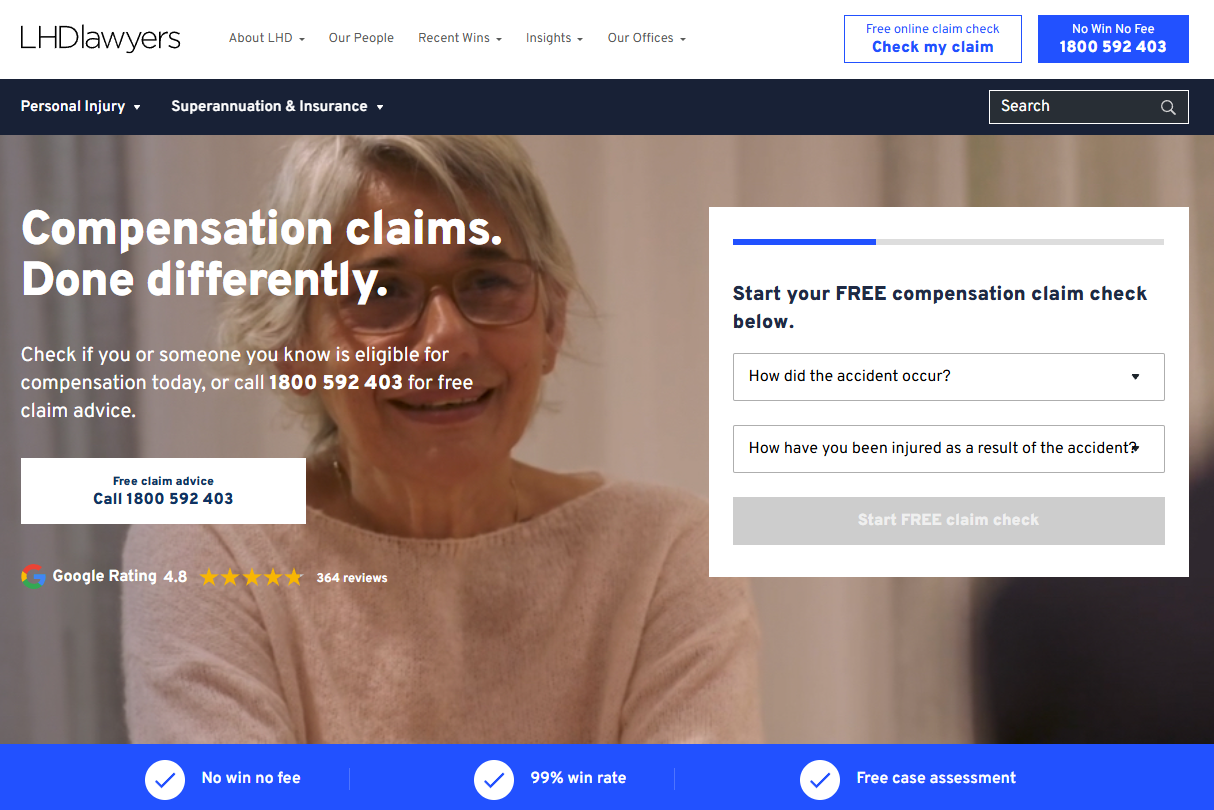
Example of a personal injury landing page with the form prominently placed above the fold alongside trust signals like Google reviews and a clear call to action.
Pro Tip: Don't let your designer talk you out of putting a form above the fold. Your landing page has one job - convert. Beauty is secondary. Test a two-form layout (top and bottom) against your current single-form page and let the data decide.
The Five-Second Test
When someone lands on your Google Ads page, you've got about five seconds before they decide whether to stay or click back to Google and try someone else.
In those five seconds, they need to be able to answer these questions:
- Is your headline relevant to what they just searched? If they searched for "motorcycle accident lawyer" and your headline is generic "Personal Injury Experts," you've already lost them. Match the intent.
- Does it capture their attention? You're not writing poetry here, but you do need to hook them. "Injured in a Motorcycle Accident? We've Secured $50M+ for Riders Like You" works better than "Experienced Personal Injury Law Firm."
- What makes you different? This needs to be visible above the fold. Not "experienced" or "dedicated" because every firm says that. Something concrete. Maybe it's your track record with specific injury types. Maybe you're former insurance defense attorneys. Whatever it is, make it clear.
- Do you have credibility? Testimonials, Google reviews, "as featured in" widgets, professional credentials. These need to be immediately visible. If I have to scroll to see that you have 200 five-star reviews, you're hiding your best asset.
- Can they see how to convert? Form or phone number needs to be obvious. On mobile especially, this is critical.
This is all very important to have above the fold. Every element I just mentioned should be visible without scrolling.
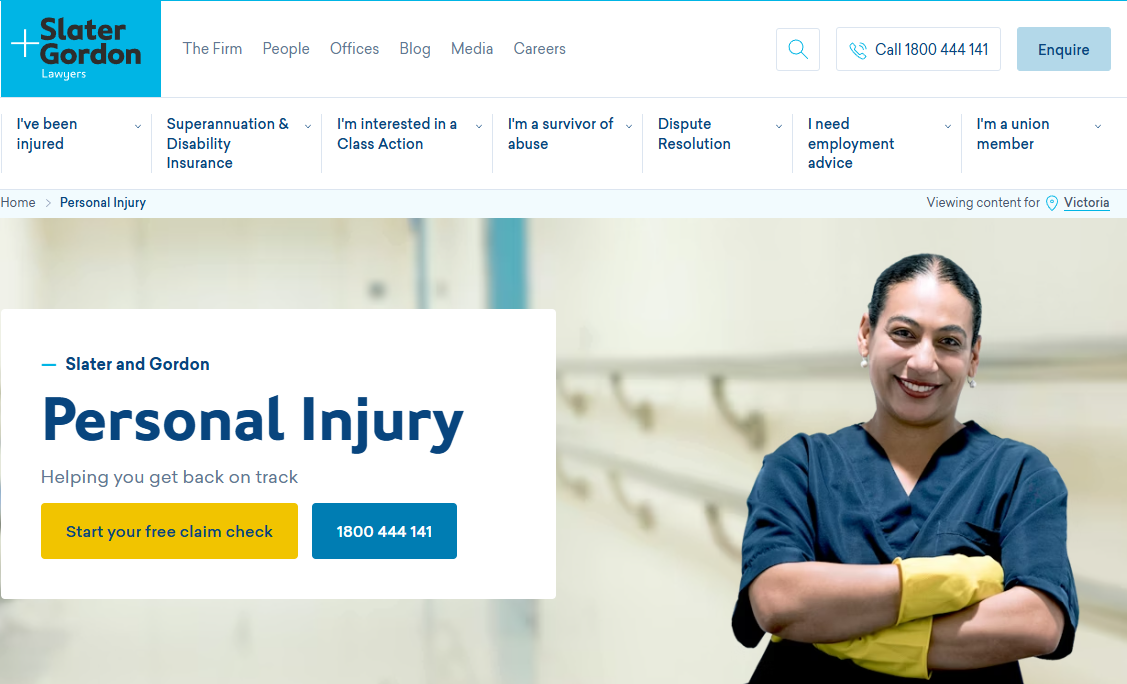
Slater and Gordon's personal injury page demonstrates a clean hero section with a clear headline, trust signals, and an obvious call to action - all visible without scrolling.
Fast Fix: Open your landing page on your phone right now. Can you see a headline, a trust signal, and a way to convert without scrolling? If not, you're losing prospects in the first five seconds.
The Page Structure That Converts
Here's how a high-converting personal injury landing page should be structured:
Section 1: Hero (Above the Fold)
- Headline matching search intent
- Subheadline highlighting your key differentiation
- Contact form or prominent phone number
- Trust signals (Google reviews, credentials, "featured in" logos)
- One strong testimonial or case result
Section 2: Pain or Services
This depends on whether you're building a general page or a specific injury page.
For general personal injury pages where you don't know the specific injury type, lead with pain. These people are hurt, frustrated, dealing with insurance companies trying to lowball them. Speak to that:
"You're dealing with medical bills piling up, lost wages because you can't work, and an insurance adjuster who keeps calling trying to get you to settle for nothing. We help accident victims get the full compensation they actually deserve."
For specific injury pages like "car accident lawyer" or "motorcycle accident lawyer," you can go straight into addressing the unique challenges of that injury type. Motorcycle accidents have different liability issues than car accidents. Workplace injuries have different compensation structures than slip and falls. Show them you understand their specific situation.
Alternatively, use a services grid showing the types of cases you handle. This works when prospects need direction toward the right practice area.
Section 3: Why You're Different
This is your differentiation section. What makes you different from every other personal injury firm?
The challenge here is that personal injury is a sea of sameness. Everyone's "experienced." Everyone "fights for their clients." Everyone has "recovered millions."
You need something concrete:
- Do you specialise in specific injury types with better outcomes?
- Are you former insurance defence attorneys who know their tactics?
- Do you have a better fee structure or payment terms?
- Is your communication process genuinely different?
Make it specific. "We communicate better" isn't differentiation. "You'll receive weekly video updates on your case and can text your case manager directly" is.
Here's why this matters: if prospects don't build preference with you, they'll call two or three firms. Then you're competing on speed to lead, what's being said during that first call, the advice and experience being given. This section builds preference so you're the first call, not the third.
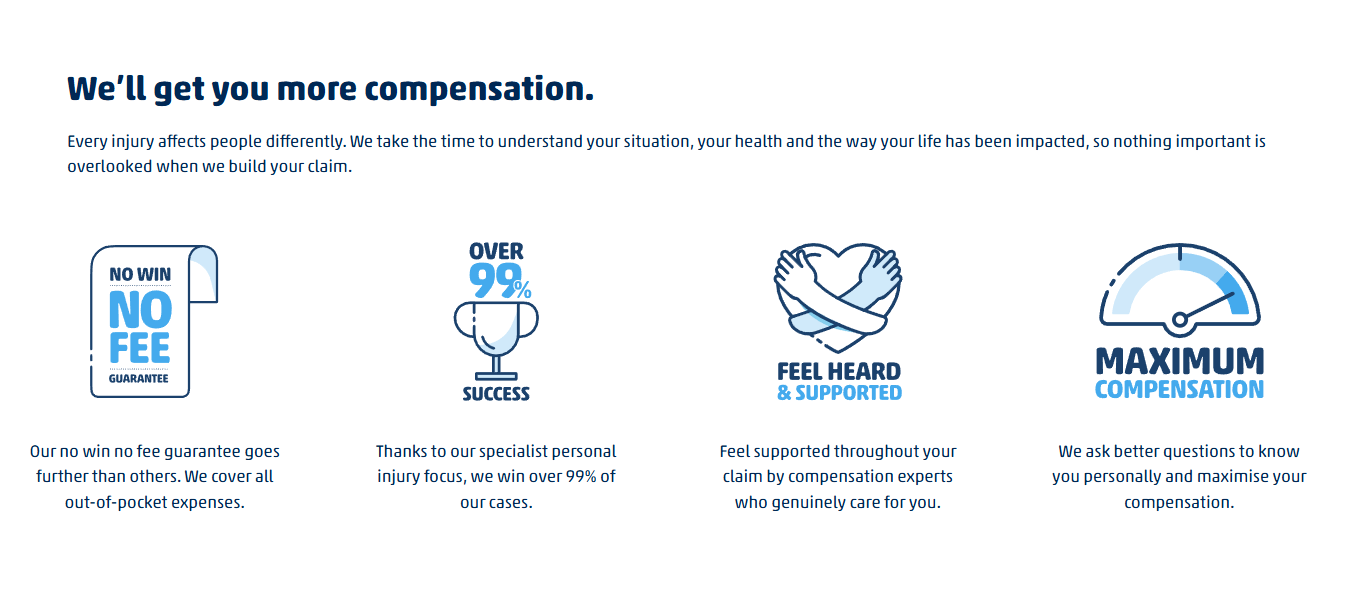
Strong trust signals like "No Win No Fee," success rates, and clear value propositions help prospects build preference quickly - making you the first call, not the third.
Key Insight: Differentiation isn't about saying you're "experienced" or "dedicated" - every firm says that. It's about something concrete and verifiable. If you're struggling with this, read about why most law firm marketing fails and how to actually stand out.
Section 4: Proof (Case Studies)
Most lawyers don't use case studies effectively. The ones that do see significant impact.
Show proof of results for the types of prospects you want to generate. If you're targeting younger prospects aged 25–40 who still have large careers ahead of them, show cases for injury types they might have and the outcomes you achieved.
Structure them like this:
- The situation (injury type, challenge)
- The insurance company's initial offer
- What you secured
- Impact on the client's life
Example: "Client was rear-ended on the freeway, suffered herniated discs requiring surgery, couldn't return to work as an electrician. Insurance offered $30,000. We secured $385,000 covering all medical expenses, lost wages, and future earning capacity."
You can strip out personal details for privacy. Just state that names and identifying information have been removed. But keep the specifics about the injury, the challenge, and the outcome. People need to see themselves in your case studies.
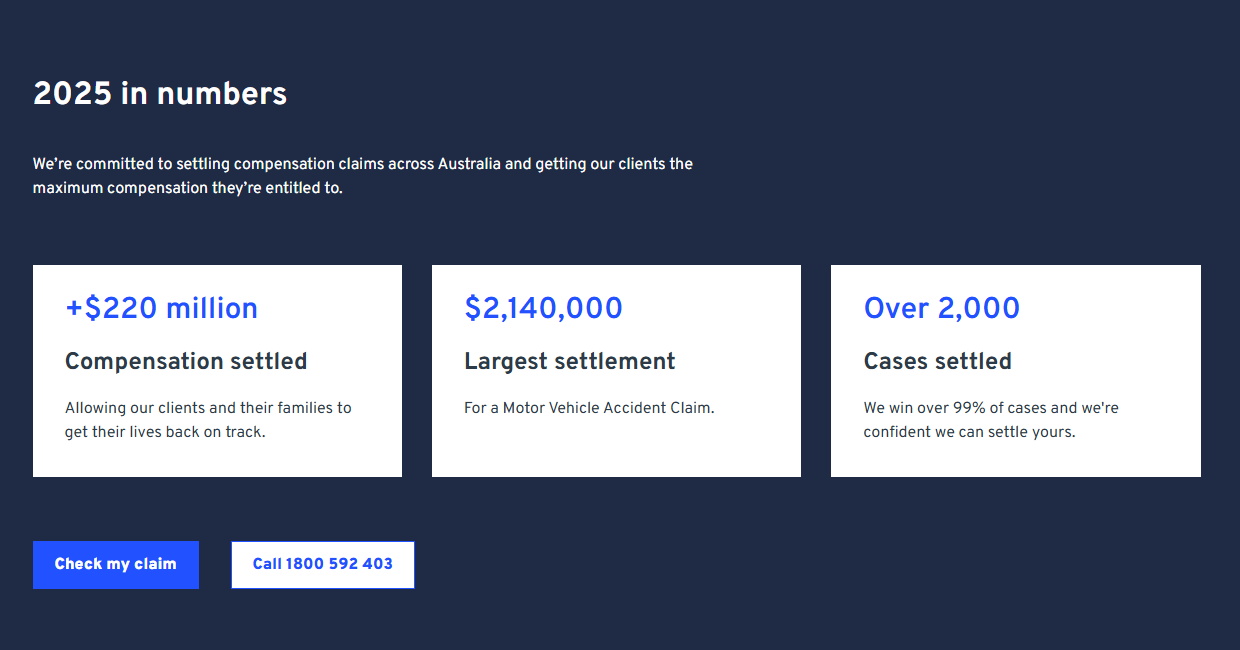
Displaying concrete case results with specific dollar amounts recovered builds immediate credibility. Numbers like "$220 million+ compensation settled" are far more persuasive than vague claims.
Pro Tip: Structure your case studies around the prospect you want to attract. If you're targeting workers comp cases, show workers comp results. If you want more motor vehicle accidents, lead with MVA outcomes. People need to see themselves in your proof.
Section 5: Video Testimonials
Video testimonials are massively underutilised in personal injury. If you have clients who've had good experiences, get on a call with them.
Tools like Riverside make it easy to record both sides. Jump on a call, ask questions about their experience, record it, send it to a video editor on Upwork or Fiverr. You can find editors cheaply anywhere now.
The video doesn't need professional production. Authentic often works better than over-produced. People trust real stories from real people more than they trust polished marketing videos.
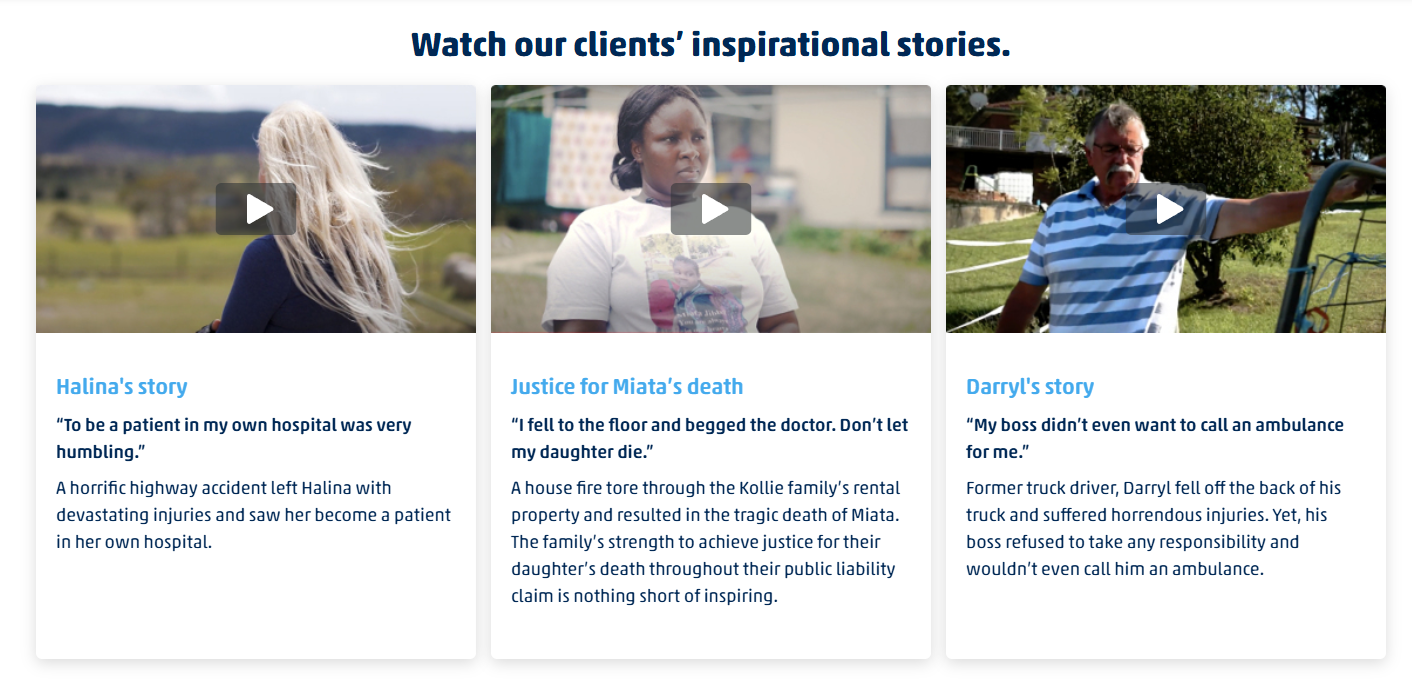
Video testimonials from real clients are one of the most underutilised conversion tools in personal injury marketing. Authentic stories build trust faster than any amount of written copy.
Quick Win: You don't need a production crew. Jump on a Riverside call with a happy client, record the conversation, and send it to a freelance editor. One genuine 90-second testimonial video can outperform an entire page of written reviews.
Section 6: FAQ
Handle objections here:
- "Do I have to pay upfront?"
- "What if the insurance company says it was my fault?"
- "How long does a case take?"
- "What if I can't afford a lawyer?"
Answer these clearly and you remove barriers to conversion.
Section 7: Final CTA
Give prospects one more opportunity to convert. Form or phone number, same as the top of the page.
Don't assume everyone reads top to bottom. Some people scroll straight to the bottom looking for contact information. Make it easy for them to convert wherever they are on the page.
Fast Fix: Add a second form or phone number at the bottom of your page today. It takes five minutes and you'll capture prospects who scroll past your hero section looking for more information before converting.
Building Landing Pages for Meta Ads Traffic
With Meta ads, you've got a couple of different approaches you can take. The key thing to understand is that these prospects are colder, so you need to warm them up somehow.
The Sales Letter Approach
One option is a sales letter. This is an emotion-driven long-form page that takes prospects from their current pain state through to pre-sold and ready to speak with you.
Copywriting is critical here. You're not listing services or credentials. You're taking someone through the emotional journey of their situation so they realise their current state isn't acceptable anymore.
The structure follows problem-agitate-solution:
- Problem: Start with their pain. "You were hit by a drunk driver. Now you're facing $80,000 in medical bills, you can't work, your car is totalled, and the insurance company just offered you $15,000 to 'settle it quickly.'"
- Agitate: Help them see why this is worse than they realise. Why accepting that offer would be a massive mistake. Why waiting and hoping the insurance company will be fair is costing them money every day.
- Solution: Introduce yourself as the answer. Show what's possible. Build credibility with proof. Handle their objections. Give them a clear next step.
This works when you have a compelling offer and you're willing to do the education work upfront through long-form copy.
Key Insight: The sales letter approach works brilliantly for Meta ads because you're taking cold prospects on an emotional journey from pain to solution. This is fundamentally different from Google Ads where people are already solution-aware. If you want to understand why this distinction matters, read about why selling to cold prospects is harder than ever.
The Sales Funnel Approach
The alternative is a sales funnel. You warm up cold traffic in stages before asking them to convert.
Sometimes less is more with Facebook. You can send people straight to a qualification survey. You see this constantly with personal injury - ads go to a Typeform or custom page that asks a series of questions, then qualifies the prospect to book a call.
The questions serve two purposes:
- They filter out unqualified leads (no viable case, outside statute of limitations, already settled)
- They warm up the prospect by making them think through their situation
By the time someone finishes answering questions about when their accident happened, what injuries they sustained, whether they're currently employed, they're more invested in the process.
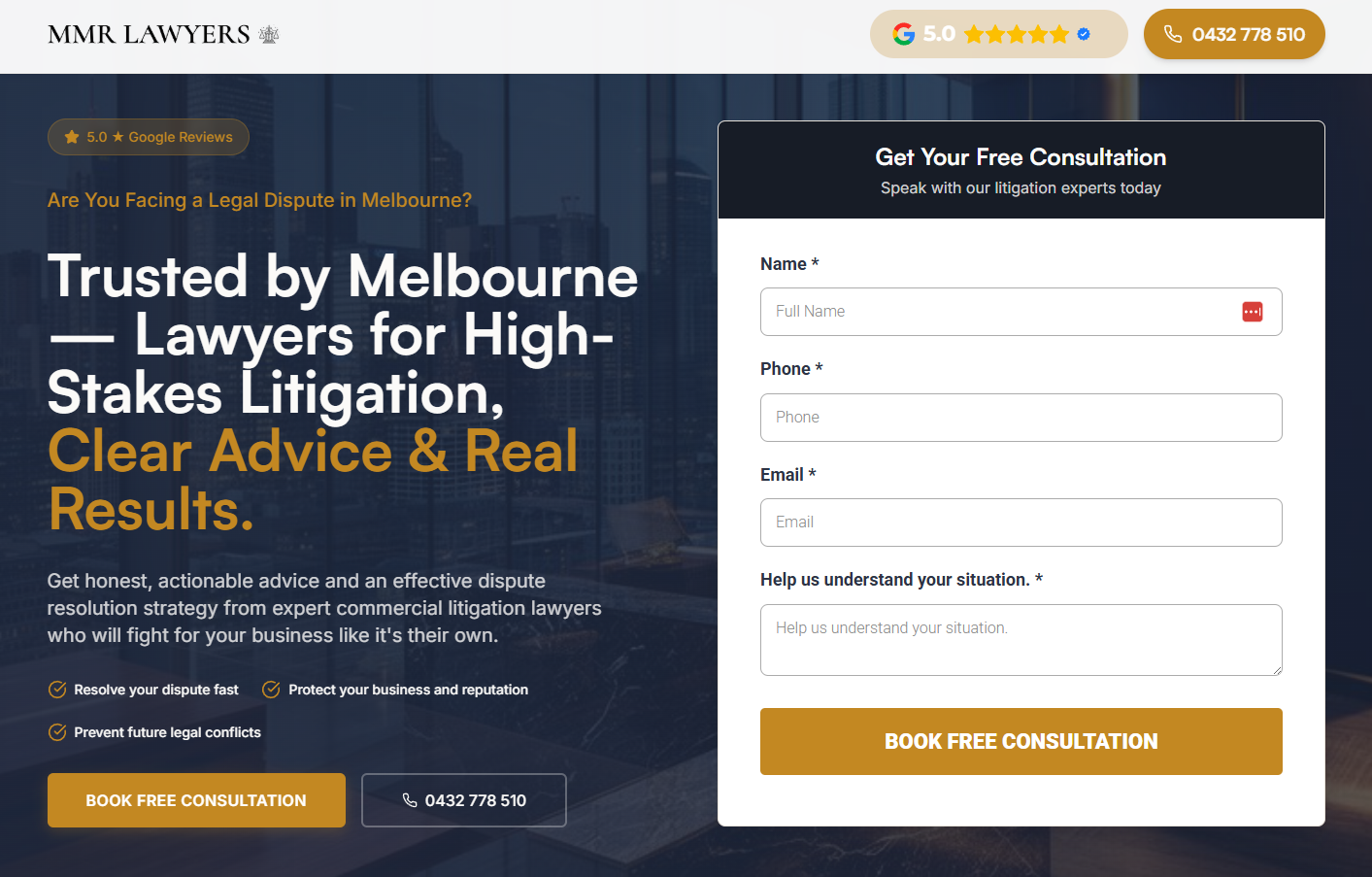
Even for commercial litigation and business law, the same principles apply - a strong hero section with clear credibility signals and an obvious conversion path.
Video Sales Letters
For business lawyers or litigation firms, you need to move people from problem-aware to solution-aware. This is where video sales letters come in.
A video sales letter works like a written sales letter, but you're on camera speaking directly to them about their situation. You appear as a person, not just a firm. You explain their pain, build the case for why they need help and establish trust.
People hire lawyers, not law firms. Seeing your face, hearing your voice, watching you explain their situation builds trust faster than any amount of written copy.
Pro Tip: Video sales letters work for every practice area - not just personal injury. Family lawyers, criminal lawyers, and even immigration lawyers can use the same approach to build trust with cold prospects before they ever pick up the phone.
Why Pre-Selling Matters
Meta traffic requires pre-selling. You need to start the sales conversation and build trust so cold prospects become warm and ready to talk.
Weak offer, ineffective pre-selling, or insufficient trust-building results in spam and poor quality leads. I see this constantly: firms send cold Facebook traffic to a basic contact form, get a bunch of form fills, then complain Meta doesn't work.
It's not that Meta doesn't work. You're not doing the work to bridge the gap between scrolling Facebook and being ready to hire a lawyer.
That bridge is either a sales letter, a qualification funnel, a video sales letter, or some combination. You can't skip it.
Key Insight: If you're buying leads from vendors instead of building your own pre-selling system, you're letting someone else control your lead quality. Building your own funnel with proper pre-selling gives you control over cost, quality, and volume.
Using Qualification to Train Your Algorithm
Tools like Lovable AI let you build qualification mechanics directly into your landing pages. This does two things: filters out bad leads and trains the advertising algorithm on what a good prospect looks like.
Here's a simple example. Ask prospects whether they're looking for free or legal aid services. If yes, don't show the form. You've saved your intake team from a call that was never going to convert.
If no, show the form and let them inquire normally.
This is powerful because you're not just filtering - you're training the algorithm. Think about it: if you count every form submission as a conversion, you're telling Facebook or Google "this is what I want."
If half those submissions are people looking for free legal aid or cases you can't help with, you're training the algorithm to find more of those people.
But if you filter them before they submit, you only send conversion signals for qualified prospects. Over time, the algorithm gets smarter about finding people like that.
Quick Win: Add one qualifying question to your landing page today: "Are you looking for free legal aid?" If yes, redirect them to a legal aid resource page. This single filter can improve your lead quality dramatically without reducing overall volume.
Qualification Examples for Personal Injury
For personal injury cases specifically, you can qualify based on things like injury date and employment status. Here are some examples:
- When did the accident happen? If it's outside your statute of limitations, filter them out before they ever fill out a form.
- Are they currently employed? This impacts lost wages claims and case value.
- Have they already settled with insurance? You can't help them if they've already settled.
- Are they looking for free or legal aid services? Save your intake team the time and don't show the form.
These criteria dramatically improve the conversion signals you're sending back to advertising algorithms. The algorithm learns what a qualified lead looks like for your firm and finds more of them.
No lawyer wants more leads just for the sake of leads. You want qualified opportunities you can actually close and see impact with. Qualification mechanics help you get there without sacrificing volume. Sometimes you actually get more volume because you're teaching the algorithm what to look for.
Pro Tip: The most underrated benefit of qualification is algorithm training. Every time you filter out an unqualified lead before they submit a form, you're telling the algorithm "don't find me more people like this." Over time, your cost per qualified case drops significantly.
What This Comes Down To
Your landing page exists to convert traffic at the highest rate possible. Not to look pretty. Not to win design awards. To turn expensive clicks into cases that pay your bills.
That means understanding the fundamental difference between Google Ads traffic and Meta traffic.
For Google Ads: You're dealing with people already looking for you. Focus on trust, relevance, and frictionless conversion. Put forms above the fold. Use video testimonials. Show specific case results matching your target prospects. Build preference so you're the first call, not the third.
For Meta: You're interrupting people who aren't actively looking for a lawyer. Take them on an emotional journey. Use sales letters or qualification funnels to pre-sell and warm them up. Don't send cold Meta traffic to your Google Ads pages.
For both channels: Qualify your leads properly. The goal isn't more leads. It's more of the right leads your team can actually close.
If your current landing pages aren't converting where they should be, the issue is usually one of these:
- Wrong page structure for the traffic source
- Weak differentiation
- Poor trust signals
- Lack of qualification
Fix those and your cost per case drops dramatically without increasing ad spend.
The firms winning with PPC aren't necessarily the ones with the biggest budgets. They're the ones who understand that the landing page is where campaigns are won or lost. Everything else just gets people to the door. What happens when they walk through determines whether you make money or lose it.
If you're a personal injury firm looking for a marketing partner who actually understands how to build landing pages that convert PPC traffic into signed cases, book a strategy call and let's look at what you're working with.
Want us to implement these strategies for you?
Book a free strategy call and let's discuss how we can grow your business.
Book Your Free Call
Written by
Byron Trzeciak
Founder of PixelRush, Byron has spent over a decade mastering digital marketing. His agency has helped 300+ brands grow, managed $10M+ in ad spend, and optimised 400+ landing pages. He shares hard-won strategies so you can skip the learning curve.
Continue Reading
View All →
Why Personal Injury Google Ads Are Getting More Expensive (And What to Do About It)
22 min read
The Lead Response Crisis: Why Your "Bad Leads" Might Actually Be Gold
4 min read