




$224.
That's what "personal injury lawyer Sydney" costs per click on Google in May 2026, up from $171 the year before. Not per lead. Per click. Every single tap from a stranger on a search result.
At a 5% conversion rate from click to form fill, that's $4,480 to get one enquiry. At a 25% enquiry-to-signed-client rate, that's close to $18,000 to win one case, paid up front, with the settlement still 12 to 18 months away from showing up in your trust account.
If you run a boutique personal injury law firm in Australia, you already know this. CAC climbing every quarter, margins compressing, and you can't switch the ads off because the pipeline collapses inside a fortnight. The national firms absorb $1,500-per-lead economics because they have settlement-funded reserves, institutional capital, and the volume to spread case selection across hundreds of intakes a month. You don't.
This article isn't about how to win the auction. You can't. The deck is stacked, the bidders are deeper-pocketed, and the trend gets worse every year.
What I want to walk through is what we've been doing instead. How to make Google Ads economically viable at boutique scale, where the actual leverage points are, and what to build alongside it so you're not betting the firm on one channel that the nationals are slowly pricing you out of.
Key Takeaways
- CPC for "personal injury lawyer Sydney" hit $224 in May 2026. Most boutique firms can't make those economics work.
- Broad match is whack-a-mole. Less than 1% of broad match conversions in PI accounts we've audited were qualified opportunities.
- Most firms train Google's algorithm wrong by counting every form fill as equal. Splitting qualified versus unqualified events into separate conversion actions changes everything.
- If you're spending under $20K a month, you can't afford an enterprise account structure. Collapse down to two campaigns and get hyper-focused on one practice area.
- Performance Max for PI is risky. In Queensland it's a PIPA compliance landmine because of auto-generated creative.
- The real escape is building familiarity before someone searches. Meta video ads at $80 to $150 per enquiry are doing what $300 to $500 Google Ads enquiries can't.
What Personal Injury Google Ads Actually Cost in Australia
$224 per click for "personal injury lawyer Sydney". $137 per click for "injury lawyers Sydney". $97.54 for "compensation lawyers". $203 for "injury claim lawyer".
These aren't outliers. This is the live market in May 2026.
The downstream math is brutal. If your conversion rate from click to enquiry is 5%, which is decent for the category, you're paying $4,480 to get one form fill. If 25% of those enquiries become signed clients, which is also solid, you're sitting at $17,920 per signed case. For the full breakdown of where boutique firms typically land, see our piece on personal injury client acquisition cost in Australia.
You're also running no-win-no-fee. The marketing cost hits today. The settlement lands in 12 to 24 months. So that $18,000 is a working capital problem before it's a P&L problem.
Shine and Slater & Gordon can run these economics because of scale, institutional funding, and average case values that boutique firms can't match. At their volume, $1,500 per signed lead works. At your volume, it doesn't.
CPCs Have Climbed 20 to 40% a Year for Five Years Running
This isn't a temporary spike. Personal injury CPC has compounded at 20 to 40% annually for five years.
Why does it keep rising? More firms chasing the same limited ad inventory. National firms with institutional capital that can bid aggressively. Google knows PI firms are dependent on the channel and prices accordingly. No incentive on Google's side for the trend to reverse.
The trend line is clear. Next year will be more expensive than this year. The year after that, worse again. If you're waiting for Google Ads costs to stabilise or drop, you're waiting for something that isn't coming. (We've written a wider take on whether Google Ads are still worth it for law firms if you want the broader argument.)
Broad Match Is a Game of Whack-a-Mole
Most agencies pitching you Google Ads will tell you broad match is where the real growth is. They'll say their AI tooling has cracked it. They'll show you a conversion graph trending up and to the right.
What they won't show you is where those conversions actually came from.
Last quarter we audited four PI accounts. Three in Melbourne, one in Brisbane. Spending between $14K and $48K a month. We pulled apart their broad match search terms. Across all four, less than 1% of the leads broad match produced were qualified opportunities. The rest were people researching their own claim, comparing settlement amounts, looking for a free template, students writing essays, and in one case someone asking whether they could still sue over an injury from 2011.
The conversions themselves look fine in the report. Form filled, lead dropped into the CRM, agency invoice goes out on time. The problem is what those conversions train Google to do next. Once the algorithm sees a "type" of person convert, it goes and finds more of them. Cheaper clicks, more conversions, optimisation report looks great. Your intake team is drowning, your partners are wondering why $30K in ad spend produced three signed clients, and the agency is showing you a CPL graph that's trending down.
The negatives never catch up either. You add Reddit. Google finds Quora. You add Quora. Google finds career sites. You add jobs and salary. Google finds "how much does a personal injury claim pay", a totally valid keyword that's completely useless to you because the searcher isn't hiring anyone, they're estimating their own case. It's whack-a-mole. You'll never get ahead of it because Google isn't optimising for your case acquisition cost. It's optimising for clicks at $80 plus a pop.
The One Scenario Where Broad Match Pays Off
There is a version of broad match that works for PI firms, and it has two preconditions:
- Full-loop tracking. Offline conversions feeding back from your CRM into Google Ads, with signed-client revenue as the optimisation target.
- Qualification baked into the form, so Google never sees an unqualified lead as a conversion in the first place.
Without those two pieces, broad match is the most expensive way to look productive ever invented.
Why Google's Auto-Apply Recommendations Cost You Money
Google's auto-apply recommendations actively push you toward broad match. The language is always about "missing opportunities". What that actually means is Google wants to show your ads to more people regardless of intent, because more impressions equal more clicks equal more Google revenue.
We've audited PI accounts where 40 to 50% of total budget was being burned on broad match search terms that had no business clicking on a lawyer's ad. If you haven't manually reviewed and tightened your match types in the last quarter, that's almost certainly happening in your account too.
How to Qualify Leads Before Google Counts Them
If you're going to fix Google Ads, this is where to start. Not match types. Not negative keywords. Conversion tracking, with qualification baked in. We've covered the strategic case for this in should law firms qualify leads or take everyone who calls.
Two approaches. Both work. Different tradeoffs.
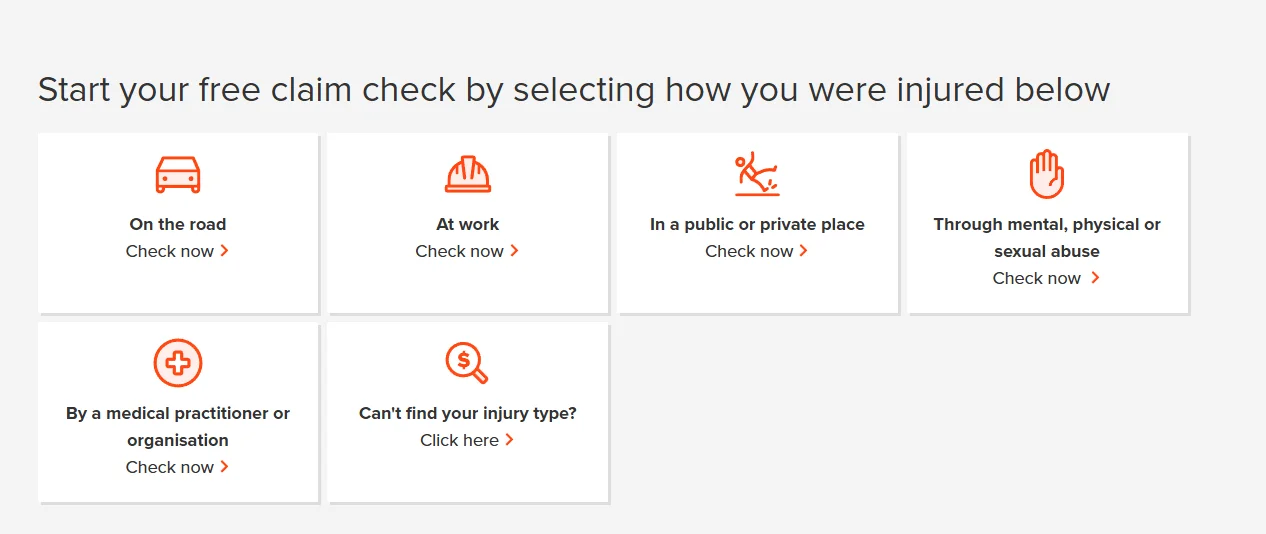 A real PI qualification flow: the first step segments the claim type before the form even loads, so unqualified injuries can be routed away from the intake queue.
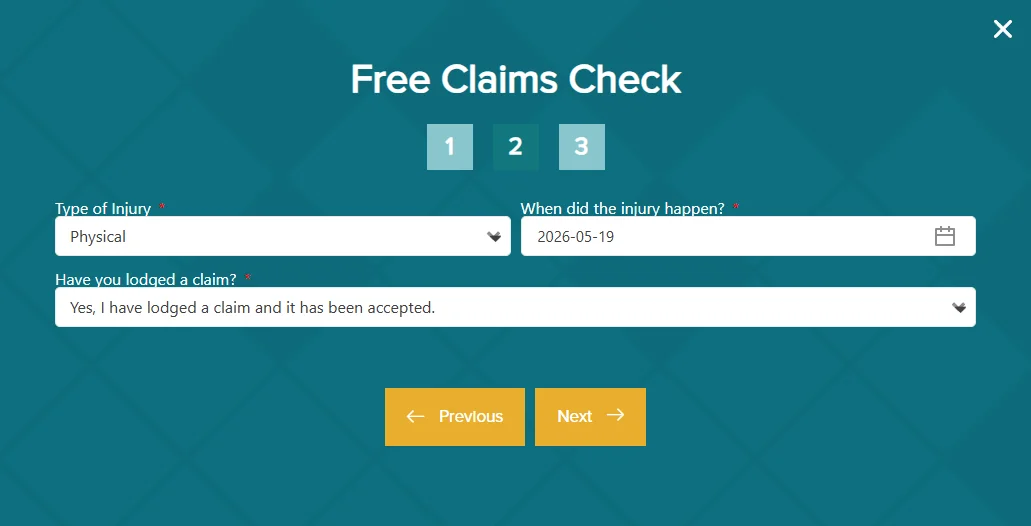 Step two captures the three fields that actually disqualify most enquiries: injury type, date of injury, and whether a claim has already been lodged. Qualified completions fire a separate conversion event from disqualified ones.
Hard Disqualification vs Soft Disqualification
Hard disqualification: someone fills out your form, fails qualification on a knockout criterion (wrong injury date, already settled, weren't employed at the time, whatever you've defined) and they get a polite screen telling them you can't help. They never enter your intake queue. The trade is that your cost per lead goes up because Google sees fewer "conversions", but your team isn't burning hours chasing dead enquiries.
Soft disqualification: same form, same qualification logic, but instead of bouncing the lead, you take it and tell them someone will be in touch. The difference happens in the tracking layer. Qualified completions fire one conversion event, call it qualified_lead. Unqualified completions fire a different one, unqualified_lead. Now your agency can see, campaign by campaign, what proportion of leads are actually worth chasing. Google's algorithm gets trained on the qualified event and ignores the noise. Your intake team triages on signal, not faith.
The soft approach is what we use with most clients. You give the algorithm the cleanest possible signal of what "good" looks like. Your sales team gets visibility into lead quality at the source instead of three weeks into a follow-up sequence. And you don't have to make a binary "you don't deserve a callback" decision at the form itself.
Value-Based Bidding for PI Firms
If you want to push further, layer value-based bidding on top of qualified leads. The setup looks like this:
- Qualified lead, strong case profile: send conversion value of $1,000 to Google
- Qualified lead, uncertain case strength: send conversion value of $500
- Unqualified: send $0 or no conversion at all
Google's bid algorithms optimise toward higher-value conversions. You're explicitly teaching the system which leads are worth more, and over 60 to 90 days it gets noticeably better at finding the high-value ones.
Either approach works across any campaign type, whether search, broad, or Performance Max. The point is that without one of them, you're letting Google decide what success looks like. And as we've established, Google's definition of success is volume, not signed clients.
Spending Under $20K a Month? Stop Running an Enterprise Account
There's a budget reality in Australian PI that nobody likes discussing. Firms in this space run anywhere from $2,000 a month to $100,000 plus. The top of the market is one of the deepest-pocketed verticals in Australian paid search.
If you're sitting under $20K a month, and that's most boutique firms, you cannot afford to copy what big agencies do for the nationals.
The standard "best practice" account structure has eight or ten campaigns: workers comp Sydney, workers comp Brisbane, motor vehicle Sydney, motor vehicle Brisbane, public liability, medical negligence, and so on. Each campaign gets a thin slice of budget, a few conversions a month, and exactly the wrong amount of data. Enough to confuse Google's algorithm, not enough to train it.
The harsh math: Google's bid algorithms need roughly 30 conversions per campaign per month before they have anything useful to optimise on. Spread a $15K budget across eight campaigns and you'll get two to five conversions in each. That's eight under-trained campaigns, all bidding inefficiently, all eating the budget you do have.
What we'd do instead: collapse the account down. Pick the practice area where you make the most money per signed client. Pick the geographic area you can actually service well, not state-wide, not nationally, but a 25 to 50km radius around your office. Push 80% or more of your budget into that single campaign until you're hitting 30 plus qualified conversions a month.
Most of our PI clients at this budget level run two campaigns, not eight. One primary practice area, one secondary. Both geo-restricted to where the firm can actually service cases. The conversions consolidate. The algorithm has enough data to optimise. The cost per signed client comes down because Google is no longer making blind bids on twelve different micro-audiences.
Add the next campaign when the first one has plateaued and you've got more budget to deploy. Don't try to run a Slater & Gordon style account on a boutique budget. You'll lose every one of those auctions because you're spread thin and they're not. More on why this hurts boutique accounts specifically in why your small Google Ads budget is actually harder to manage.
Performance Max, Kids Clicking Ads, and the Queensland PIPA Trap
We're reluctant on PMax for personal injury. Search campaigns still produce our highest quality leads when we can get the volume to train them properly. But search is genuinely getting harder. AI Overviews are eating click-through rate on informational queries. ChatGPT, Claude, and Gemini are absorbing the research stage of the buying journey that used to feed search funnels. Google itself isn't seeing the same volume on commercial queries it was 18 months ago.
So PMax is what Google keeps pushing, and reluctantly, it's something most PI firms now need to test.
The catch is that PMax mixes search, display, YouTube, Gmail, Maps, and the broader Google network into one black-box campaign. That mix is excellent for ecommerce, where it was originally built. It's brutal for legal lead generation because the bottom-of-funnel placements like display, in-app ads, and video attract clicks from people who aren't searching for a lawyer at all.
A real example. A client of ours got three calls in a single week from the same number. Every call was a child. Turns out a kid was playing a game on their parent's phone, an interstitial ad fired, they tapped it, and Google's mobile click-to-call routed them straight through to the firm's intake line. The parent didn't notice until call three. That's PMax doing exactly what it was designed to do, driving "conversions" through display placements you didn't actively choose.
You can mitigate this with proper conversion tracking, value-based bidding fed by your CRM, hard-excluded placements, and aggressive audience signals. But on a boutique PI budget, you'll struggle to feed PMax enough qualified-lead data to teach it what good looks like. You'll spend $5K to $15K finding out it doesn't work for you the way it works for a Shopify store.
If you're going to run PMax, and at some point you probably should test it, treat it as a tightly fenced experiment, not a primary channel.
The Queensland PIPA Compliance Risk in PMax
If you're advertising personal injury services in Queensland, there's a specific PMax problem most agencies don't know about. PMax has automatic asset generation enabled by default. If you don't supply a video, Google will generate one for you, sourced from your Google Business Profile images and your website. If you don't lock down image variants, Google will generate alternative creative on its own.
That's a compliance landmine. Queensland's PIPA (Personal Injuries Proceedings Act) restricts what can be said and shown in legal advertising for PI matters. Auto-generated creative bypasses your compliance review entirely, and you don't see what Google actually served until after the impressions are in.
Two protective moves before you spend a dollar on PMax in Queensland:
- Turn off automatic image generation and automatic video generation in every PMax campaign. You supply the creative. Google serves only what you supplied. Nothing else.
- Audit what's actually running via the Google Ads Transparency Center. It shows live ad creative for any advertiser. If anything's running that you didn't approve, that's an immediate compliance review.
Outside Queensland this matters less in regulatory terms, but it's still good practice. Auto-generated creative for legal services is rarely a good look, and the broader regulatory mood around AI-generated content in legal contexts isn't friendly.
Is Google Ads Still Worth It for Personal Injury Firms?
This is the question I keep hearing from frustrated managing partners. When you're spending $10,000, $20,000, or $50,000 a month and watching CPL climb every quarter, it's natural to wonder if Google Ads makes sense at all anymore.
The honest answer: it depends on what you're using it for and what you have to replace it with.
Google Ads still works, but only if you understand what it actually is. It's not a lead generation channel. It's a lead capture channel. You're intercepting people who've already decided they need a lawyer. You're just trying to be the one they choose from a list of six.
That's valuable. It's also incredibly expensive because you're competing with every other PI firm in your area for the same moment of decision.
The bigger question is whether you have a better way to generate enquiries right now. Most firms don't. They're relying on referrals which are inconsistent, word of mouth which is slow to scale, and Google Ads which is expensive but at least works. So they keep the ads running because turning them off means watching the pipeline collapse.
That's not a strategy. It's dependency.
What Happens When You Turn Google Ads Off
The pattern when a PI firm switches Google Ads off without a replacement channel:
Week one: enquiries drop 40 to 60%. Week two: new signed cases drop to near zero. Week three: panic. Week four: ads go back on at higher budgets because the firm is now desperate.
This is why firms keep paying even when the unit economics make no sense. The alternative feels worse. (When you do get an enquiry, the 60-second rule on lead response is what decides whether it converts at all.)
The reason turning off Google Ads is so painful is because you haven't built any other predictable source of enquiries. You're dependent on a single channel that's squeezing you harder every month. The solution isn't to keep feeding the beast. It's to build alternative sources before the costs get high enough to force a desperate decision.
How to Lower Your Cost Per Lead Without Killing Volume
A few practical fixes you can deploy this quarter. These won't solve the fundamental problem (CPC is going up regardless), but they'll buy you margin and time while you build longer-term solutions.
Switch Broad Match to Phrase or Exact
Go into your account today and switch broad match keywords to phrase match or exact match. Yes, impressions will drop. That's the point. Fewer, better clicks from people who actually want to hire a lawyer beats hundreds of clicks from students researching case law or DIYers looking for templates.
Start with phrase match. Monitor for two weeks. If conversion rate improves even with lower lead volume, you're on the right track. Move to exact match only on the keywords where you have strong intent signal and the volume to support it.
Build Out 200+ Negative Keywords
Most PI firm accounts have 20 to 30 negative keywords. The ones that work have 200 to 300. Starter blocks to add today:
- free (people seeking free advice will rarely hire)
- jobs (career searchers)
- salary
- course (students)
- study
- how to become (career research)
- DIY (self-helpers)
- template
- sample
- Reddit (research forums)
- Quora
- forum
- worth it (people researching whether to bother)
- payout calculator
- how much
After this starter list, work the search terms report weekly. Every wasted search you spot becomes a new negative. This is maintenance, not a one-time fix. Block low-intent searches before they cost you money.
Push Landing Page Conversion Above 10%
If your landing page converts at 3 to 5%, you're losing money. A well-optimised PI landing page should sit at 8 to 12% minimum. The strongest ones we've built hit 15 to 18%. Full teardown of what changes between a 3% and a 15% page in our personal injury landing page optimisation guide.
What usually needs to change:
- Too many form fields. Cut down to name, phone, and a brief description of injury. That's all you need at the form stage.
- Generic copy that could apply to any law firm. "We fight for your rights" means nothing. Get specific about outcomes you've actually delivered.
- No social proof above the fold. Testimonials, case results, and review counts need to be visible without scrolling.
- Weak CTA. "Contact us" is dead. "Book your free case assessment" is better. "Find out if you have a case in 60 seconds" is better again.
- Broken mobile experience. Over 60% of PI searches happen on mobile. If the page is slow or ugly on a phone, you're losing half your traffic.
Even a small conversion lift compounds hard. A firm spending $20K a month at 5% conversion gets 100 enquiries. Lifting to 10% means 200 enquiries on the same spend. CPL just halved.
Lead With Settlement Figures and Video Testimonials
The single biggest conversion lift we see on PI landing pages is hard, specific trust signals above the fold. Not "trusted by thousands". Real numbers, real faces, real outcomes. Two formats consistently outperform everything else.
1. A "Results in Numbers" block. Total compensation settled, largest single settlement, total cases won, win rate. Plain text on a dark background, no stock photos, no fluff. This is what LHD Lawyers run near the top of their landing pages and it's a pattern almost every high-converting PI page in the country borrows from.
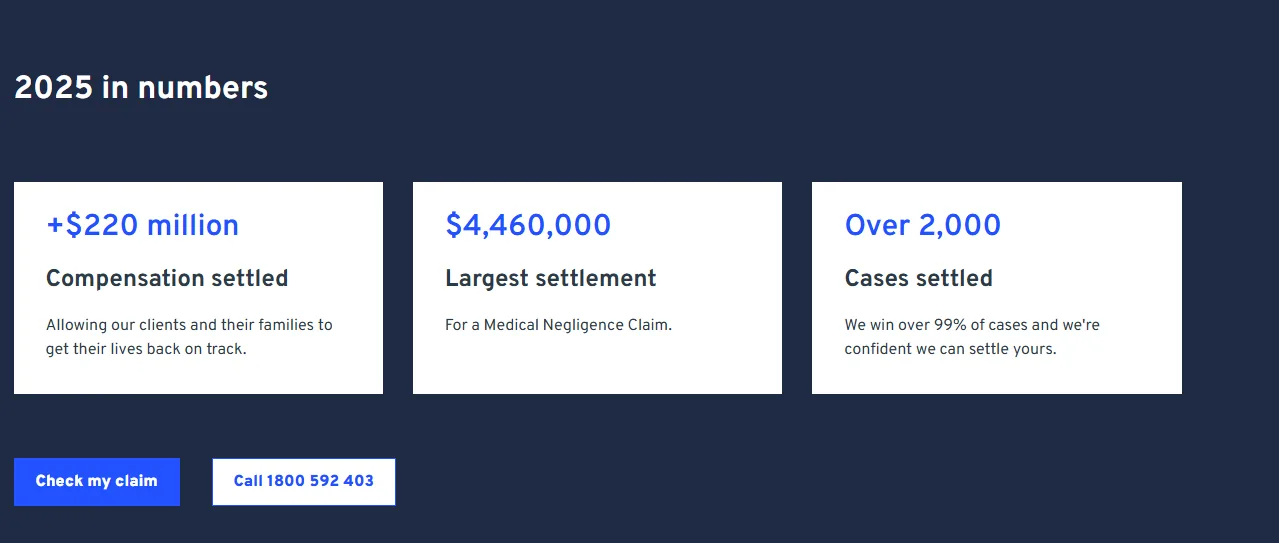 Hard numbers do more work than any headline. Compensation totals, largest single settlement, case count, and win rate signal credibility in under three seconds.
If you're a boutique firm and the numbers feel small, segment them. "$4.2M recovered for Queensland workers in the last 24 months" lands harder than "$50M+ across the firm" if the second number is a multi-decade total. Be honest, be specific, and update quarterly.
2. Real client video testimonials. Not written quotes with a stock headshot. Actual filmed clients telling their story in 60 to 90 seconds. Three of them above the fold or just below, with a still frame thumbnail and a short caption.
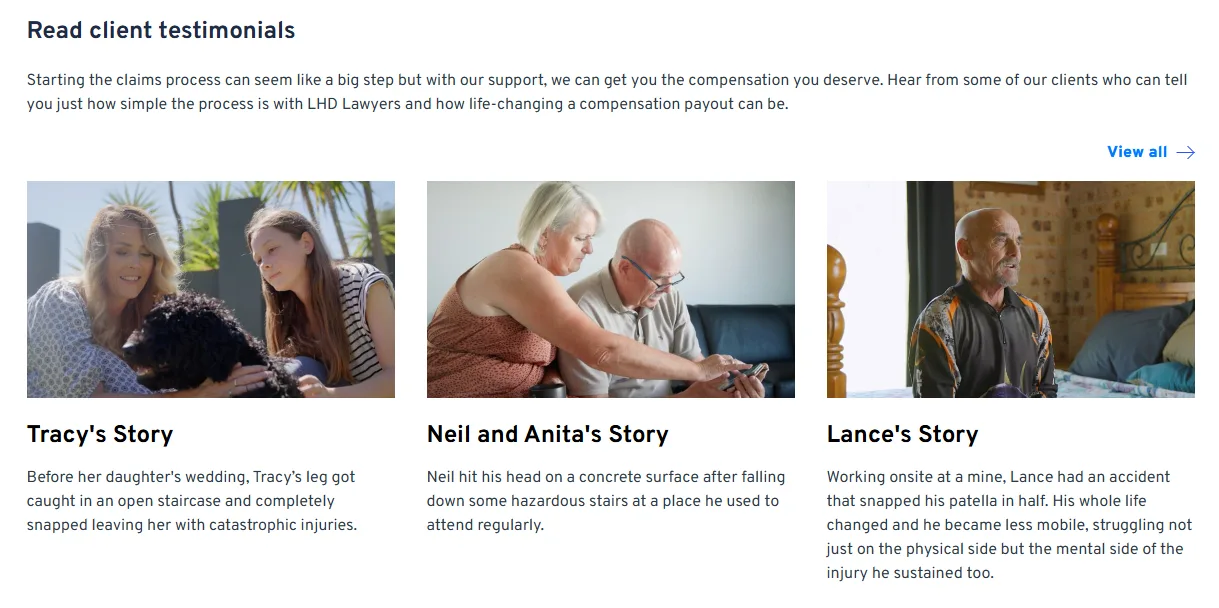 Filmed client stories outperform written testimonials by a wide margin. The thumbnail does most of the work, even before anyone presses play.
We've A/B tested written versus video testimonials on PI landing pages multiple times. Video wins every time, usually by 20 to 40% on form fill rate. The hard part is getting the footage. Most firms put it off because filming takes coordination. The firms that invest in three to five client story videos lower their CPL more than any bid strategy change ever does.
If you can't shoot studio quality, shoot on a phone with a lapel mic in a quiet room. Authenticity beats production value. A real client in their kitchen explaining what the settlement meant for their family converts better than a polished corporate video every time.
Block Competitor Brand Terms, Even on Phrase Match
Google's "close variants" feature triggers your ads on competitor brand searches even when you're running phrase or exact match. You might think you're not bidding on "Shine Lawyers", but Google sees someone search "Shine Lawyers Sydney" and decides your phrase match "injury lawyers Sydney" is close enough.
This isn't a bug. It's intentional. Google calls it close variants.
The fix is tedious but mandatory. Add every major competitor brand as a negative keyword. Shine. Slater and Gordon. Maurice Blackburn. Compensation Lawyers. Every national firm in your space. Do it now before you waste another few thousand on people who want someone else.
You'll occasionally see competitor brand clicks convert. Someone searches for a national firm, sees your ad, decides to enquire instead. It happens. But the rate is low enough that for most boutique firms, the wasted spend isn't worth the occasional conversion. Let the nationals fight over their own brand terms.
Reach People Before They Ever Search for a Lawyer
Here's the structural shift that's working for PI firms who've stopped trying to win Google's game.
When someone searches "personal injury lawyer Sydney", they're in comparison mode. They see Shine. They see Slater & Gordon. They see your firm, if you're bidding high enough and your quality score is good enough. You're one option among six. The firms with the biggest budgets, the most reviews, and the most brand recognition win that comparison more often than not.
What if you could reach the same person three days before they searched?
What if the conversation happened before they even knew they needed a lawyer? What if when they finally decided "I need help with this", your face was already familiar and your firm's name was already in their head?
They wouldn't search "personal injury lawyer Sydney" at all. They'd search your name. Or they'd click your ad on autopilot because they already feel like they know you.
That's the difference between competing in an auction and operating in an ocean of one.
How Meta Video Ads Work for PI Firms in Australia
This is where video-based advertising on Meta becomes a real channel for PI firms. We've broken down the creative side of this in Facebook ads for personal injury law firms.
You're not targeting people searching for lawyers. You're targeting people who fit the profile of someone who might need a PI lawyer soon. Someone who's been in a car accident. Someone dealing with a workplace injury. Someone whose circumstances suggest they might have a claim.
You show them a short video where you explain something useful. Not a sales pitch. Genuine education about their rights, what to watch out for, common mistakes people make.
They watch the video. They don't need a lawyer right now, so they scroll on. But you've planted something. When they do need help, they remember you. You're not some random firm competing with ten others. You're the lawyer who helped them understand their situation before they even knew they had one.
This approach takes consistency. You're not running ads for a fortnight and expecting results. You're building familiarity over weeks and months. When someone in your audience does need a PI lawyer, you're the obvious choice because you're already familiar.
The Economics of Meta Video vs Google Ads for PI Firms
The economics we've seen across PI clients running this strategy:
- Cost per enquiry through video-based Meta ads: $80 to $150
- Cost per enquiry through Google Ads (search): $300 to $500 and climbing
We break the full economics out by channel in personal injury lead generation cost in Australia.
The quality of enquiries is also higher because they're not comparing you to five other firms. They're coming to you specifically. Conversion rate from enquiry to signed client lifts because trust is partially established before the call. They've seen your face. They've heard you explain things. They feel like they already know you.
This isn't theoretical. It's happening for firms who've stopped trying to compete on Google's terms and started building familiarity before the search happens.
What About SEO for Personal Injury Law Firms?
Quick reality check on SEO, because too many PI firms waste money on services that will never deliver.
If you're not already ranking in the top three for your money terms, catching up will cost you $5,000 to $10,000 per month for 12 to 18 months minimum. And that's just to start competing. Not to dominate. To get in the conversation.
Why so expensive? Because you're fighting firms that have been building domain authority for a decade. Shine has thousands of indexed pages, hundreds of quality backlinks, and a domain age that gives them a huge head start. You can't "do SEO" for six months and expect to outrank them. The math doesn't work.
Is SEO Worth It for Boutique PI Firms?
For most boutique PI firms, no, not as a primary lead source.
The time horizon is too long. The investment required is too high. The competition is too fierce. And even if you do everything right, you're still betting on Google's algorithm not changing in a way that wipes out your rankings.
That's a lot of risk and spend for uncertain returns that won't materialise for over a year.
If you've got capital to deploy and you're thinking three to five years out, sure, SEO can be part of your marketing mix. If you need leads in the next six to twelve months to keep your firm growing, SEO is the wrong channel to focus on. The longer version of this argument lives in is SEO worth it for personal injury law firms.
Google Business Profile Is the Exception
Google Business Profile optimisation (local SEO) is a different story. It's fast, cost-effective, and works for PI firms.
Getting your GBP fully optimised, collecting reviews systematically, and showing up in the local map pack when someone searches "personal injury lawyer near me" delivers results much faster than trying to rank organically. This should be part of every PI firm's marketing strategy. But it's a complement to paid advertising, not a replacement.
What a Sustainable PI Lead Gen System Looks Like
A sustainable PI lead generation system doesn't rely on a single channel. It doesn't depend on Google Ads staying affordable, because they won't. It doesn't wait for SEO to kick in, because that's too slow.
It looks more like this:
Video-based advertising on Meta and TikTok builds familiarity and trust before someone needs a lawyer. This is the primary lead generation engine. You're reaching people early, educating them, making yourself the obvious choice when they do need help.
Google Business Profile captures local searches from people who are ready to hire. Defensive positioning. When someone does search, you want to show up in the map pack with strong reviews.
Retargeting stays in front of people who engaged with your video content or visited your website. Most people don't hire a PI lawyer the first time they see your ad. Retargeting keeps you top of mind until they're ready.
Referral systems make it dead simple for past clients to refer new ones. This is the highest-quality lead source you have, and most firms completely neglect to systematise it.
Strategic Google Ads runs at a small percentage of total spend, capturing the specific high-intent searches where the economics still work. You're not trying to win on volume anymore. You're being selective about where you compete. This is the same multi-channel mix we use inside our closed-loop growth system.
This mix gives you consistency, predictability, and resilience. If one channel gets more expensive or less effective, you're not scrambling because the others are still delivering.
Where to Start This Week
If you're a PI firm watching your Google Ads costs climb and your margins shrink, here's a sequence that works.
This week. Audit your Google Ads account. Switch match types from broad to phrase or exact. Add the negative keyword starter list above. Add competitor brand names as negatives. Pull the search terms report and identify the worst waste.
Next week. Implement lead qualification. Add three to four qualification questions to your enquiry form that identify whether someone has a viable case. Start tagging which leads pass qualification and which don't. This is the data that unlocks everything else.
This month. Fix your conversion tracking. Stop sending every form fill to Google as a conversion. Send qualified leads as one event and unqualified leads as a separate event, or no event at all. If you can't configure this yourself, hire someone who can. This single change will transform campaign performance over the next 60 to 90 days.
Next month. Start testing video-based Meta ads. Begin small, $50 to $100 a day. Create three to four short videos explaining common PI scenarios in your area. Track cost per view, cost per engagement, and cost per qualified enquiry.
Next quarter. Build your video library out. More videos, different angles, different case types. Test what resonates. Scale what works. Build retargeting audiences from your best-performing content.
The goal isn't to replace Google Ads overnight. It's to reduce your dependency on a single channel while building infrastructure that gives you more control and better economics.
The Bottom Line for Boutique PI Firms
Personal injury Google Ads are expensive and getting worse. That's not changing.
What you can control is the quality of leads your campaigns produce and the signals you're sending to Google's algorithm. Most PI firms train Google to find more leads when they should be training it to find better leads. Fix conversion tracking. Implement qualification. Stop rewarding the algorithm for delivering rubbish.
And while you're doing that, start building alternative channels. The firms that thrive over the next few years won't be the ones who optimise Google Ads campaigns 5% better. They'll be the ones who built lead generation systems that don't depend on winning auctions against national firms with unlimited budgets.
Start thinking about how to reach people before they search. Build familiarity through video. Show up consistently. Make yourself the obvious choice before the moment of decision arrives.
That's how you compete when you can't afford to compete.
Want us to implement these strategies for you?
Book a free strategy call and let's discuss how we can grow your business.
Book Your Free CallContinue reading
More on Law Firm Marketing
How Do Criminal Lawyers Get More Clients? (It Comes Down to What a Matter Is Worth)
How Australian criminal lawyers get more paying clients. Why the value of the matter decides which marketing works, what Google Ads clicks really cost, why reviews and the map listing matter so much, how the leading firms do content without stuffing it, the lawyers getting millions of views on social media, and why referrals carry the serious matters.
How Should Law Firms Use Email Marketing? (The Six Emails Worth Sending)
Email rarely wins a law firm a new client on its own, but it decides what happens to the enquiries, past clients and referrers you already have. The six emails worth sending, what to send leads who don't sign, getting reviews and referrals, the Spam Act and privacy rules for Australian firms, what Queensland's injury advertising law means for email, deliverability, tools and what to measure instead of open rates.
How Do You Write a Law Firm Marketing Plan? (Build One System at a Time)
A law firm marketing plan that works is a series of marketing systems, built one at a time. How to work out who your clients are and where they look for help in each practice area, check capacity, set a ceiling per signed client, crack one channel before adding the next, turn each channel into a system that runs without the partners, scale it to compete with top-tier firms, and spot the systems that are costing money without doing their job.
What Should a Law Firm Website Include? (84% of Your Ad Clicks Are on a Phone)
What an Australian law firm website should include, page by page. What goes above the fold, how to structure practice area and location pages, lawyer profiles, enquiry forms that qualify without creating conflicts, what the conduct rules allow, how fast it needs to be, WordPress vs builders vs static sites, what it costs in Australia, and how to brief a designer and compare quotes.