




Almost every accountant I speak with tells me the same thing. Their work comes from referrals and word of mouth, and they're grateful for it.
But scratch the surface and a different picture emerges. They feel completely at the mercy of those referrals. They can't turn them on when they want to, and worse, they often feel obliged to take whatever walks through the door, even when it doesn't fit the practice they actually want to build.
That's the part nobody talks about. Referral growth isn't just unpredictable. It's quietly shaping your firm into something you didn't plan.
In nearly every sales conversation I have with an accountant, the same maths shows up. They might get ten enquiries in a month from word of mouth. Maybe twenty if they're well networked. Of those, one or two might actually match the ideal client they described to me five minutes earlier. The rest? They take them anyway. Because the work's there, and you've got staff to pay.
That's not a growth strategy. That's a treadmill.
Key Takeaways
-
Most accounting firms grow by accident, not by design, because referrals dictate what kind of practice you end up with.
-
Out of every ten referrals, accountants tell me only one or two are an ideal client fit, the rest get taken on anyway.
-
Taking on poor-fit clients makes systemisation nearly impossible and caps your growth ceiling.
-
A marketing system isn't there to replace referrals, it's there to give you a lever you can actually pull.
-
Accountants benefit from unusually high client lifetime value, which makes the maths on paid acquisition more generous than most firms realise.
-
Most firms targeting $1.5M, $3M or $10M can't get there on referrals alone, the maths simply doesn't add up.
-
The firms that scale profitably build a marketing channel before they're desperate for one.
-
Proper conversion tracking and offline data feeding back to ad platforms is what makes every dollar work harder over time.
-
The right offer beats the right channel, every time.
Referrals Aren't A Strategy, They're A Symptom Of Good Work
When an accountant tells me referrals are their growth engine, what they're really telling me is that they do good work. That's a compliment, not a strategy.
Good work makes referrals possible. But referrals will never give you the dial you need to make a decision and act on it. You can't decide on Monday that you want three more advisory clients by the end of the quarter and have referrals magically produce them. The alternative is a channel you control, one you can switch on the moment you decide to grow.
This is where a lot of accounting firms get stuck. Looking at the firms I speak with, the patterns are consistent:
-
Revenue plateaus around the owner's personal network. Once you've tapped your existing clients' contacts, referral velocity drops off a cliff. You can't network your way to the next $1M.
-
Seasonal volatility kills planning. Most accountants tell me July and August are stupidly busy, then it dries up. Referrals follow the same rhythm, which makes the problem worse.
-
Capacity decisions get made backwards. You hire because work showed up, then you scramble to find more work to keep them busy.
-
Your growth rate is whatever your existing clients feel like delivering. That's a passenger seat, not a driver's seat.
Key Insight
Referrals are a result, not a proactive growth strategy. They prove your work is good, but they hand you no control over timing, volume or fit.
The Hidden Problem: You're Growing The Wrong Practice
This is the part that gets missed in most articles about accountant marketing. The bigger issue isn't that referrals are unpredictable. It's that they slowly turn your firm into something you didn't choose.
Here's what happens. A client refers you their friend. The friend is a sole trader doing $80k a year and needs a basic return. You take them on because they were referred, because saying no feels rude, and because every fee helps. You charge them a few hundred dollars once a year and you're in and out in half an hour.
Multiply that by two hundred clients and you've built a high-administration, low-fee practice. That practice was never the plan. It was the result of saying yes too many times.
I see this constantly. One accountant I spoke with recently has been in business five years. He's flooded with international students, taxi drivers and rideshare drivers, all from his community network. None of it was advertised for. None of it pays well. And he's stuck because that's now what his practice looks like, even though what he wants is $10k-a-year business clients turning over $500k or more.
Another firm sits in a high foot traffic area in central Sydney. They love the brand awareness, but most of the walk-ins are small individual returns. In their own words:
"Low fees, high administration, and honestly a pain to deal with. They pull all our focus away from the $4,000-a-month retainers we actually want."
The pattern is the same across nearly every firm I talk to. The accountants who feel busiest are often the ones least likely to grow.
Why You Can't Systemise A Practice Full Of Mixed Clients
The other thing referral-led growth quietly destroys is your ability to systemise.
Every accountant I work with eventually wants the same thing. They want a process that runs without them. They want junior staff to be able to deliver consistent work. They want to step out of the day-to-day and either focus on advisory or sell the practice for a multiple that reflects its repeatability.
You can't build any of that on top of a client base that's wildly mixed. If you're servicing a $2 million construction firm on Monday, a sole trader rideshare driver on Tuesday, an NDIS provider on Wednesday and an SMSF on Thursday, every job needs a different workflow, a different tech stack, a different level of partner involvement. The "system" is whichever partner happens to know that file.
The firms that scale are the firms that decided what they were and weren't. One accountant I spoke with won't take anyone who isn't already in the Xero ecosystem. If a prospect uses MYOB, they either pay to be converted across, or they're shown the door. That kind of clarity is only possible when you've stopped accepting whatever the referral pipeline delivers.
Pro Tip
Decide who you are not for before you decide who you are for. The exclusions are what make a systemised, sellable practice possible.
The Maths Of Referrals Versus The Maths Of Acquisition
Here's where it gets interesting. Accountants have one of the strongest business models I work with for paid acquisition. The reason is simple: client lifetime value.
When a good accountant signs a client, they tend to keep them. Five years, ten years, sometimes longer. That makes the upfront cost of acquiring a client almost a non-issue once you do the maths properly.
Let's run a scenario based on what I see in conversations every week. You sign a small business advisory client at $1,500 a month. That's $18,000 in year one. Keep them three years and that's $54,000. Five years, $90,000. And that's before any spin-off projects, business sales, or referrals they generate.
| Metric | Referral Client (Avg Fit) | Acquired Ideal Client |
|---|---|---|
| Control over timing | None | High |
| Typical annual fee | $300 – $2,000 | $18,000+ |
| 5-year client value | Often under $5,000 | $90,000+ |
| Acquisition cost | "Free" | Small fraction of year one |
| Fit to ideal practice | 1-2 in 10 | Chosen on purpose |
Now compare that to the cost of acquiring them. Even at the higher end of what we typically see for paid search in this space, the cost per signed client is a small fraction of year one revenue. The conversation stops being "can I afford to advertise?" and starts being "how fast can I scale this?"
Referrals look free at the point of acquisition. But there's a hidden cost you don't see on a P&L: the cost of not being able to choose.
If 80% of your referrals are clients you wouldn't have advertised for, your effective cost per ideal client isn't zero. It's the opportunity cost of all the capacity and brand positioning you spent on the wrong work.
Why The Offer Matters More Than The Channel
A lot of firms ask me about Google Ads versus Meta versus LinkedIn. That's the wrong first question. The first question is: what specifically are you selling, and to whom?
I had a conversation recently with an accountant scaling from $1.4M to $3M, with a long-term target of $10M. He'd been thinking about marketing for months but kept getting stuck on what offer would stand out. His instinct was right. If your offer sounds like every other accounting firm in your suburb, paid acquisition will burn through your budget without much to show for it.
The accountants who get this right tend to do a few things differently:
-
They speak to a specific industry, not "small business". Construction, NDIS, childcare, franchise operators, medical practices. Pick one or two and go deep. Generic firms compete on price. Specialised firms get chosen.
-
They lead with the outcome the client actually wants. NDIS providers don't want bookkeeping. They want to know whether they're profitable across their participants, whether their cash flow can survive a price freeze, and whether they're keeping enough back for tax. Sell the outcome, not the line item.
-
They have a named program or system. A "Construction Cash Flow Audit" or an "NDIS Profit Protection Review" sounds different from "advisory services". Naming the thing makes it harder to compare you against the firm down the road.
-
They get specific about who they're not for. The minute you make it clear you don't take on sole trader tax returns, the right prospects lean in. The wrong ones go elsewhere. That's a feature, not a bug.
When the offer is sharp, the channel becomes a delivery mechanism. When the offer is generic, no channel saves you.
What A Working Marketing System Actually Looks Like
Once the offer is right, the system underneath it is more straightforward than most accountants expect. The components are predictable.
A paid acquisition channel is the engine. Meta tends to work well for cold prospects who don't yet know they have a problem worth fixing, the ones still scrolling at 9pm watching ads pop up between videos. Google tends to work for warm prospects who are actively searching. Most firms benefit from a mix.
A short video or pre-sell page sits behind the ad. This is where the offer gets articulated in the prospect's language, where you build enough trust that they're willing to book a call. The video doesn't need to be polished. It needs to sound like you, address the specific problem the prospect has, and make it clear why you're the right firm to solve it.
A booking page replaces the contact form. Speed to lead is the difference between winning and losing in this category. If a prospect fills in a form and waits two days for a callback, they've already booked with the firm that responded in ten minutes. A direct calendar booking removes the gap entirely.
A CRM captures every prospect, every touchpoint and every outcome. Without this, you have no feedback loop and no way to make next month's ads work harder than this month's.
Offline conversion data flows back to the ad platforms. This is the part most agencies skip, and it's the part that compounds over time. When your CRM sends qualified-lead and closed-client signals back to Meta or Google, the algorithm learns who looks like a paying client and starts finding more of them. If you only train the platform on form fills, you'll get more form fillers. If you train it on signed clients, you'll get more signed clients. Most accountants who tried paid ads in the past and gave up did so because nobody set up that loop properly.
What This Looks Like When It Works
Numbers make this real. Here is a snapshot from one of our own accountant campaigns, tracked end to end through the exact loop above.
| Metric | Result |
|---|---|
| Ad spend | $11,688 |
| Leads | 251 at $46.57 each |
| Quotable leads | 138 |
| New clients signed | 20 at $584 cost per client |
| Revenue generated | $105,116 |
| Return on ad spend | 9x |
| Avg client value | $5,255 |
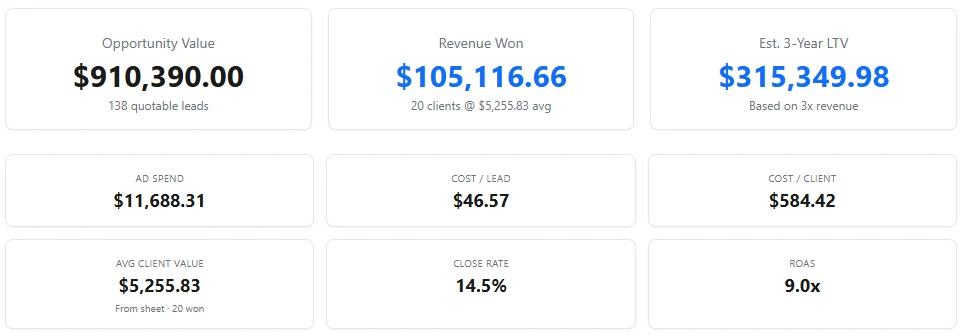
Every lead, quotable opportunity and signed client tracked end to end inside one reporting dashboard.
This is where the accountant lifetime value maths stops being theoretical. A $584 cost to sign a client who stays for years is not a marketing expense, it's the best return in the practice. On a client worth around $12,000 a year, that same $1,600-ish cost to acquire returns $12,000 in year one, $36,000 over three years if they stay. That is exactly the maths an accounting firm needs when the goal is to buy growth, and to buy the ideal clients you actually want rather than absorbing whatever the referral pipeline delivers.
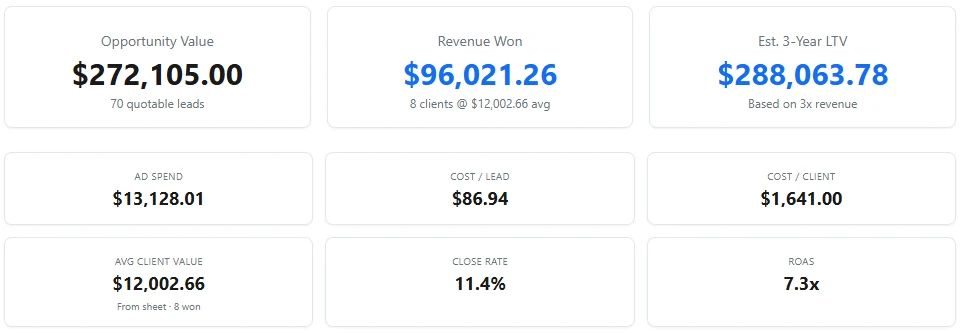
A different campaign signing higher-value clients: $1,641 to acquire a client worth around $12,000 a year, or roughly $36,000 over three years.
What's Realistic In The First Six Months
I'll be direct about timing because this is where expectations go wrong.
Paid doesn't need a long runway. With the right strategy and offer, a well-built campaign can start producing booked calls in the first weeks, not months. The lead generation itself is rarely the hard part.
The bigger sticking point is almost always on the firm's side. Accountants are used to warm referrals who already trust them and arrive half-sold. Cold leads behave differently. They need to be handled faster, qualified harder and closed on the call, and they come in higher volume than a referral pipeline ever produces. Most firms who struggle with our system don't struggle because the leads aren't there. They struggle because the practice hasn't yet learned how to convert a cold prospect and manage the volume. Solve that, and the system compounds quickly.
SEO and organic content sit in a different timeframe entirely. Twelve to eighteen months before they're a meaningful contributor, and even then they tend to be a tailwind for the paid system rather than a replacement for it.
If your current pipeline is purely referrals and you want to grow, paid is where you start. Organic is where you go after the paid system is paying for itself.
The mistake I see most often is firms waiting until they're desperate to put a system in place. That's the worst time to start. Paid acquisition needs a few months of consistent investment for the algorithm to find your best prospects. If you start it when revenue is already tight, the temptation to switch it off after a month is overwhelming. And switching it off after a month guarantees you never see the return.
The firms that scale build the system when referrals are working, not when they've dried up.
Key Insight
The best time to build a marketing channel is while referrals are still strong. The worst time is when they've already dried up and you're desperate.
Where To Start If You've Never Marketed Before
If you're starting from zero, here's the order I'd suggest, based on what works for the accountants I see growing fastest.
Start with a written offer that's specific enough to make you nervous. If it doesn't make you think "what if we exclude too many people", it's not specific enough. Pick one industry, one outcome, one type of business you genuinely want more of.
Get your CRM and tracking in place before you spend a dollar on ads. Even something simple. You need to know where every lead came from, what happened to it, and how long it took to close. Without that, you'll never be able to tell what's working.
Run a small, focused test on one channel for at least 90 days. Resist the urge to try a bit of everything. Spreading $2,000 across Meta, Google, LinkedIn and a directory listing tells you nothing. Putting all of it into one channel for three months tells you everything.
Listen to your sales calls. The difference between a 10% close rate and a 30% close rate isn't usually the ads. It's the conversation. Even great prospects can be lost in a clunky sales process, and this is where most firms quietly leave money on the table.
Stop saying yes to every referral that doesn't fit. This is the hardest one. But the practice you actually want to build will only emerge when you stop letting the wrong work fill your calendar.
The Real Question
The question isn't whether referrals or marketing wins. They both work, in their own way. The real question is whether you want a practice you chose or a practice that happened to you. Whether you want to grow by accident or by design. Whether you want to wait for the phone to ring or pick up a lever and pull it.
Referrals will always be part of the answer for a good accountant. But if you want to scale to $1.5M, $3M, $10M or beyond, the maths doesn't work on referrals alone. You need a channel you control, an offer that earns the right to charge what you want to charge, and a tracking system that makes every dollar work harder than the one before it. The proof is in what's working for accounting firms right now.
If you're ready to build that channel, book a strategy session. I'll show you exactly where the maths actually pencils out, and what a system designed around your offer and your ideal client would look like. No pitch, no fluff, just an honest conversation about where you are and where you want to get to.
Want us to implement these strategies for you?
Book a free strategy call and let's discuss how we can grow your business.
Book Your Free CallContinue reading
More on Accountant Marketing
How to Build a Marketing Funnel for Your Accounting Firm: The Complete A–Z Guide
The complete A–Z system for building an accounting firm marketing funnel that signs clients on demand: the maths, the ads, the landing page, the sales call and the tracking.
How to Scale Your Accounting Practice Without Hiring More Staff
You can scale an Australian accounting practice without hiring more staff by improving capacity per full-time equivalent through workflow automation, offshoring, higher-value service mix, and more selective client acquisition. The firms growing right now aren't adding headcount....
Accounting Firm Marketing Budget: What Actually Works in Australia
The old rule of "spend 5-10% of revenue on marketing" doesn't work for accounting firms. You're not a widget manufacturer with predictable monthly sales cycles. Your revenue spikes during tax season, drops in summer, and depends heavily on client retention rates that most firms c...
How to Beat Cheap Online Accounting Without Competing on Price
You're losing clients to online bookkeeping platforms and DIY accounting software. Every month, another business owner mentions they're switching to Xero or MYOB because it's "cheaper and easier." Meanwhile, your firm is stuck justifying why your monthly fee costs more than their...