
You have probably Googled this before and landed on some article telling you to spend five to ten percent of your revenue on marketing.
That advice was written for a different era. Follow it today and you will either underspend badly, overspend blindly, or end up doing both at once across different channels.
Here is the framework that actually drives smart marketing budgets today, and a realistic breakdown of what your money gets you.
Key Takeaways
- The percentage-of-revenue rule is outdated. The businesses winning today budget based on cost per acquired client versus lifetime client value.
- A 2:1 return means you are barely breaking even once you account for overheads. A 6:1 return or higher is where you start genuinely buying growth.
- A website, a CRM, and one well-run paid traffic channel are your foundations. Everything else is optional until those three are working.
- AI tools have permanently changed what a small budget can achieve, but experience still determines whether you use them well.
- Getting one channel working predictably beats being average across five.
- Organic traffic as a standalone strategy is quietly dying. Google is shifting toward zero-click results. Being found in AI-generated answers is the new SEO.
Why the Percentage Rule Will Get You Into Trouble
The old rule said spend five to seven percent of revenue to maintain, seven to ten percent to grow, and ten to fifteen percent to dominate.
The problem? It has nothing to do with whether your marketing is actually working.
A business turning over $500,000 could spend $50,000 on marketing and generate $400,000 in new client value. Another business at the same revenue level spends the same amount and generates close to nothing. Same percentage. Completely different outcomes.
Key Insight
Revenue tells you how big you are. It tells you nothing about whether your marketing makes financial sense. Budget based on return, not revenue.
The Framework That Actually Works: ROI Ratios
Sophisticated businesses, especially those running paid advertising properly, think about budgets through one lens: what does it cost to acquire a client, and what is that client worth?
Once you know those two numbers, the budget question answers itself.
Here is how the ratios break down in practice.
| ROI Ratio | What It Means | What To Do |
|---|---|---|
| 2:1 | Barely breaking even after overheads | Fix follow-up process, website conversion, or lead handling before spending more |
| 4:1 | Profitable but cautious | Look for conversion problems, not traffic problems |
| 6-8:1 | Genuinely buying growth | Increase budget confidently, it is arithmetic not a gamble |
| 8-15:1+ | Scaling to operational limits | The bottleneck is staffing and capacity, not marketing |
2:1 Return: You Are Not Actually Profitable Yet
Technically you are making money. But once you account for staff, overheads, and the cost of delivering the work, most businesses at a 2:1 return are running hard to stand still.
The fix here is rarely "spend more." It is almost always a broken follow-up process, a website that does not convert, or leads being lost between the enquiry and the first conversation.
4:1 Return: Profitable, But Still Cautious
You are in a more comfortable position, but most businesses here hesitate to increase spend. The margins feel okay. Not extraordinary.
This is where businesses plateau. Things are working well enough that the pain of change feels greater than the opportunity in front of them. The ones who break through usually find a conversion problem, not a traffic problem.
6-8:1 Return: Now You Are Buying Growth
Every dollar you put in is generating meaningful returns. Spending more stops feeling like a risk and starts feeling like arithmetic.
This is the range where increasing your budget is a straightforward business decision, not a gamble. Businesses here have typically invested in proper tracking, a high-performance website, and a follow-up system that does not leak leads.
8-15:1 and Beyond: Scaling to Operational Limits
At this level the constraint is rarely the advertising. We see this across personal injury law firms and other high-value service businesses where a single client can be worth tens of thousands in fees.
The bottleneck becomes staffing, intake, and your capacity to deliver. The marketing is working. The question becomes how fast can you grow before your operations cannot keep up.
Expert Tip
Do not increase your ad spend until you can clearly articulate your cost per acquired client and their lifetime value. If you cannot answer both numbers confidently, your tracking is the problem, not your budget.
What Does Your Budget Actually Buy?
With the ratio framework in mind, here is an honest breakdown of what different spend levels get you in Australia right now.
| Annual Budget | What You Get | Who This Suits |
|---|---|---|
| Under $5,000 | DIY foundations, AI-built website, learning phase | Brand new businesses bootstrapping |
| $5,000 - $10,000 | Solid website, Google Business Profile, basic CRM | Early-stage businesses building foundations |
| $10,000 - $20,000 | Performance website, one managed ad channel, CRM, basic tracking | Businesses ready to generate consistent leads |
| $20,000 - $50,000 | Two to three channels, content strategy, experienced specialists | Growth-stage businesses ready to scale |
| $50,000+ | Multiple channels, dedicated specialists, full attribution | Established businesses pushing operational limits |
Under $5,000 Per Year
You are bootstrapping. Nothing wrong with that if you are just starting out, but be realistic about what it means.
The one thing that has genuinely changed at this budget level is AI. Tools like Lovable let you build a functional, professional website faster and cheaper than ever. Pair that with the right AI tools for content and ideas and you can execute things that would have required serious agency budget not long ago.
The trade-off is time and learning curve. And the results are only as good as the judgement you bring to using them.
$5,000 to $10,000
You can get a solid website built, your Google Business Profile properly set up, and a basic CRM running. You are not generating consistent leads from paid traffic at this level, but you are building the foundations that make paid traffic work later.
Most businesses who try to skip these foundations and go straight to ads burn this budget quickly and conclude that marketing does not work for them.
$10,000 to $20,000
This is where real marketing begins. You can afford:
- A performance website that actually converts visitors into enquiries
- A managed Google Ads or Meta campaign with meaningful ad spend behind it
- A CRM to track, nurture, and follow up leads properly
- Basic tracking so you know what is working
This is also where you start accumulating enough data to understand your actual cost per lead and cost per client. That data changes everything about how you think about budget going forward.
Key Insight
Most businesses who say "marketing does not work" actually have a follow-up problem, not a marketing problem. A CRM that tracks every lead from first click to closed deal changes the entire conversation.
$20,000 to $50,000
You can run two or three channels in parallel without spreading too thin. A proper content strategy becomes viable. You have enough budget to bring in experienced specialists rather than generalists.
Businesses at this level who commit properly tend to see compounding results year on year. The foundations built in year one make year two more efficient, and year three more efficient again.
$50,000 and Above
You are no longer asking whether marketing works. You are figuring out how hard to push before operations become the constraint.
Multiple channels, dedicated specialists, and proper attribution tracking are all on the table. This is not where most small businesses start. It is where most successful ones end up.
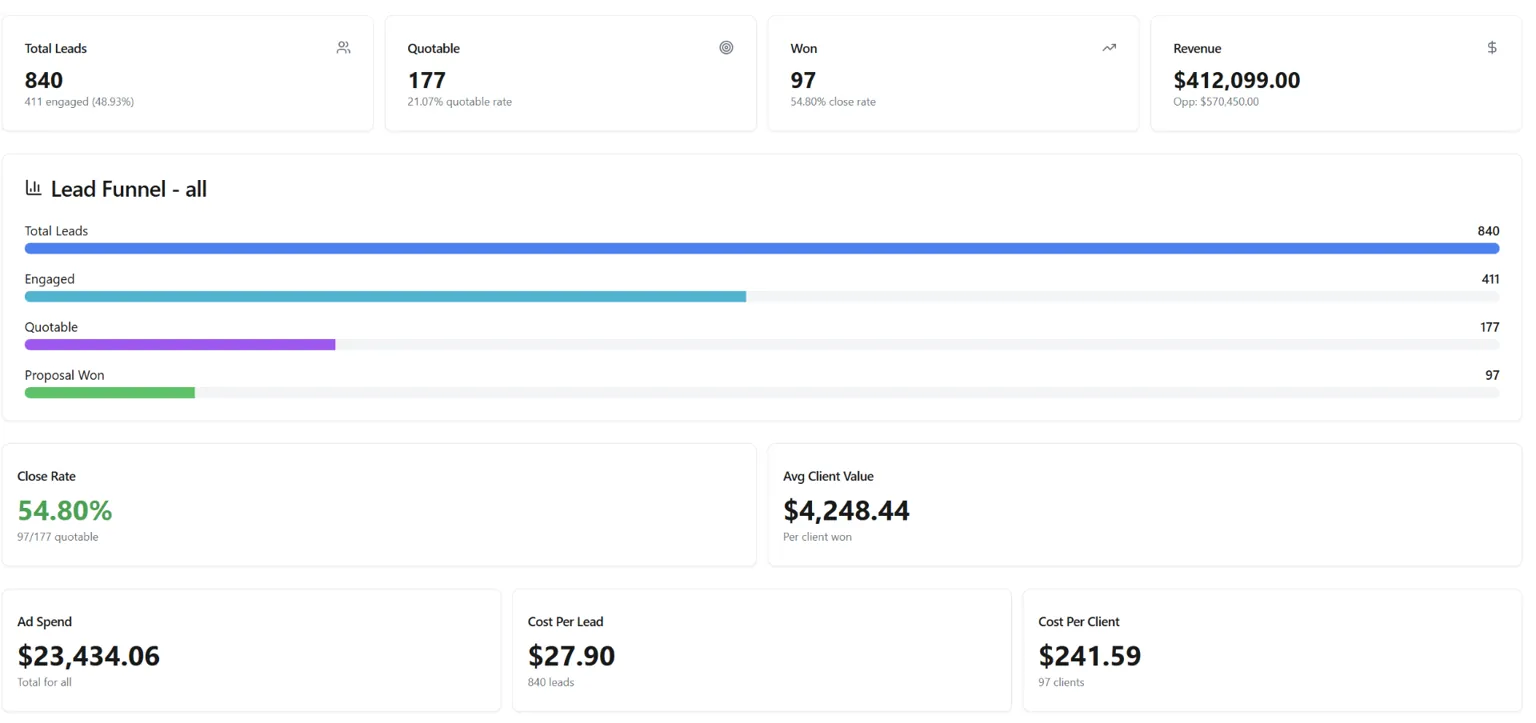 At higher spend levels, closed-loop reporting connects every dollar of ad spend back to actual signed revenue. This is what turns marketing from a cost centre into a growth engine.
The Building Blocks: What You Are Actually Paying For
Before you allocate a dollar, it helps to understand what each piece of the puzzle actually costs and what it does for your business.
Your Website
Website costs in Australia range from essentially nothing on a template builder to well over $100,000 for a custom enterprise build. We have a detailed breakdown on the PixelRush blog, but here is the short version.
A professionally built lead generation website typically runs between $5,000 and $15,000 for most small to mid-sized businesses. The range that actually matters is not about how it looks. It is about whether it converts visitors into enquiries.
AI tools like Lovable have made it possible to build a functional, decent-looking site at a fraction of the traditional cost. The catch is the same as it always was: you still need to know what makes a website convert. Speed, trust signals, clear calls to action, mobile performance. AI gives you the tools to build faster. It does not give you the judgement to build it right.
A cheap website that does not convert is not a bargain. It is an expensive anchor on every dollar you spend driving traffic.
Pro Tip
Before spending a cent on ads, run your website through a simple test: can a visitor landing on your homepage understand what you do, who you help, and what to do next within five seconds? If not, fix the site first.
SEO
SEO costs in Australia typically range from $1,000 to $20,000 per month. Most quality agencies sit between $1,500 and $3,000 per month for competitive service businesses.
The landscape has shifted significantly and we have covered this in depth in our Australian SEO pricing guide. The short version:
- AI has made basic content production so cheap that low-cost SEO packages are now worth even less than they used to be. You are paying for volume, not strategy.
- Genuine SEO, the kind that moves the needle on competitive terms, requires rare skills and costs accordingly.
- Google is progressively shifting toward a zero-click experience where AI-generated answers appear before any organic result. Building a content strategy that surfaces within those AI summaries is quickly becoming as important as traditional ranking.
If your SEO agency cannot explain the difference between what AI has commoditised and what still requires real expertise, they probably cannot tell you which one they are selling you.
| SEO Price Range | What You Typically Get | Watch Out For |
|---|---|---|
| Under $500/mo | Automated reports, minimal work | Templated content, no real strategy |
| $500 - $1,500/mo | Basic on-page, some content | Volume-driven, rarely competitive |
| $1,500 - $3,000/mo | Proper strategy, link building, content | Standard for competitive service businesses |
| $3,000 - $10,000/mo | Full-service, technical SEO, authority building | Expect clear reporting and measurable outcomes |
| $10,000+/mo | Enterprise-level, multiple markets | Only justified for large, competitive verticals |
Google Ads and Meta
Paid advertising remains one of the fastest ways to generate leads when the foundations are right. Most businesses who struggle with it have one of two problems: a website that does not convert, or tracking that stops at the lead form and never connects back to actual revenue.
In Australia, you can start getting meaningful Google Ads results with a total monthly investment of around $2,000 to $3,000, including management fees and ad spend combined. Meta can work at lower levels, but creative quality and offer clarity matter more than budget size.
The key difference between the two worth understanding:
- Google Ads captures demand. People are searching for your service right now and you are putting your hand up. Read more about how Google Ads works for service businesses.
- Meta creates demand. You are interrupting someone with a problem or solution they were not actively searching for. The offer and creative need to do more of the work. See our Meta Ads breakdown.
We have also published a detailed comparison of Google Ads vs Meta Ads for accountants that breaks down when each platform makes sense.
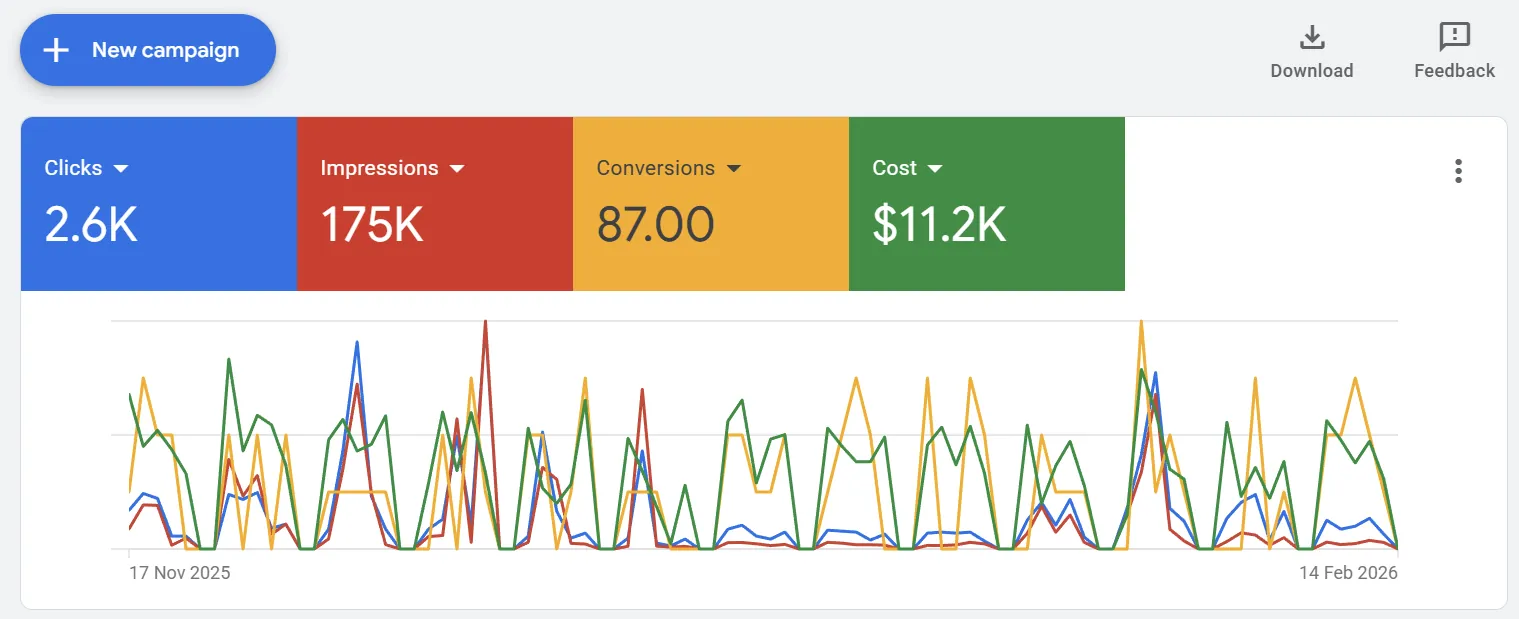 A real Google Ads campaign dashboard. The numbers here show exactly what each lead costs and whether scaling makes financial sense.
Expert Tip
Do not judge your ad performance on cost per lead alone. A $50 lead that converts to a $10,000 client is infinitely better than a $10 lead that never picks up the phone. Track cost per acquired client, not cost per form fill.
Your CRM and Tech Stack
This is where most small businesses quietly throw money away. They spend thousands generating leads and then manage those leads in a spreadsheet or their inbox.
GoHighLevel (GHL) has become one of the most practical options for small to mid-sized Australian businesses. The Starter plan runs around USD $97 per month and gives you a full CRM, pipeline management, automated follow-up workflows, and landing page tools. The Unlimited plan at around USD $297 per month is what most growing businesses and agencies run. Usage-based fees for SMS, calls, and certain AI features sit on top of that depending on how much you use them.
HubSpot is the other name that comes up constantly. The free tier is genuinely useful for getting started. Paid plans begin at around AUD $22 per month for the basics, scaling up to around AUD $648 per month for the Professional Marketing Hub where real automation and attribution live. Enterprise configurations go well beyond that.
| CRM Platform | Starting Cost | Best For | Key Trade-off |
|---|---|---|---|
| GoHighLevel Starter | ~USD $97/mo | SMBs wanting all-in-one | Learning curve, usage fees on top |
| GoHighLevel Unlimited | ~USD $297/mo | Growing businesses and agencies | Higher base cost, but comprehensive |
| HubSpot Free | $0/mo | Getting started with basics | Very limited automation |
| HubSpot Professional | ~AUD $648/mo | Businesses needing full attribution | Expensive for small businesses |
For most small businesses in Australia, GHL delivers more than HubSpot Professional at a fraction of the cost. The tool matters less than the process you build around it.
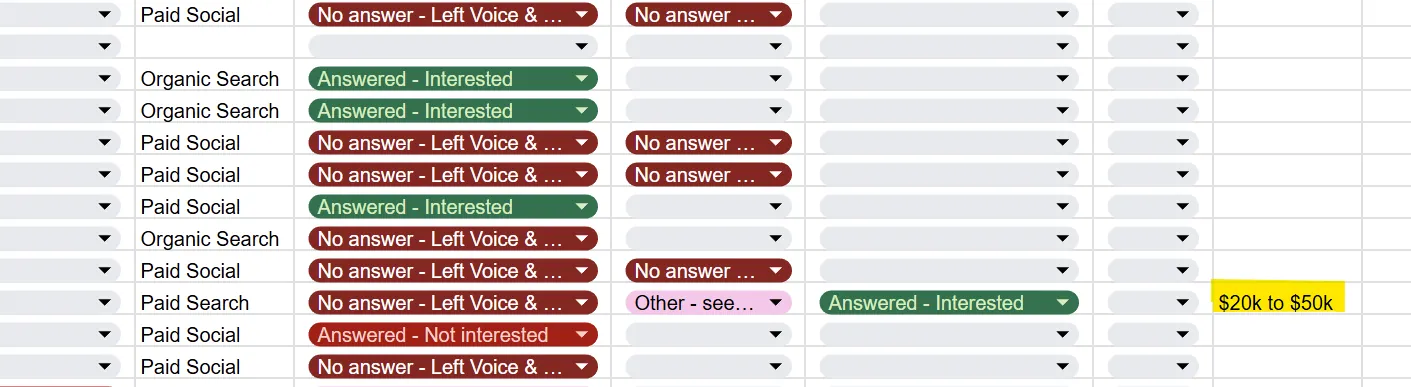 A CRM pipeline view tracking leads by source and status. This is the difference between knowing your numbers and guessing.
An In-House Marketer
The appeal is obvious. Someone dedicated entirely to your business, accountable to you, who understands your brand from the inside.
A competent marketing manager in Australia costs between $70,000 and $110,000 in salary before super, leave, and equipment. And that is before you have spent a dollar on actual marketing.
The honest challenge is finding one person who can execute at a competitive level across SEO, Google Ads, Meta, landing pages, content, and analytics. That combination exists. It is just rare, and if you find it, it does not come cheap.
AI has made the in-house option more viable than it was. A skilled marketer who uses AI tools well can now punch above their weight in ways that were not possible a few years ago.
But here is the trap. Without the experience to know whether AI output is good or bad, you have no filter. You end up executing a mediocre strategy confidently and at speed. Experience is what tells you when the AI is leading you somewhere wrong.
We have a detailed in-house versus agency breakdown on the PixelRush blog if this is a decision you are working through.
Key Insight
The real cost of an in-house marketer is not their salary. It is the opportunity cost of mediocre execution across channels that each require deep specialist knowledge. One great channel beats five average ones.
How AI Has Changed the Cost of Getting Started
It would be dishonest to write about marketing budgets without being direct about AI, because it has permanently changed the cost curve for several things.
Content creation, basic website builds, CRM automation, follow-up sequences, and elements of ad creative can all now be produced faster and cheaper than at any point before. A business running a sensible AI-powered stack built around tools like Lovable, Claude, and WisprFlow can execute things on a modest budget that would have required a full team not long ago.
Here is what has not changed: the judgement required to know what to build, where to focus, and how to read performance data is still the scarce resource.
AI amplifies the capabilities of someone who already knows what they are doing. It gives false confidence to someone who does not.
Most businesses will not adopt these tools at any meaningful speed. When AI becomes the older player in the room, the majority of businesses will still be barely scratching the surface of what it can do. If you get ahead of that curve now, the competitive advantage is real and it compounds.
Pro Tip
Start with one AI tool that solves a specific bottleneck in your workflow, whether that is content drafting, follow-up sequences, or reporting. Master it before adding the next. Stacking tools without mastering any of them just creates a different kind of chaos.
The Other Channels Worth Understanding
Anyone can post on LinkedIn, especially with AI to help structure your thinking and a tool like WisprFlow to capture ideas quickly and get them into written form.
The reality is LinkedIn is slow. Most businesses posting without a specific point of view aimed at a specific type of prospect will spend months chasing impressions with zero impact on revenue. If you know exactly who you are talking to and why they should care, it builds genuine pipeline over time. If you do not, it is performance art.
Post at least once a day if you can build the habit. Expect it to take time. And focus relentlessly on speaking to one type of person about one type of problem. Broad content gets likes. Specific content gets clients.
Short Form Video
Point-and-shoot iPhone footage converts better than overproduced content for most service businesses because it feels real. Some businesses are generating meaningful revenue from short form video, and the barrier to entry is genuinely low.
But the bar on mediocre content is rising fast. If you do not have the personality and the message to hold attention in the first three seconds, consistency just means consistently not converting. The window for average content is closing.
SEO and Written Content
Still works. But the frame has shifted.
The better question is no longer "can I rank for this keyword?" It is "does this piece of content give someone a genuinely better answer than they will find anywhere else?" If yes, it will surface in traditional search, AI-generated results, and through sharing. If not, it adds to the noise.
Read our guide on content writing for law firms for a deep dive into how we approach content that actually performs.
The Actual Point of All of This
Every channel mentioned in this article works. Google Ads, Meta, SEO, LinkedIn, video, email, referrals.
The mistake most small businesses make is trying to run all of them before any of them are genuinely working. They spread budget thin, see average results everywhere, and conclude that marketing does not work for their business.
The businesses that grow almost always did one thing first. They picked one channel, invested in it properly, and did not move on until they had a reliable, trackable return.
Get one channel to a point where you know your cost per acquired client and you know what that client is worth to you. Once that ratio makes sense, spend more. If it does not make sense yet, fix the process before you increase the budget.
The budget question gets a lot simpler once you have that answer.
Takeaway
Do not ask "how much should I spend on marketing?" Ask "what does it cost me to acquire a client, and what is that client worth?" Once you can answer that, the budget sets itself.
Want to Know Where Your Budget Should Actually Go?
If you are spending on marketing without a clear return, or you want to understand what a proper growth system looks like for your business, book a strategy call with the PixelRush team.
No pitch. No hard sell. Just an honest conversation about what is working, what is not, and what we would focus on first.
Want us to implement these strategies for you?
Book a free strategy call and let's discuss how we can grow your business.
Book Your Free Call
Written by
Byron Trzeciak
Founder of PixelRush, Byron has spent over a decade mastering digital marketing. His agency has helped 300+ brands grow, managed $10M+ in ad spend, and optimised 400+ landing pages. He shares hard-won strategies so you can skip the learning curve.
Continue Reading
More on Paid Ads
Can Personal Injury Lawyers Advertise in Queensland? PIPA and What It Really Means for Your Marketing
What PIPA actually allows for personal injury advertising in Queensland: the methods, the content limits, why Google Ads and SEO are fine but images and claims aren't, and where lawyers disagree.
How to Build a Marketing Funnel for a Personal Injury Firm: A–Z Guide
The complete A–Z system for a personal injury firm marketing funnel that signs real cases: the maths, the ads, the landing page, intake and tracking, backed by real Australian benchmarks.
How to Build a Marketing Funnel for Your Accounting Firm: The Complete A–Z Guide
The complete A–Z system for building an accounting firm marketing funnel that signs clients on demand: the maths, the ads, the landing page, the sales call and the tracking.
Referrals vs Marketing Systems: Why Most Accountants Are Building The Wrong Practice
Referrals prove you do good work, but they quietly build the wrong practice. Here's how accountants use a marketing system to grow by design, not by accident.