
If you're an accounting firm trying to decide between Google Ads and Meta Ads, you've probably been told that Google is the obvious choice. Search intent, people actively looking for an accountant, it makes sense on paper.
But what if I told you that one of our accounting clients spent over $36,000 on Google Ads with two of Australia's biggest agencies and had almost nothing to show for it? Meanwhile, across two separate accounting clients, our Meta campaigns have generated over $112,000 in tracked revenue, signed 22 clients, and built an estimated 3-year lifetime value pipeline of over $337,000.
That's not a theory. That's what actually happened. And in this article, I'm going to break down exactly why Google Ads is failing most accounting firms, what Meta Ads can do instead, and the real numbers behind both.
Key Takeaways
- One of our clients spent $36,303 on Google Ads across two major Australian agencies and generated roughly one decent client worth $12,000 in billable work. Most "conversions" were personal tax enquiries, ATO calls, and startups with no budget.
- Across two separate accounting clients, our Meta campaigns signed 22 paying clients from $24,061 in total ad spend, generating $112,367 in first-year revenue and an estimated $337,101 in 3-year lifetime value.
- Google Ads cost per lead for accountants averaged around $285, but the real problem isn't cost. It's that you can't control who clicks. You get a mixed bag of tyre-kickers, price shoppers, and people looking for the ATO phone number.
- Meta Ads let your creative do the targeting. For one of our accounting clients targeting construction and property development businesses, we achieved a cost per lead of $35 and a cost per booked call of just $95, with many of those prospects confirming revenue over $200K.
- Accountants typically retain clients for 3 years at minimum. When your cost to acquire a client is $943 and their lifetime value is $10,000 or more, you're building a growth engine that pays for itself many times over.
- The firms winning with Meta aren't running generic "trusted accountants" messaging. They're positioning themselves in an ocean of one, reaching their ideal prospect before that person has ever searched Google and compared prices with three other firms.
The Google Ads Problem for Accountants
Let's start with what actually happened.
One of our clients came to us after spending over $36,000 on Google Ads with two of Australia's biggest digital marketing agencies. On paper, the campaigns looked like they were doing something. The main search campaign alone reported 94 conversions at $348.35 per conversion, with a total spend of $32,744.
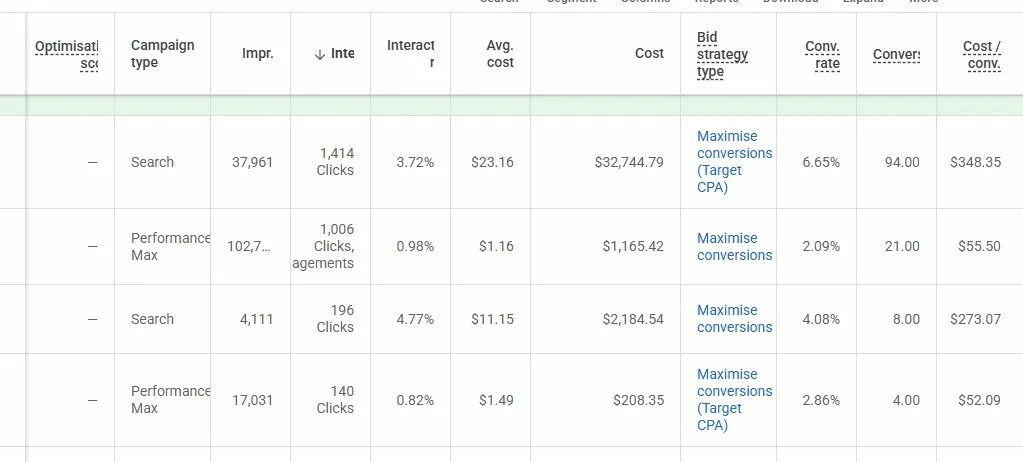 Google Ads campaign overview showing $36,000+ in spend across Search and Performance Max campaigns for this accounting client.
Sounds productive, right? Until you look at what those "conversions" actually were.
Here's what the client told us directly: "The main problems we were having with Google were a lot of personal tax enquiries, not businesses. Of the businesses, most were startups with not much money. We didn't get any established businesses like we are with Facebook."
It gets worse. "A lot of the Google reported conversions were people looking for the ATO, other accounting firms, or a quote for a personal tax return on the cheap."
So those 94 conversions at $348 each? Most of them were garbage. People who had zero intention of becoming a long-term accounting client.
The one bright spot? "Our Google Ads did pick up one Google client at end of June that we have now had $12,000 worth of work from, but apart from that it wasn't great."
One client. $12,000 in revenue. From $36,000 in ad spend. That's a negative ROI any way you slice it.
Key Insight: This is the same pattern we see across professional services where reported conversions don't match actual signed clients. The platform counts every phone call and form fill as a "conversion" regardless of quality.
Why Google Ads Struggles for Accounting Firms
Here's the thing most agencies won't tell you about Google Ads for accountants.
When someone searches "accountant Melbourne" or "business accountant near me," you have absolutely no control over who that person is. It could be an established business owner looking for a new accounting firm. It could also be a uni student looking for someone to do their $80 tax return.
Google doesn't know the difference. And neither does your ad.
You're paying $23 per click on search campaigns for accounting keywords, and you're getting a completely mixed bag of what comes back at you. There's minimal ability to qualify prospects before they pick up the phone or fill out a form. By the time you realise they're not a fit, you've already paid for the click and your team has already spent 15 minutes on the phone with them.
The "conversion" reporting makes it even more misleading. Google counts a phone call as a conversion. A form fill as a conversion. It doesn't matter if that call was someone looking for the ATO's phone number or another accounting firm entirely. It still shows up as a conversion in your dashboard, and your agency reports it as a win.
Here's how our client summed it up: "In summary we did pick up some work but the ROI didn't stack up, mainly due to lack of business leads."
The core issue isn't that Google Ads can't work at all. It's that for accountants specifically, the search terms are too broad to attract the type of client you actually want. You can't filter out the personal tax returns from the $500K revenue businesses. You can't stop startups with no budget from clicking your ad. You're paying premium prices for a lottery ticket.
Expert Tip: If you do keep Google Ads running, focus on hyper-specific long-tail keywords and make sure you're tracking conversions properly all the way through to signed clients, not just form fills.
What Meta Ads Actually Delivered (Two Clients, Real Numbers)
Now let's look at the other side. These are results from two separate accounting clients we manage on Meta.
Client A: High-Value Targeting
This client wanted to attract established business clients with higher average engagement values. Here's what we delivered:
- Ad spend: $7,087
- Cost per lead: $66.23
- Quotable leads: 50
- Clients signed: 4
- Revenue won: $52,377
- Average client value: $13,094
- Cost per client: $1,772
- Return on ad spend: 7.4x
- Estimated 3-year lifetime value: $157,131
 Client A performance dashboard: $7,087 in ad spend generated $52,377 in revenue won with a 7.4x return on ad spend.
Four clients from $7,087 in ad spend. And those four clients aren't going anywhere. Accountants don't lose clients every six months. These are relationships that stick for years.
At an average client value of $13,094 per year and a conservative 3-year retention estimate, this client is looking at $157,131 in lifetime revenue from a $7,087 investment. That's over 22x return when you factor in how long accounting clients actually stay.
Client B: Volume Approach
This client cast a slightly wider net, targeting a broader range of business clients at a lower price point. Different strategy, still profitable:
- Ad spend: $16,974
- Cost per lead: $52.72
- Quotable leads: 194
- Clients signed: 18
- Revenue won: $59,990
- Average client value: $3,333
- Cost per client: $943
- Return on ad spend: 3.5x
- Estimated 3-year lifetime value: $179,970
 Client B performance dashboard: $16,974 in ad spend signed 18 clients at $943 cost per client with 3.5x ROAS.
Eighteen clients at $943 each to acquire. When each of those clients is worth $3,333 per year and sticks around for 3 years minimum, that's nearly $180,000 in lifetime value from under $17,000 in ad spend.
And here's what makes both of these numbers so compelling. These aren't vanity metrics. We're not counting leads or form fills and calling it a day. These are signed clients, tracked all the way through to revenue. That's the number that matters.
 PixelRush internal benchmarks: cost per lead, cost per qualified lead, and average client value across law firm and accountant verticals.
Key Insight: Compare these numbers to other professional services verticals where qualified leads can range from $351 to $1,040. Accountants have a distinct advantage with lower acquisition costs and longer client retention.
The Lifetime Value That Most Firms Overlook
This is the part that changes the entire equation, and it's something most agencies completely ignore when they report on campaign performance.
Accounting clients don't churn like ecommerce customers. When a business owner finds an accountant they trust, they stay. Three years is a conservative estimate. Many stick around for five, seven, even ten years.
So when we say Client A's cost per client was $1,772, that sounds like a significant outlay. But that $1,772 is buying you a client worth $13,094 per year who is realistically going to stay for at least three years. That's $39,000 or more in lifetime revenue from a single acquisition.
Client B tells the same story at a different price point. A $943 acquisition cost for a client worth $3,333 per year. Over three years, that's roughly $10,000 in lifetime revenue per client. From a $943 investment.
When you look at it through the lifetime value lens, the acquisition costs on Meta are absurdly cheap. You're paying under $1,000 to $1,800 to acquire a client who could be worth $10,000 to $40,000 over the life of the relationship.
Now compare that to the Google Ads experience. $36,000 spent. One meaningful client worth $12,000 in first-year revenue. Even with a 3-year retention, that's $36,000 spent to acquire maybe $36,000 in lifetime value. Break even at best, assuming that client sticks around. And that's with two of Australia's biggest agencies running the campaigns.
Pro Tip: When evaluating any ad channel, always calculate your cost per signed client and compare it against the 3-year lifetime value of that client. If you're only looking at cost per lead, you're missing the full picture. This is the same closed loop reporting approach we use across all our clients.
Why Meta Works Better for Accountants
The reason Meta outperforms Google for most accounting firms comes down to one thing: your creative does the targeting.
On Google, you target keywords. And those keywords are broad. You can bid on "business accountant" but you can't stop someone with a side hustle and $2,000 in revenue from clicking your ad. Everyone who types that search term into Google gets served the same ads, and you have no way of filtering before they click.
On Meta, you don't need to rely on search terms at all. Your ad itself becomes the filter.
Here's a real example. One of our accounting clients wanted to specifically target construction and property development businesses. With Google Ads, there's no keyword that cleanly separates "construction business owner looking for a specialist accountant" from "tradie looking for the cheapest tax return." They'd all search the same terms.
On Meta, we built creative that spoke directly to construction and property development business owners. The result? A cost per lead of $35 and a cost per booked call of just $95. And these weren't tyre-kickers. Many of these prospects confirmed they were running businesses with over $200K in annual revenue.
That level of targeting precision simply isn't possible with Google search campaigns. You can't bid on "construction business owner with $200K revenue who needs a specialist accountant." But you can create an ad that speaks only to that person, and Meta's algorithm will find them.
The Ocean of One: Positioning Before the Comparison
Here's the strategic advantage that makes Meta fundamentally different from Google, and it goes beyond just targeting.
When someone searches "accountant Melbourne" on Google, they're going to click on three or four results. They'll visit your website, then visit your competitor's website, then visit another competitor's website. Within about ten minutes, they've got three quotes open in different tabs and they're comparing on price.
You're one of many. And unless your website is significantly better than everyone else's, the cheapest option wins.
Meta flips this entirely. When your ad reaches someone in their feed, you're the only accountant in their world at that moment. They're not comparing you to three other firms simultaneously. They're watching your video, reading your message, and forming an opinion about you, and only you.
If your creative is specific enough and your offer is compelling enough, you've positioned yourself in an ocean of one. By the time they book a call with you, they already feel like you understand their business, their industry, and their specific challenges. They're not shopping around because you've already differentiated yourself before they had a chance to compare.
This is the complete opposite of the Google experience where every prospect arrives having already looked at your competitors. With Meta, you get to make a first impression without any competition in the room.
Think of your market like a triangle. At the bottom, you've got price-sensitive prospects. There's a lot of them, but they're not profitable for you. In the middle, you've got decent prospects. And at the top, you've got your ideal client, fewer in number but exponentially more valuable.
When you aim your messaging at the top of that triangle, something interesting happens. You naturally attract prospects from every level. But when you target the bottom with generic messaging like "experienced accountants," you only capture bottom-tier clients. Google forces you to compete at the bottom because the keywords are broad. Meta lets you aim straight at the top because your creative is the qualifier.
Key Insight: This is the same "demand before search" principle we apply across all our clients, including accountants stuck competing on price. The firms that win aren't the ones bidding on the broadest keywords. They're the ones creating demand through targeted creative before the prospect ever opens Google.
The Offer Makes or Breaks Everything
Here's where most accounting firms go wrong with Meta Ads, and it's not the platform's fault.
Your Meta Ads will only ever be as good as your offer.
If you're running an ad that says "Trusted accountants serving businesses for 20 years," you're going to get the same mixed results you'd get anywhere else. That messaging could apply to any accounting firm in the country. There's nothing for your ideal client to latch onto, and you've destroyed your ocean of one positioning before you've even started.
Instead, you need to transition from selling your services to selling specific outcomes for specific people.
Stop saying "we help businesses with their accounting." Start saying something like "We help construction businesses turning over $1M or more reduce their tax bill by an average of $47,000 annually."
Or if you work with medical professionals: "We help dentists and specialists structure their practice finances to maximise take-home pay while staying fully compliant."
See the difference? The first one could be anyone. The second one makes a specific person feel like you're talking directly to them.
Here's how to think about building your offer:
- Get specific about who you serve. Pick an industry or a revenue bracket. The more specific you are, the more your ideal client feels like you understand their world. Our construction and property development targeting example didn't work because of clever audience settings. It worked because the creative spoke a language only those business owners understood.
- Lead with the outcome, not the service. Nobody wakes up excited about "bookkeeping and tax compliance." They do wake up worried about paying too much tax or getting audited. Speak to that.
- Give it a name. Instead of "accounting services," try something like "The Builder's Tax Reduction Strategy" or "The Practice Profit System." When your offer has a name, it can't be directly compared to a competitor's generic service list. You've created something that stands alone. That's how you maintain your ocean of one positioning.
- Use real numbers where you can. If you've saved clients an average of $30,000 in tax, say so. Specificity builds trust and makes the offer feel tangible.
When your offer value is $10,000 to $20,000 per client instead of $2,000 to $5,000, every new client can cover your entire advertising cost and then some. Factor in the 3-year lifetime value and the economics become almost ridiculous.
Expert Tip: This principle applies across every industry we work in, from accountants to B2B companies. The firms that struggle with paid ads almost always have an offer problem, not a platform problem.
Video Ads Are the Secret Weapon
If you're going to run Meta Ads for your accounting firm, video is where the real results come from.
A talking-head video with polished captions and clean transitions outperforms static image ads almost every time for professional services. And the reason is simple: your prospects need to trust you before they'll hand over their financial information.
A 60-90 second video where you speak directly to camera, explain the specific problem you solve, and show confidence in your ability to deliver results does something no Google Ad can ever do. It builds a relationship before the prospect has even contacted you. By the time they book a call, they already feel like they know you. That's your ocean of one working before a single conversation has happened.
Here's what makes a video ad work for accountants:
- Open with the pain point. "If you're a business owner turning over $1M or more and you feel like you're paying too much tax, you probably are. And here's why."
- State who this is for (and who it's not for). "This is specifically for established business owners, not startups, not sole traders. If you've got revenue, employees, and you're still using the same tax strategy you had five years ago, keep watching."
- Present the outcome. "We've helped over 150 business owners restructure their finances to keep an average of $40,000 more per year. Here's how we do it."
- End with a clear next step. Not "contact us." Something specific like "Book a free tax strategy session and we'll show you exactly where you're leaving money on the table."
When your video does the talking, it pre-qualifies prospects before they ever reach your calendar. People who aren't a fit simply don't respond. And those who do respond already feel like they know you.
The Cold Prospect Reality (And Why Your Sales Process Matters)
Here's the honest part that most agencies gloss over.
Meta Ads generate cold prospects. These aren't people who searched for "accountant near me" at 11pm because they just got an ATO letter. They saw your ad while scrolling through their feed, and something about your message resonated enough for them to take action.
That's a fundamentally different type of lead than a Google search lead, and you need to treat it differently.
Our data shows close rates sitting around 8-10% for accounting firms running Meta campaigns. That means for every 100 leads, you're converting 8 to 10 into paying clients. That's normal for cold traffic, and it's perfectly profitable when your cost per lead sits between $35 and $66.
But here's the catch. If your sales process isn't set up to handle cold prospects, you'll burn through those leads and conclude that "Meta doesn't work." That conclusion would be wrong. It's not the platform that failed, it's the follow-up.
What you need to get right:
- Speed to lead matters. Cold prospects lose interest fast. If someone fills out a form on Monday and you call them Thursday, they've forgotten why they enquired. Aim to follow up within hours, not days.
- Pre-qualification systems save you time. Build qualification questions into your lead form. Ask about annual revenue, number of employees, current pain points. If they're a personal tax return looking for the cheapest option, they'll self-select out before wasting your team's time.
- Nurture the ones who aren't ready yet. Not every lead is going to sign up on the first call. Some of them are 3-6 months away from switching accountants. An email sequence, a follow-up call, a piece of valuable content can keep you top of mind until they're ready.
- Track everything to revenue, not just to leads. This is the biggest mistake we see. Firms count leads and think the campaign is working or not working based on volume. That tells you nothing. You need to track which leads became clients, how much revenue they generated, and what your true cost per client is. That's the only number that matters.
Pro Tip: This is exactly why we built the closed loop growth system. It tracks every lead from first click through to signed client and revenue, so you always know your real numbers, not just what Google or Meta tells you.
The Side-by-Side Comparison
Let's put this all together so you can see the full picture.
Google Ads Performance (One Client, Two Major Agencies)
| Metric | Result |
|---|---|
| Total spend | $36,303 |
| Reported conversions | 127 |
| Actual quality leads | Minimal (mostly personal tax, ATO enquiries, startups with no budget) |
| Clients signed | 1 meaningful client |
| Revenue from Google | Approximately $12,000 |
| Estimated 3-year value | ~$36,000 (if client stays) |
| Return on ad spend | Negative |
Meta Ads Performance (Two Separate Clients)
| Metric | Result |
|---|---|
| Total spend | $24,061 |
| Cost per lead | $35 to $66 |
| Clients signed | 22 |
| Revenue won (first year) | $112,367 |
| Average client value | $3,333 to $13,094 per year |
| Cost per client | $943 to $1,772 |
| Estimated 3-year lifetime value | $337,101 |
| Return on ad spend | 3.5x to 7.4x (first year only, increases with retention) |
The difference isn't subtle. One channel burned through $36,000 and delivered one decent client. The other invested $24,000 and has already generated $112,367 in tracked revenue with an estimated $337,101 in lifetime value from 22 signed clients.
When you factor in that those 22 clients are likely sticking around for 3 years minimum, the Meta investment doesn't just pay for itself. It funds your next year of growth, and the year after that.
When Google Ads Can Still Make Sense
I'm not here to tell you Google Ads is completely useless for accountants. There are scenarios where it can work, particularly for local search and Google Business Profile optimisation where someone is actively looking for an accountant in their area and ready to engage.
But if you're spending $3,000 to $8,000 per month on Google search campaigns and getting a pile of personal tax enquiries and tyre-kickers, the platform isn't the problem. The problem is that Google search terms for accounting are inherently broad, and you're paying premium prices for an audience you can't control.
If you do run Google Ads, keep the budget tight and focus on hyper-specific long-tail keywords that indicate a higher-value prospect. But don't make it your primary growth channel unless you've exhausted what Meta can do for you first.
What To Do Next
If you're an accounting firm spending money on ads and not seeing the return, here's where to start.
Get clear on who your ideal client is. Not "businesses" but the specific type of business, the revenue bracket and the problem you solve better than anyone else. If you can't articulate that in one sentence, your ads won't be able to either.
Build an offer that speaks directly to that person. Give it a name. Lead with the outcome. Make it impossible to compare to a generic accounting service. Position yourself in an ocean of one so that by the time your prospect books a call, they're not comparing you to three other firms.
Consider Meta Ads as your primary acquisition channel, especially if you're targeting established businesses. Let your creative do the targeting and invest in video that builds trust before the first phone call.
And most importantly, track your results to revenue, not leads. Your agency should be telling you how many clients you signed and how much they're worth, not how many form fills you got this month.
If you're an accountant stuck competing on price, or you want to see what a Meta campaign could look like for your firm, reach out for a free strategy session. We'll show you the exact approach we'd take to attract your best clients, not just any client.
Want us to implement these strategies for you?
Book a free strategy call and let's discuss how we can grow your business.
Book Your Free Call
Written by
Byron Trzeciak
Founder of PixelRush, Byron has spent over a decade mastering digital marketing. His agency has helped 300+ brands grow, managed $10M+ in ad spend, and optimised 400+ landing pages. He shares hard-won strategies so you can skip the learning curve.
Continue Reading
View All →
Why Personal Injury Google Ads Are Getting More Expensive (And What to Do About It)
22 min read
The Lead Response Crisis: Why Your "Bad Leads" Might Actually Be Gold
4 min read