
How To Find Your Average Cost Per Click
You want to start with Google Keyword Planner, this is a purpose made tool for finding keywords and suggested bids.
- https://ads.google.com/home/tools/keyword-planner/
- Type in your keyword and set your location
This tutorial won’t go into detail on how to use the keyword planner, it’s pretty straight forward. Once you type in your keyword you’ll be presented with keyword ideas for which you’ll find the exact search term as well as other keywords the Keyword Planner shows by relevance.
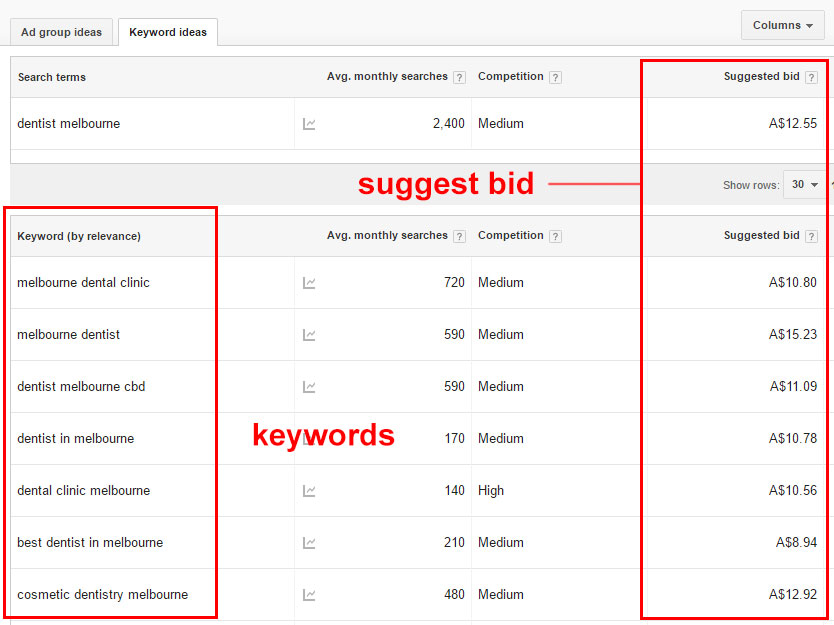
Based on this example we can see that the average cost per click will be around $11 dollars for a Dentist in Melbourne.
Now, this isn’t the holy grail of keyword cost estimates as a number of factors can complicate how much you’ll pay for a keyword, such as quality score, but it should give you a good starting point.
There’s a few things to remember when research keyword opportunities:
- Always review keywords for each service you offer i.e. cosmetic dentistry, dental implants, mouth guards etc.
- Always review keywords for capital cities and suburbs i.e. Melbourne versus hawthorn
Export as many keywords as you need to get a solid understanding of your average cost per click.
You’ll find that services that have higher lifetime value or service value will obviously attract higher pay per click prices which is why it’s important to research a broad range of keywords to get a better feeling for your average cpc.
Quick Win
Use Google Keyword Planner to find suggested bids for your top 5 keywords before you even launch a campaign.
How To Estimate Your Daily Spend
So now that you have your average cost per click it’s time to estimate your daily spend and you might need to spend to get the number of sales or enquiries you need.
On average we’ve found that Google Ads campaigns will convert at 10% or higher for local businesses, we have some campaigns that convert at 25%, but for the sake of this article we’ll provide a few examples below. Let’s say that you have a spend of $1500 dollars per month and your average cost per click is $11 dollars which means you’ll receive around 136 clicks for your spend.
Here are some conversion rate examples:
- If your conversion rate is 5% you’ll receive 7 enquiries
- If your conversion rate is 10% you’ll receive 13 enquiries
- If your conversion rate is 20% you’ll receive 27 enquiries
What about your daily spend:
Each month has between 21 and 23 working days each month and therefore we advise for local businesses to only show your adverts on working days, we’ve found that restricting ads to business hours generates the highest conversion rate. Of course, if you run an online store, which is available 24/7, then obviously you’ll need to review which times and days work best for you and start to restrict your campaign accordingly.
If you use the average of 22 business days you’ll see that your daily budget will become around $70 dollars – $1500 divided by 22.
Key Insight
Local businesses often see 10%+ conversion rates; estimate your daily spend based on your desired conversions, not just clicks.
Reverse Engineering Your Spend
No business owner I’ve ever spoken to cares about clicks – they care about conversions, sales and enquiries and it’s important to talk in the same language.
Ask yourself, how many conversions do you want to get out of your campaign each month? Is it 10 or 20 or even 100?
If we already know the conversion rate of the website then we can use that as a guide to understand how frequently we convert our clicks before we’ve even spent a dollar. Keep in mind that Google Ads traffic often converts at a much higher rate than organic SEO, when configured correctly, so don’t be afraid to inflate your conversion rate for more accurate estimates.
I prefer to aim on the lower side so that expectations going into the campaign aren’t inflated. More often than not the results we generate are significantly higher but it’s not a guarantee and often the first month or two of a campaign requires tweaking before you see it’s full potential.
Take a look at your website conversion rate for the past month for all traffic, in this example it’s 10%.

So we know that for every 10 clicks to our site we’ll receive one conversion plus we already know that the average click cost in our industry is $11.00.
Therefore we can assume that in order to receive one conversion per day we require a minimum of 10 clicks and a daily spend of $110 dollars. If we convert at a higher rate then obviously we can get more conversions with the same amount. As the campaign progresses and we make subtle changes we’ll get an indication of hard the campaign can be pushed.
Pro Tip
Start with your desired monthly conversions, then work backward to determine the required clicks and budget.
How To Reduce Your Cost Per Click
So your next question should be, can we reduce the cost per click price?
The answer is yes, we’ve written a comprehensive article on how to reduce your cost per click, so check that out as the following steps will only be a summary.
Remember there are multiple factors that Google considers when determining your Quality Score and Quality Score can have a significant affect on your Cost Per Click.
According to Google, they are as follows:
- CTR – Click-through-rate
- Relevance of each keyword to its ad group
- Quality and relevance of the landing page
- Relevance of the ad text
- Quality score for your ads, campaigns and account.
How to reduce your cost per click.
- Structure your campaigns
- Use single keyword ad groups
- Optimise ad copy and be relevant
- Optimising landing pages to be relevant
- Use sitelinks to improve CTR
- Use ad extensions to improve CTR
- Use the right match type i.e. broad match modifier instead of broad match.
- Use negative keywords to control relevance
Fast Fix
Improve your ad copy and landing page relevance to immediately boost your Quality Score and lower CPC.
How To Control Your Ad Spend
Finally, you need to learn how to control your spend if you’re going to make Google Ads affordable for your business. You don’t want to be wasting spend on clicks that don’t convert.
For example there’s not point advertising at 11pm at night if your business is a call focused business that operates between the hours of 9 and 5.
Things You Can Control With Google Ads
- The maximum cost-per-click you are willing to spend to get a visitor to your website
- When or where your advert appears (search, display, keywords etc)
- Which format your ad appears in (text, banner, video, shopping listing, etc.) and it’s content
- Which page of your website the advert will take people towards (the landing page)
- The cost of your products or services on the website (the perceived cost depending on quality and/or service)
- How the website works, looks and interacts with the visitors (how the website converts)
- The maximum daily spend you want to spend.
Things You Cannot Control With Google Ads
- The competition’s maximum cost-per-click amounts (this information is also hidden)
- The competition’s ad content
- The competition’s price for similar products or services
- The conversion rate of the competitor’s website
- The number of times your advert will appear for certain searches or topics (display or keyword traffic)
Quick Win
Analyze your conversion times and schedule your ads to run only when your business is open and actively converting.
Final Tips on Google Ads CPC
- Google Ads is based on an auction system will reward you for high-quality ad campaigns with lower costs and better ad placement.
- You should aim for tight control over how your Google Ads budget is spent using ad scheduling, match types, negative keywords, device targeting and more.
- The search network is the most expensive network and most businesses should expect to pay $3 dollars an upwards.
- The most expensive keywords in Google Ads and Bing Ads cost $100 or more per click . These are generally highly competitive keywords in industries such as plumbing.
If you’re struggling to get your head around Google Ads, and don’t want to waste your money, get in touch with us so that we can setup and manage your spend effectively.
Want us to implement these strategies for you?
Book a free strategy call and let's discuss how we can grow your business.
Book Your Free Call
Written by
Byron Trzeciak
Founder of PixelRush, Byron has spent over a decade mastering digital marketing. His agency has helped 300+ brands grow, managed $10M+ in ad spend, and optimised 400+ landing pages. He shares hard-won strategies so you can skip the learning curve.
Continue Reading
View All →
Why Personal Injury Google Ads Are Getting More Expensive (And What to Do About It)
22 min read
The Lead Response Crisis: Why Your "Bad Leads" Might Actually Be Gold
4 min read