




Most talk about injury marketing in the US is about Google, TV and billboards. Facebook and Instagram get treated as an afterthought.
That is out of date, and it leaves a big opening for firms that take Facebook seriously.
We pulled the live US ads of 21 of the biggest injury firms from Meta's Ad Library. That is the free public tool that shows every ad running on Facebook and Instagram. Two firms are testing ads at a huge scale. A handful run a small set of ads aimed at getting leads. And a lot run almost nothing, or spend their Facebook budget on holiday posts and ticket giveaways.
How many Facebook ads do the biggest injury firms run?
The range is huge. Morgan & Morgan had 1,380 ads and TopDog Law had 821. After that, the next biggest was Mike Morse with 145. Most firms ran fewer than 70.
A big ad count is not always a good thing. Many ads are versions of the same message, where Meta mixes a few headlines, texts and images into lots of combinations.
But the top firms are clearly testing far more ideas than the rest. On Facebook, the ad itself decides who sees it. A firm that tests a few new ads every month learns much faster than one that runs the same six ads all year.
What do injury firms say in their Facebook ads?
The same few ideas came up again and again. Here they are, with real lines from live ads:
| Idea | Line from a live ad | Firm |
|---|---|---|
| Ask the question | "Injured in a Car Accident?" | TopDog Law |
| Pain shows up later | "Did you walk away from a car accident thinking you were fine, but the pain got worse a few days later?" | Law Brothers |
| Do not take the first offer | "Don't accept any settlement until you know the FULL value of your claim." | Jacoby & Meyers |
| Time is running out | "Every week you wait, your case gets harder to prove." | Law Brothers |
| Money worries | "Your paycheck stopped. Your bills didn't." | Edgar Snyder |
| You matter | "You are more than a case number." | George Sink |
| A local lawyer | "Tampa injury lawyer, Kaley Dreyer, is ready to make it a #FarahFight" | Farah & Farah |
| Proof | "50 years, 100,000 clients, and over one billion dollars won" | George Sink |
| In Spanish | "¿La aseguranza ya te ofreció dinero? Espera." (Has the insurance company already offered you money? Wait.) | Los Defensores |
| Know your rights | "Learn to spot the signs of illegal solicitation and know your rights." | Morgan & Morgan |
Here is what Law Brothers is running. Notice the "pain got worse a few days later" ads:
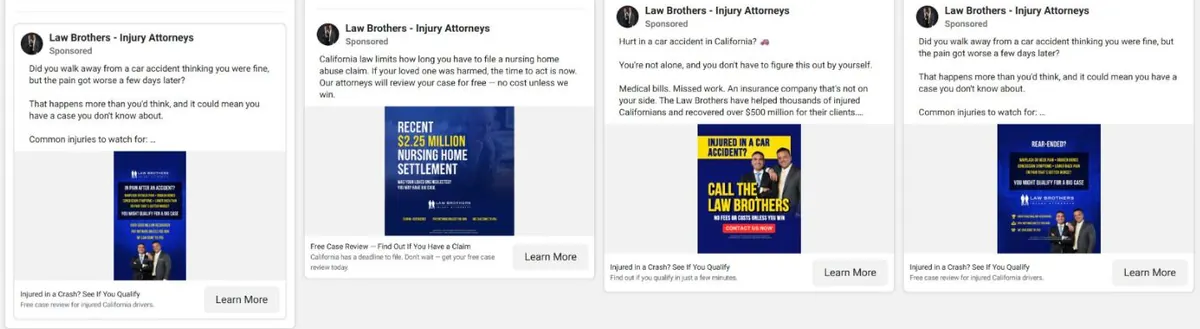
The best ads tell people something new about their own situation. Pain can show up days later. Evidence fades while you wait. The first insurance offer is usually not the last. These ads stop the right person, because they speak to what that person is going through right now.
We see the same thing running video ads for injury firms in Australia. The ads that sign cases talk straight to the viewer about their situation or deadline. Not stories about someone else.
One rule to know: Facebook does not allow ads that say or hint things about the viewer's health or personal life. So "Are you suffering from back pain?" gets rejected. "Hurt in a crash that wasn't your fault?" describes a situation, so it is fine. Every ad also has to follow your state bar's rules. Our guide to attorney advertising rules covers them.
Where do Facebook ads send people?
There are three main options:
| Where the click goes | Who uses it | Trade-off |
|---|---|---|
| A form inside Facebook (called an instant form) | Los Defensores, Rubenstein Law, Gordon McKernan and others | Cheapest leads and the easiest to fill in. That also means more weak leads, so you must call fast. |
| A page built only for Facebook visitors | Morgan & Morgan, George Sink, Law Brothers, Mike Morse, TopDog Law | Costs more per lead, but leads are usually better. The page can ask screening questions. |
| The firm's main website | Edgar Snyder, Gordon McKernan, Rubenstein Law (some ads) | Easy to set up, but a general website rarely turns Facebook visitors into leads. |
The firms testing the most almost all send Facebook clicks to a page built just for Facebook visitors. They also tag every link so each lead can be traced back to the exact ad. Mike Morse, for example, sends Facebook leads to a separate form made just for them. That is what lets a firm judge each ad on signed cases, not just on how many forms it got.
My own approach is to start with instant forms. They are the fastest way to test if a new message gets a response. Once an idea works, move it to a page that screens better. What does not work is running instant forms with slow intake. Those leads go cold within hours.
Why do some big firms run so few Facebook ads?
Some firms use Facebook to build their name, not to get leads. We saw Thanksgiving food drives, sports sponsorships, concert ticket giveaways and "pay $0 unless we win" posts. Those help people remember the firm, but they are not trying to sign cases this month.
Others, like Kanner & Pintaluga and Lerner and Rowe, had nothing live on their main pages at all. They may advertise from other pages, or rely on TV, Google and Local Services Ads.
Either way, in most US cities the Facebook feed is less crowded with injury ads than the billboards suggest.
That is the opening. A local firm running a steady stream of good attorney videos, with fast intake, is up against a few big brands and a lot of silence.
What should a smaller firm test on Facebook first?
Here is the order we would test in:
| Test | What to run | How to judge it |
|---|---|---|
| 1. The message | Three or four image ads, each with a different idea: pain shows up later, do not take the first offer, evidence fades, a local lawyer. | After about 72 hours, look at clicks and cost per lead. Stop the clear losers. |
| 2. Attorney video | The winning idea as a 30 to 60 second video of a real attorney talking to camera. | Cost per good lead, not just cost per lead. |
| 3. Where it goes | Instant form against a page with two or three screening questions. | Cost per signed case after a few weeks. |
| 4. Spanish | Spanish versions of your best ads, if your area fits and intake can reply in Spanish. | Cost per signed case against the English version. |
| 5. Another case type | A second case type with its own ads and page, like truck crashes or work injuries. | Cost per signed case against your target. |
A few rules that help:
- Judge ads fast. About 72 hours is enough for most ads. A bit longer when you are just starting. Very few ads that do nothing in that time turn into winners.
- Do not run too many ads on a small budget. Three images, two versions of the text and two headlines is plenty. Fifty ads on a small budget spreads the money too thin to learn anything.
- Good leads come from being memorable, not from extra form questions. People remember a person. An attorney on camera, a fast call and a clear offer do more than five extra questions on a form.
- Call within five minutes. These people were scrolling, not searching. Call fast, text if they do not answer, and keep trying for 48 hours. Our guide to running PI intake has the full plan.
How do you know if your Facebook ads are working?
The same way as every other channel: cost per signed case, tracked from the click, for each case type.
Facebook leads almost always cost less than Google leads, and fewer turn into good cases. The only way to know which is cheaper for your firm is to track each lead all the way to a signed retainer. Our guide to what a personal injury lead costs explains how.
Facebook can also start on a much smaller budget than Google, so it is often a good first paid channel. For a closer look at the biggest Facebook advertiser of all, see our breakdown of Morgan & Morgan's marketing. And if you want help building attorney videos, landing pages and intake that turn Facebook leads into signed cases, that is the heart of our US personal injury marketing.
Want us to implement these strategies for you?
Book a free strategy call and let's discuss how we can grow your business.
Book Your Free CallContinue reading
More on Personal Injury
Are Google Local Services Ads Worth It for Personal Injury Lawyers?
Local Services Ads put a Google Verified badge and your reviews at the very top of Google, and you pay per lead instead of per click. For injury firms with strong reviews that answer fast, they can be one of the cheapest ways to sign cases. For firms that miss calls, they quietly stop showing. Here is how they work.
Do Google Ads Work for Injury Lawyers? Which Keywords Are Worth $250 a Click
Injury clicks are the most expensive in Google Ads, and most firms waste a lot of their budget on the wrong searches. This guide uses Google's own click prices to show which searches are worth paying for, how to set up your ads, and when Local Services Ads or Microsoft Ads make more sense.
How Do the Biggest Injury Firms in America Win Online? (29 Firms Benchmarked)
We compared 29 of the biggest injury firms in America on ad spend, Google traffic, Google ads and Facebook ads. Big TV budgets do not always mean big Google traffic. Here is what it takes to compete, and where a smaller firm can win.
How Do You Know Which Ad Signed the Case? Tracking From Click to Signed Retainer
Most injury firms know their cost per lead, but not which ad brought in last month's signed cases. This guide shows the tracking we set up for injury firms: recording where every lead came from, tracking calls, the details to save, telling Google and Facebook which leads signed, and the one-page monthly report.